























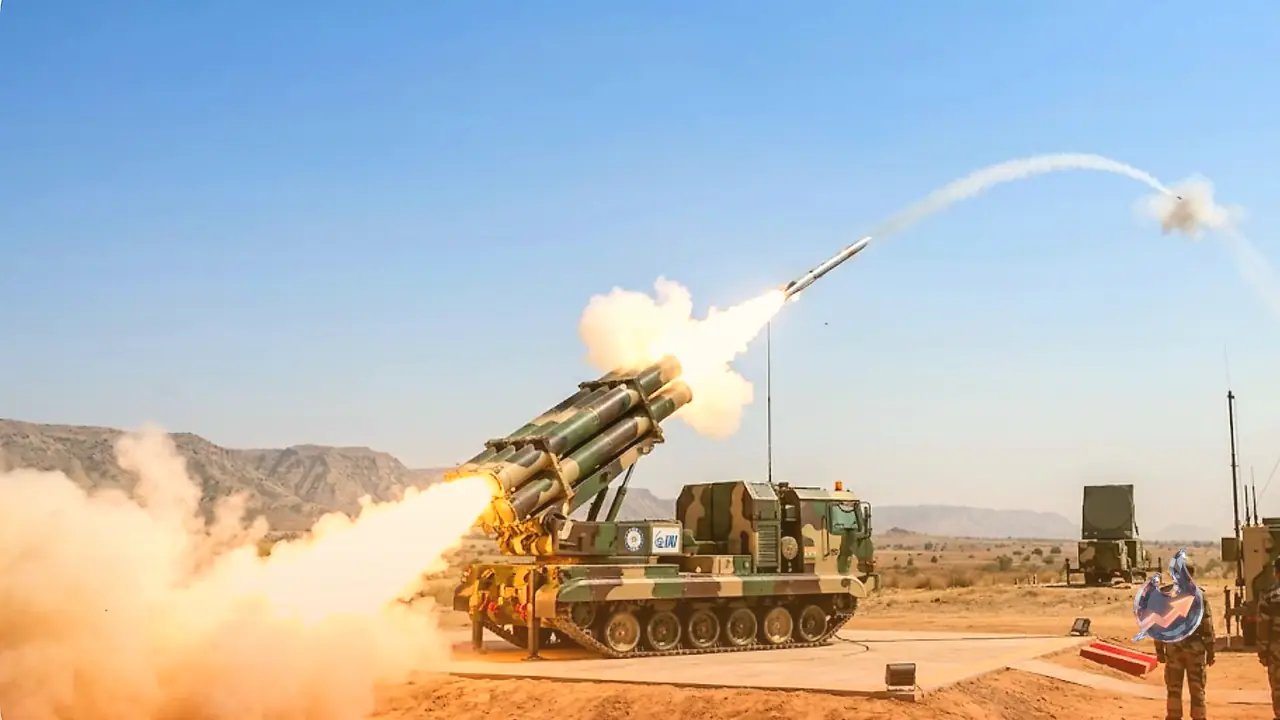

With aerial threats intensifying along India's borders with China and Pakistan, the country has taken a major step to tighten its air defence shield. Built jointly by India and Israel, the Medium Range Surface-to-Air Missile, or MRSAM, system is now ready to shut down any hostile move in Indian skies. Defence experts are calling it the bigger sibling of the short range Akash missile, since it outguns Akash in both range and firepower, even though it still falls a notch short of Russia's formidable S-400 air defence system.
Closing the gap between Akash and the S-400
The system has been jointly developed by the Defence Research and Development Organisation (DRDO) and Israel Aerospace Industries (IAI). Its biggest achievement is plugging the wide gap that existed in India's air defence layers between the Akash missile and the S-400 system. The Defence Acquisition Council has cleared the system for mass production, opening the door for it to be inducted in large numbers across the armed forces. Interestingly, all three services, the Army, the Air Force and the Navy, already operate their own customised variants of the system. The Navy calls its version LRSAM or Barak-8.
A 70 kilometre kill range and a 52,000 foot reach
The missile's biggest strength lies in its range. It can intercept and destroy any aerial threat located anywhere between 0.5 kilometre and 70 kilometres away. Altitude is not a weak point either, as it can climb roughly 16 kilometres, or nearly 52,000 feet, into the sky to hit a target. On speed, MRSAM travels at nearly twice the speed of sound, or Mach 2, translating to close to 2,469 kilometres per hour. That kind of velocity leaves an adversary almost no time to react or manoeuvre away.
A 60 kilogram warhead built for a single, decisive hit
The missile carries a pre-fragmented high explosive warhead weighing around 60 kilograms. It is fitted with a proximity fuze that detonates automatically the instant it closes in on the target, leaving little chance for the target to escape unscathed.
Three systems working together to guard the skies
The MRSAM setup rests on three key components. The first is the Command and Control System, which reads incoming threats and takes split second decisions. The second is the Multi-Function Surveillance Track Radar, or MF-STAR, built on Israeli radar technology, capable of tracking multiple threats simultaneously across a 360 degree field and beyond 300 kilometres. The third component is the Mobile Launcher System, which uses vertical launch technology to fire the missile in any direction almost instantly.
A missile that locks onto its target after launch
Another standout feature is its active radar seeker. In the initial phase after launch, the missile receives mid course updates from ground radar, but during the terminal phase of the attack, its own onboard radar seeker switches on and takes over, locking onto the target independently. Even if the enemy aircraft attempts sharp evasive manoeuvres, the missile continues tracking it relentlessly. This is why the system is widely regarded as operating on a largely fire and forget principle.