





















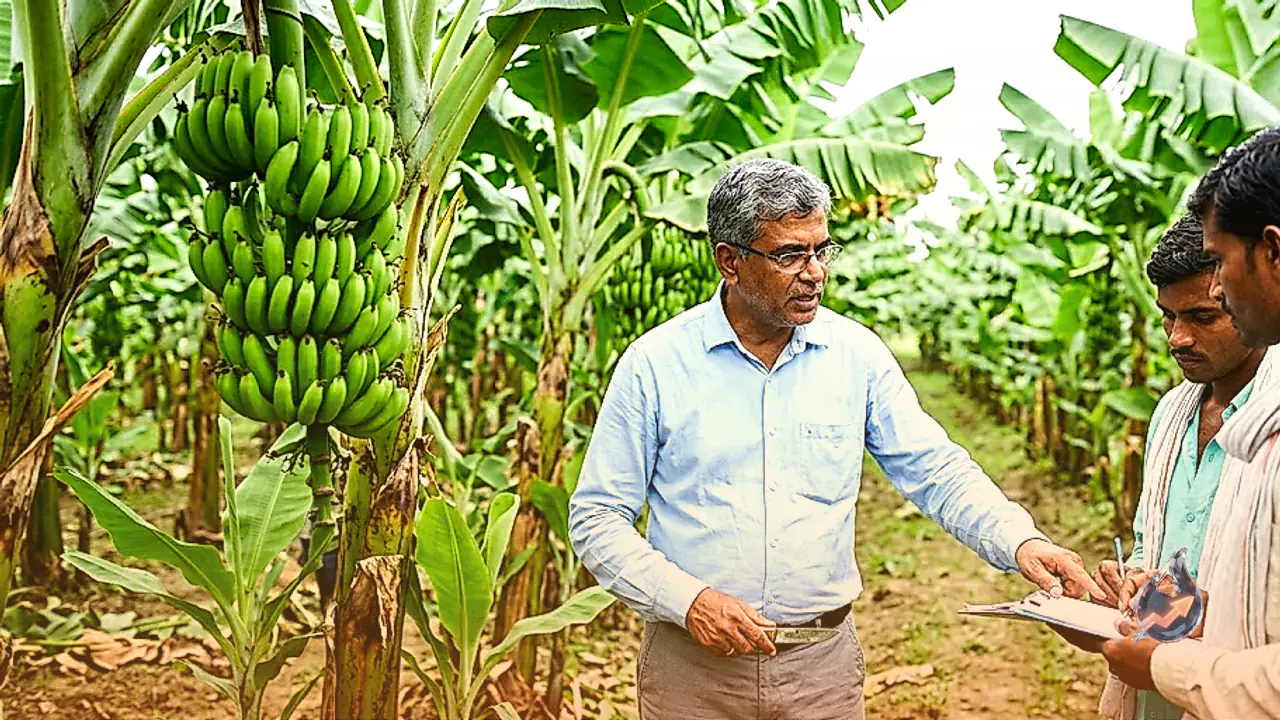

For banana growers, boosting crop yield while keeping input costs manageable remains a key priority. Addressing this challenge, Dr. S.K. Singh, a prominent agricultural expert from Bihar, has introduced a scientific crop management formula. Dr. Singh, who serves as the Head of the Banana Research Institute in Goraul, Hajipur, and also leads the Department of Plant Pathology at Dr. Rajendra Prasad Central Agricultural University in Pusa, states that implementing this management approach can enhance banana yield by 20 percent to 35 percent. Supported by over 20 years of research recognized across the nation, his recommendations offer practical guidance for farmers nationwide.
Understanding the 'Akela' Single-Plant Principle
The core concept advocated by Dr. S.K. Singh revolves around keeping the mother banana plant isolated or 'Akela'. Naturally, several small side shoots known as suckers emerge around the base of the primary plant. If left unchecked, these unwanted suckers absorb substantial amounts of soil nutrients meant for the main plant. Consequently, the primary plant receives insufficient nourishment, leading to smaller fruit bunches and weaker produce.
To overcome this issue, farmers are advised to slice off these redundant suckers using a sharp knife every 40 to 45 days. No additional shoots should be allowed to grow near the main plant until the flowering stage begins. Once the fruit bunch emerges, farmers should leave exactly one healthy follower sucker to ensure the subsequent crop cycle remains on schedule.
Banana Cultivation Trends in India and Bihar
India holds the status of the world's largest banana producer, generating approximately 3.7 crore tonnes (37 million tonnes) of the fruit annually. Within Bihar, banana farming is expanding across key districts including Vaishali, Samastipur, Muzaffarpur, Katihar, and Bhagalpur. However, relying solely on conventional fertilizer application is no longer yielding optimal results. Shifting weather patterns, emerging crop diseases, and escalating cultivation expenses present ongoing difficulties, making structured scientific management necessary.
Advanced Scientific Practices for Optimal Yield and Quality
In addition to sucker management, Dr. Singh highlights several essential agronomic practices to maximize farm output
- Soil and Seedling Selection: Select deep, well-drained loamy soil for planting. Farmers should strictly utilize disease-free seedlings developed through tissue culture.
- Irrigation and Fertigation Management: While banana plants require substantial moisture, they cannot tolerate stagnant water. Adopting drip irrigation alongside fertigation can conserve up to 40 percent of water and fertilizer resources.
- Targeted Potash Application: Potash plays a critical role in increasing fruit dimensions, enhancing natural sweetness, and bolstering plant immunity against diseases.
- Mulching and Fruit Bunch Covering: Applying dry leaf mulching helps retain soil moisture. Furthermore, covering emerging fruit bunches with blue or transparent polybags speeds up harvesting by 7 to 10 days while improving fruit coloration.