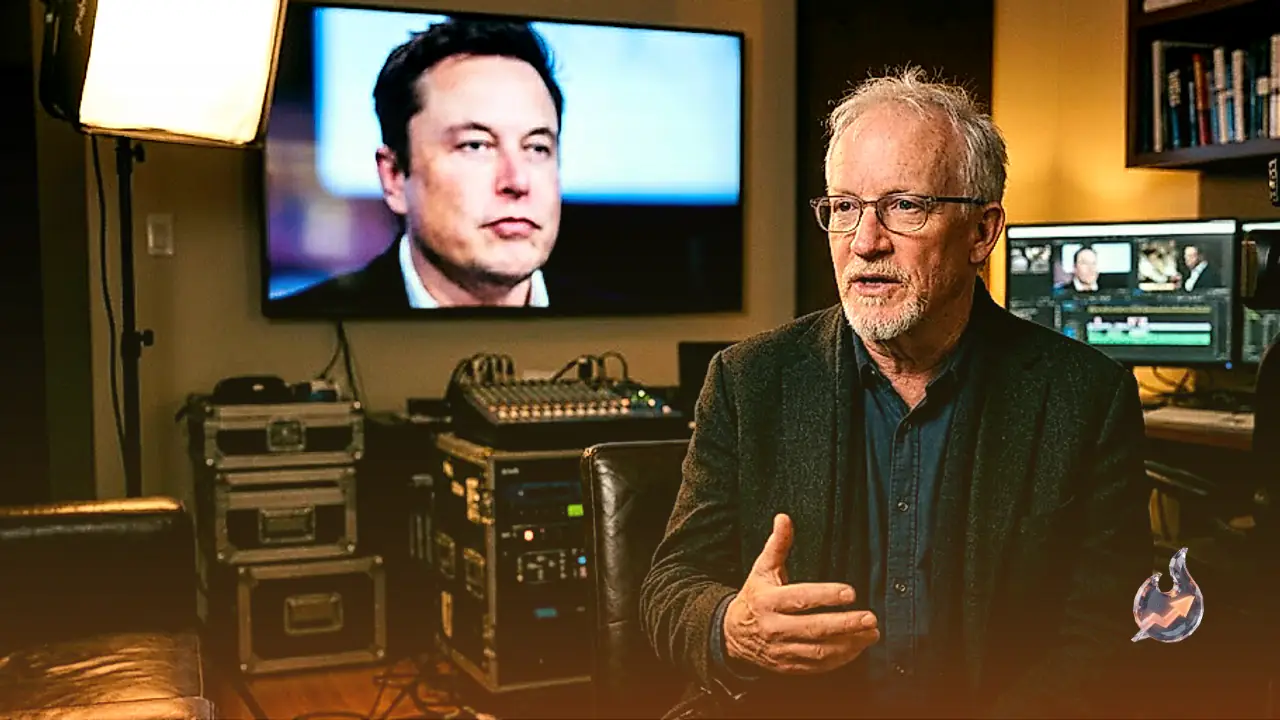

A sweeping four-hour documentary by filmmaker Alex Gibney delivers an exhaustive, critical portrait of Elon Musk, examining how the world’s most prominent tech executive constructed his public persona while amassing unprecedented corporate and political influence. Across four years of production, Gibney sought to interview the Tesla and SpaceX chief, but Musk consistently declined to participate. Rather than abandoning the central subject, the production assembled a simulated avatar anchored strictly to his historical public statements, audio archives, and media appearances, creating an on-screen counterpart that directly addresses the audience throughout the film.
The Cinematic Sandbox of Simulated Reality
The choice to use a simulated version of Musk arose directly from the entrepreneur’s own frequent musings that human reality is merely a computer simulation. Gibney turned this premise into a structural throughline, using authentic voice recordings and historical remarks placed into a carefully designed avatar. Unlike conventional broadcast interviews where Musk often looks away from interlocutors, the film positions his digital figure staring directly into the camera lens. This visual choice creates an unsettling psychological proximity with viewers, challenging them to discern the boundary between authentic intention and performance.
Visual choices around the avatar were crafted with intention. Gibney avoided distorted or satirical caricature, styling the digital character in a leather jacket and gaming chair with a neat, chiseled appearance. The objective was to maintain journalistic credibility and prevent fans or defenders from dismissing the project as petty visual mockery. By treating the representation seriously, the film allows his genuine rejoinders and arguments to sit alongside the rigorous critiques provided by former partners, executives, and investigative subjects.
Family Roots and the Critique of Easy Explanations
While securing on-camera participation from Silicon Valley power brokers required months of negotiation, Musk’s father, Errol Musk, agreed immediately. Conducted remotely from his home in South Africa, the elder Musk provided candid reflections on his son’s upbringing. Many biographers have framed the entrepreneur’s combative temperament as an inevitable byproduct of a demanding and difficult childhood under a harsh father. Gibney, however, pushes back against using early trauma as an all-encompassing excuse for adult conduct, pointing out that countless individuals endure difficult childhoods without replicating such patterns in their corporate and public lives.
The father’s testimony serves not to exonerate, but to illuminate striking behavioral parallels between generations. While explaining origins is essential for narrative context, the documentary emphasizes that psychological hardship does not absolve anyone from ethical responsibility, particularly when decisions carry immense consequences for thousands of employees and millions of public citizens.
Personal Testimonies and Narrative Hegemony
Among the personal accounts featured, the perspective of his first wife, Justine Musk, provides some of the most revealing moments regarding interpersonal dynamics. Having met him during college in Canada, she recounted how his magnetic confidence initially drew her in, while also explaining the subtle ways reality was consistently reshaped inside their marriage. She pointed to a painful memory surrounding the death of their infant child, contrasting his public social media claim of holding the child in his arms with her lived reality that the tragic moment took place in hers.
Her testimony illustrates what Gibney identifies as a persistent pattern: within the public companies and private relationships, Musk insists on being the sole defining figure. Former girlfriend Ashley St. Clair, LinkedIn co-founder Reid Hoffman, and others similarly illustrated how high the perceived risk remains for anyone speaking openly about their interactions with him. Many influential figures in technology declined on-record remarks, prioritizing elite solidarity over transparent public dialogue.
Impulsive Decisions Transformed into Strategic Leverage
The documentary tracks how impulsive corporate wagers frequently evolve into strategic tools of influence. The high-priced buyout of Twitter, later rebranded as X, appeared initially as a reckless, overpriced gamble executed without basic due diligence. Yet, despite financial value destruction for outside investors and disruptions across the platform, the service was rapidly refashioned into a formidable personal megaphone. It enabled direct engagement with retail investors and provided an indispensable platform for shaping broader political discourse.
Gibney analyzes this trajectory by drawing parallels to high-profile figures who project supreme self-assurance. When high-stakes operators become convinced that their overarching mission justifies any maneuver, they develop an internal mechanism that allows them to believe their own spontaneous rhetoric entirely. This absolute conviction proves highly persuasive to followers, partners, and regulators, even when underlying claims lack empirical backing.
Regulatory Dismantling and the Scale of Administrative Fallout
A central focus of the film involves the Department of Government Efficiency, known as DOGE, and its aggressive push through Washington federal agencies. The initiative claimed to eradicate budget deficits by cutting hundreds of thousands of public workers, yet the underlying operations inflicted severe disruptions without achieving stated balance goals. Former United States Ambassador to the United Nations Samantha Power detailed the humanitarian toll resulting from abrupt halts to foreign assistance programs like USAID, where previously allocated funding and purchased food supplies were prevented from reaching vulnerable populations.
Furthermore, internal investigations revealed that personnel operating within federal agencies often conflated maximum possible contract values with actual spent dollars, fabricating dramatic paper savings. Minor technical quirks, such as default century-old birth dates within Social Security legacy records, were erroneously publicized as fraudulent activity. Beyond the public spectacle, experts highlighted the unprecedented acquisition of sensitive citizen records made possible by elevated administrative access. In the documentary, computer scientist Geoffrey Hinton warned that concentrated administrative data could easily be leveraged in targeted disinformation efforts designed to sway electoral trust and public perception.
Crucial Dimensions Left on the Editing Floor
With an ultimate running time just shy of four hours, including an intermission, Gibney acknowledged that substantial investigative avenues had to be curtailed. Detailed deep dives into corporate turbulence at SolarCity, counterintelligence investigations, extensive securities depositions, and allegations concerning foreign influence campaigns could not be accommodated at full length. Nonetheless, the finished work stands as an unvarnished examination of how narrative control, financial leverage, and raw self-belief can reshape modern technology and governance.