




















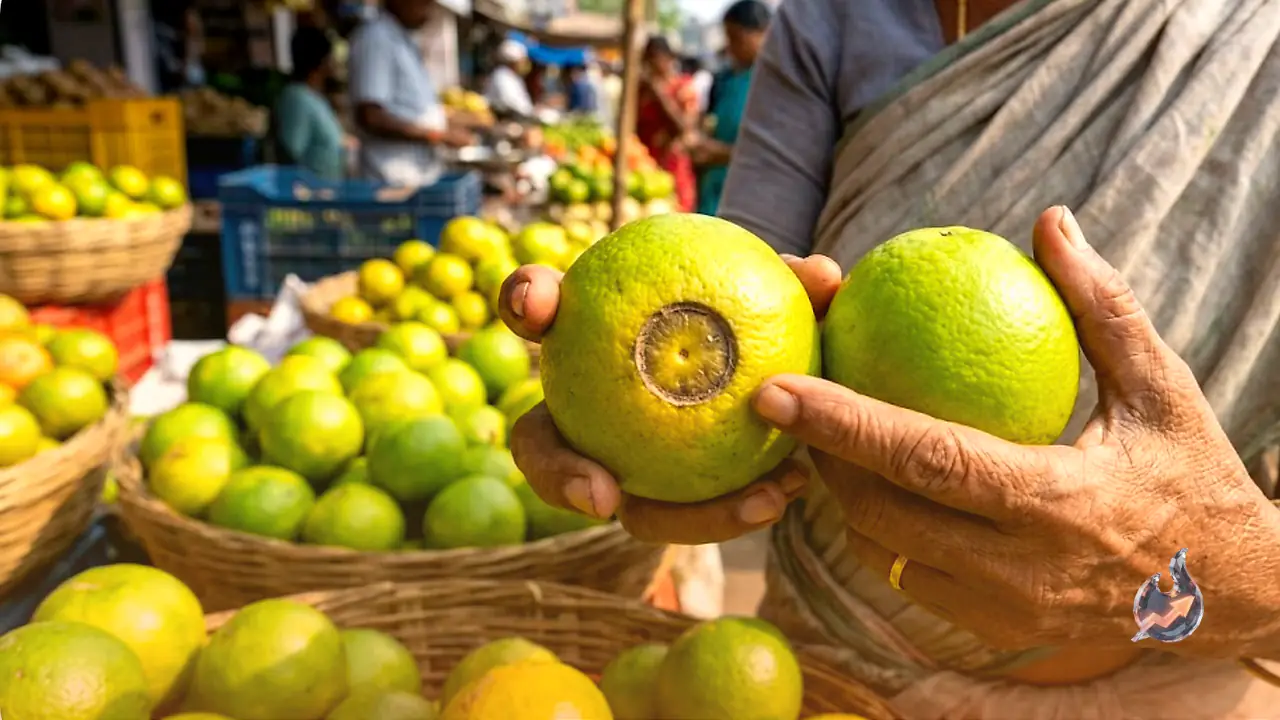

If you are about to buy sweet limes or are thinking of growing them, but cannot tell the desi variety from the imported one, a tiny clue can make things easy. A single mark on the bottom of the fruit reveals which sweet lime will give sweeter, tastier juice. Here is the straightforward way to spot the difference between the desi and Thailand varieties, and which one yields the sweetest juice of all.
Which variety is sweeter
Shishir Dubey, who began commercial sweet lime cultivation in Bihar in 2020, says the imported variety produces far sweeter and tastier juice than the desi one. Shishir lives in Baikunthwa village in the Nautan block of West Champaran district. According to him, the juice of the Thailand-origin sweet lime in particular is as sweet as rock sugar. That is exactly why juice traders in the market prefer to buy this variety from farmers.
The mark on the base gives it away
Put simply, if farmers grow the Thailand variety instead of the desi one, the chances of selling at a good price rise many times over, and their contact with traders stays strong. But the question is how to identify this variety. Shishir offers an easy answer, the Thailand sweet lime has a coin-shaped round mark on its base, while the desi sweet lime is perfectly round with no mark at all.
750 plants on three acres, now bearing heavily
Shishir has cultivated the fruit on a total of 3 acres, where around 750 plants were set. In 6 years all of them have grown into trees, each now bearing up to 40 kg of sweet limes. He estimates that this season the entire orchard could yield a harvest of around 12 tons. Since this fruit is rarely grown in Bihar, fruit and juice traders buy it straight from the field at rates of up to 80 rupees per kilogram.
Profits set to grow further
The biggest point is that as the trees mature, the quantity of fruit will keep rising and a single tree could yield up to one quintal. That gives a sense of just how profitable sweet lime cultivation can be for farmers compared with any traditional crop. One word of caution, when buying saplings, make sure the variety is the Thailand one. Shishir has planted only the Thailand variety, and he says its taste is far sweeter than the desi kind.