
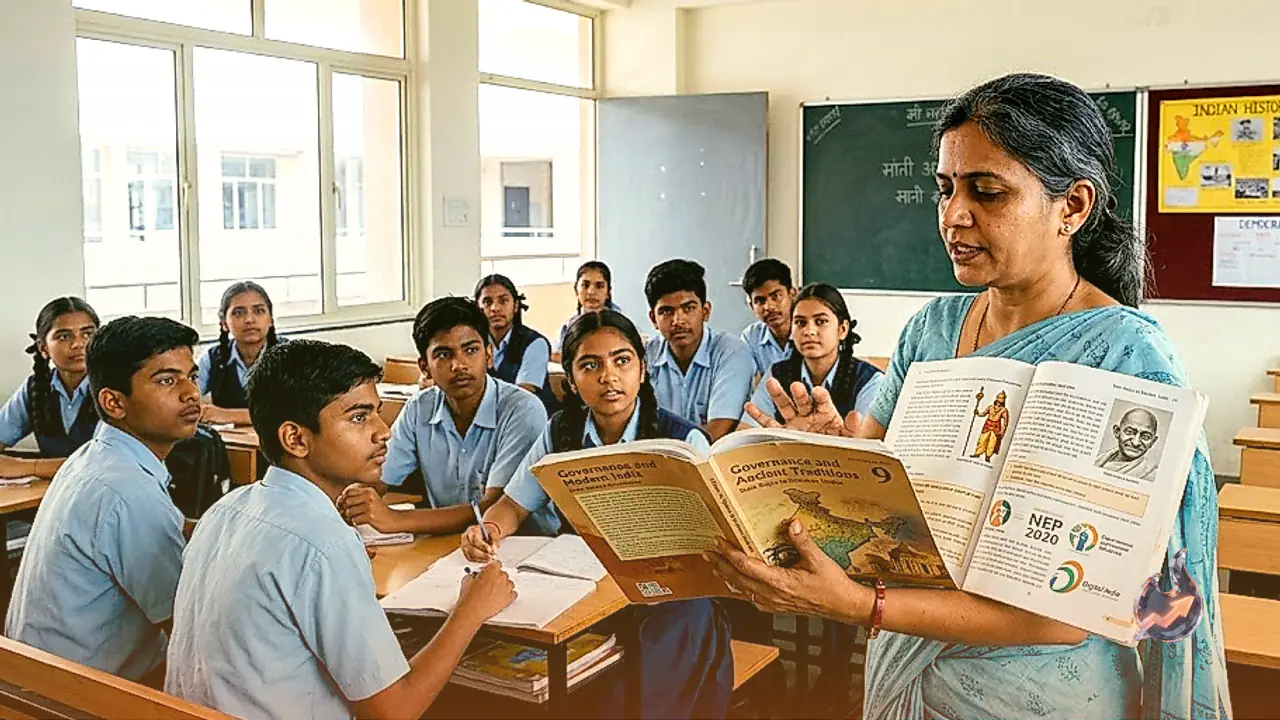

















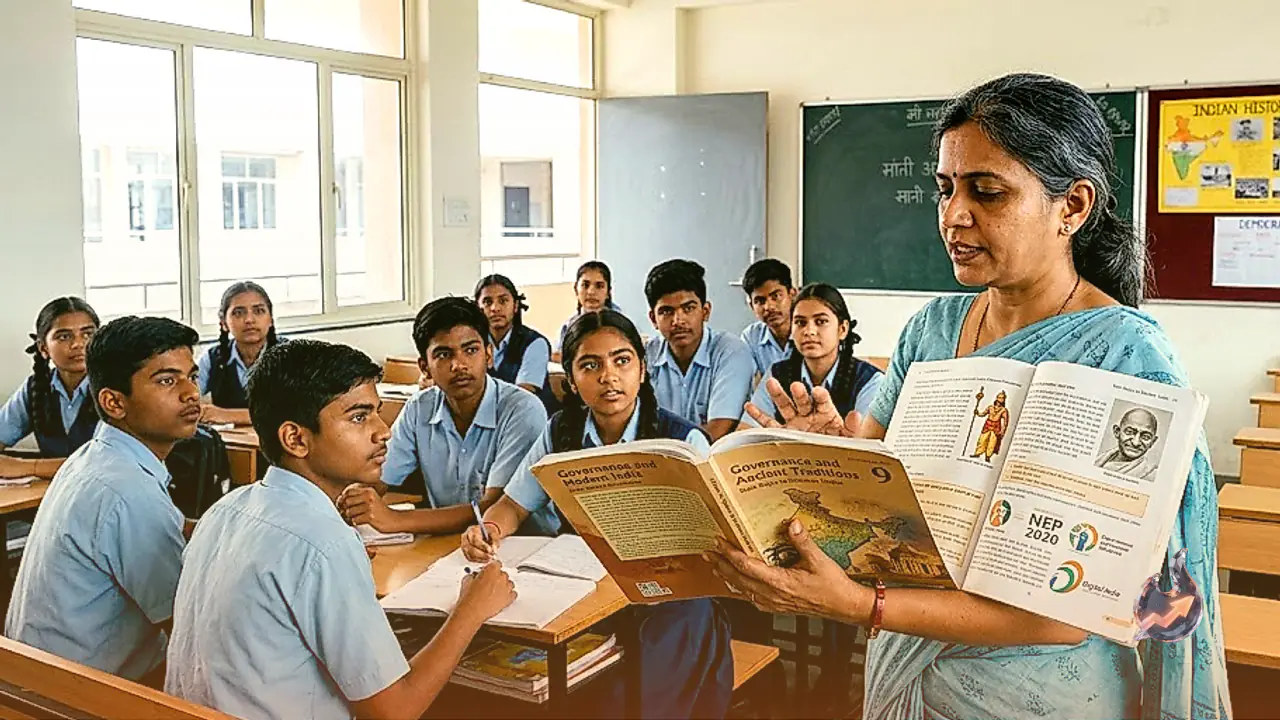

The National Council of Educational Research and Training has revised the curriculum for Class 9 secondary students with the introduction of a new integrated social science textbook. Moving away from teaching history, geography, political science, and economics strictly in separate silos, the new 153-page volume titled 'Understanding Society: India and Beyond-Part 2' aims to provide students with a holistic view of governance. The text traces the evolution of governance mechanisms in India, connecting ancient philosophical traditions and historical precedents directly to modern democratic structures and contemporary public policy.
The Trajectory of Governance from Ancient Thought to Constitutional Democracy
Chapter 4 of the textbook, titled 'Governance and Public Policy', explores how perspectives on administration, leadership, and public welfare have evolved across centuries. To explain these concepts, the syllabus incorporates historical precedents and texts such as the Chola dynasty records, the Mahabharata, the Ramayana, the Mundaka Upanishad, and Kautilya's Arthashastra. The curriculum demonstrates how early administrative mechanisms such as the Sabha and Samiti, alongside ethical frameworks like Rajdharma and Ram Rajya, laid intellectual foundations that gradually transitioned into a modern democratic order anchored by the Constitution and citizen participation.
Mahatma Gandhi's Concept of Ram Rajya as an Ideal Governance Framework
The chapter devotes attention to Mahatma Gandhi's vision of 'Ram Rajya', presenting it as a normative paradigm for public policy and administration rather than merely a religious or mythological motif. According to the text, Gandhi viewed Ram Rajya as an exemplary model of public governance driven by foundational values such as integrity, transparency, empathy, citizen welfare, and people-centric administration. By framing it within policy studies, the book encourages ninth-grade students to evaluate governance systems through ethical benchmarks that ensure public interest remains paramount.
The Chola Heritage of the Sengol and Its Modern Parliamentary Presence
The historical significance of the Sengol has also been incorporated into the curriculum as a cultural emblem of righteous authority and good governance. The text details how the tradition of using the Sengol as a sceptre of sovereignty originated during the reign of the Chola dynasty. It notes the historical moment at India's independence when Adheenam seers from Tamil Nadu presented the Sengol to Jawaharlal Nehru. Furthermore, the textbook highlights the installation of the Sengol in the new Parliament building by Prime Minister Narendra Modi in 2023, illustrating how contemporary democratic institutions in India draw upon enduring traditional symbols to reinforce ethical governance.
NEP 2020 and Landmark Contemporary Welfare Policies
Alongside historical models, the textbook presents contemporary public policies to demonstrate practical governance in modern times. In a dedicated feature titled 'Don't Miss Out', the National Education Policy 2020 is showcased as a case study in large-scale public consultation and evidence-based policy formulation. The text explains that the drafting committee comprised experts from education, science, technology, and public administration. It details the extensive grassroots feedback mechanism involving 2.5 lakh gram panchayats, 6,600 blocks, 6,000 urban local bodies, and 676 districts, which generated nearly 2 lakh public suggestions prior to the Union Cabinet's formal approval in 2020. Additionally, the curriculum incorporates recent flagship programs including the National Health Policy 2017, Khelo Bharat Policy, e-governance initiatives, and the Ayushman Bharat Pradhan Mantri Jan Arogya Yojana to illustrate active state delivery mechanisms.