























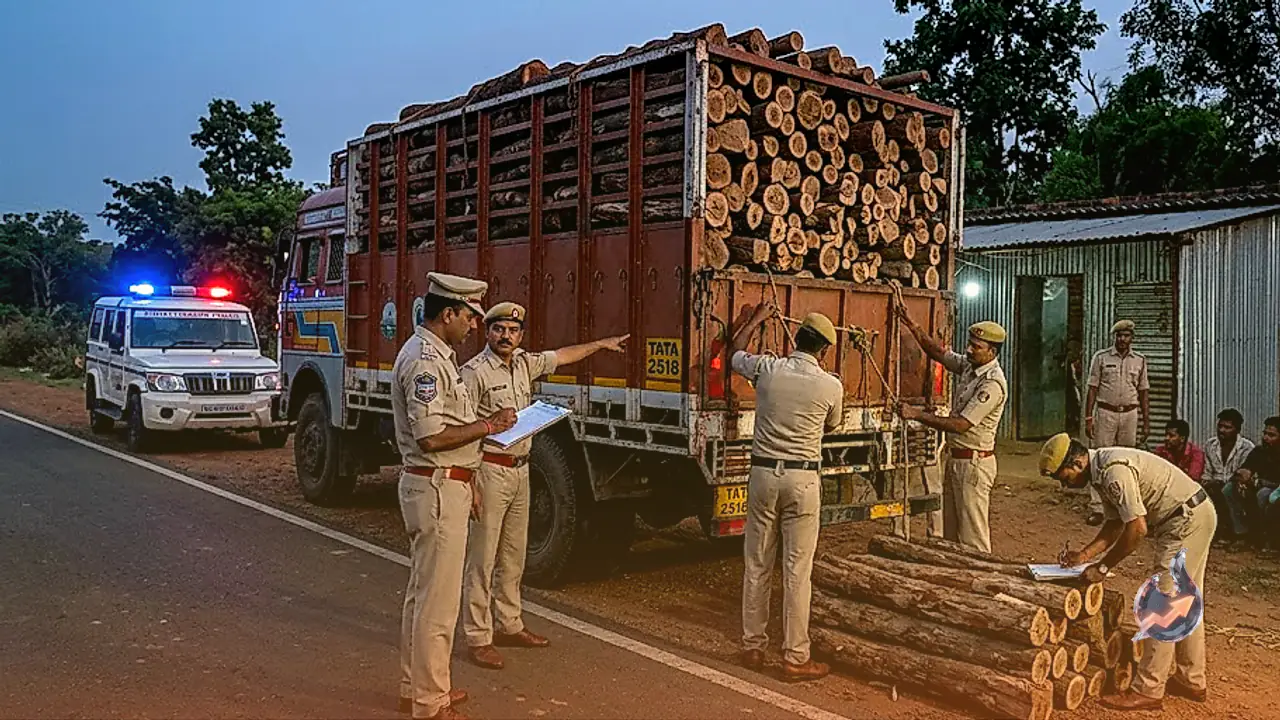

Khair heartwood serves as the primary raw material for manufacturing katha, a key ingredient commonly used in paan across India, yet its immense commercial value recently fueled a massive illicit enterprise. A three-month investigation spearheaded by the Chhattisgarh Police has unraveled an interstate smuggling syndicate valued at 120 crore rupees that spanned across six states. The racket involved illegally harvesting trees from the dense forests of western Odisha and Chhattisgarh and ferrying the timber under forged paperwork to katha processing plants in Himachal Pradesh. The multi-state operation began unraveling following a targeted vehicular inspection at an interstate checkpoint.
Checkpoint Inspection Exposes Forged Credentials
The turning point in the case occurred on June 17 when local police in Mahasamund intercepted a freight truck entering from Odisha. A physical search of the cargo hold revealed 23,350 kilograms of illicit khair timber intended for commercial katha manufacturers in Himachal Pradesh. When inspecting officers scrutinized the accompanying logistics documentation, they uncovered an entirely fabricated clearance permit. The forged National Transit Pass System (NTPS) pass purported to be officially issued by the Kurnool forest division in Andhra Pradesh, a document typically relied upon by checkpoint authorities to verify lawful transport of forest goods.
Multi-State Raids and Statutory Charges
Following the vehicle seizure and the discovery of counterfeit passes, enforcement teams launched an expanded inter-agency crackdown. Mahasamund Superintendent of Police Prabhat Kumar noted that coordinated raids across Chhattisgarh, Haryana, Odisha, Himachal Pradesh, and Madhya Pradesh resulted in the confiscation of over 50 tonnes of smuggled khair wood during a two-month span. Enforcement efforts have yielded the arrest of 12 individuals linked to the supply and distribution network.
Formal criminal proceedings were initiated on July 9 under comprehensive anti-fraud and forestry statutes. The suspects face charges under Bharatiya Nyaya Sanhita (BNS) sections 318(4), 338, 336(3), 340(2), 61(2), 3(5), and 111, which cover organized crime, cheating, forgery, and criminal conspiracy. In addition, charges were invoked under sections 41(2)(b)(d) and 52(1) of the Indian Forest Act, 1927.
Key Figure and Enforcement Operations
Investigative leads identified Manish Agarwal, a resident of Sarsiva in Chhattisgarh, as a central actor coordinating the logistical transactions. Operating on intelligence, police searched his premises on September 7 and seized 81 lakh rupees in cash. Agarwal sought pre-arrest protection and secured anticipatory bail from the High Court, where his defense argued that he functioned strictly as a commercial intermediary, claiming no direct evidence established his involvement in forging no-objection certificates (NOC) or defrauding any party. Nevertheless, Agarwal carries an extensive record of forestry violations and formal complaints. Raigarh Police recently took him into custody in connection with an ongoing investigation into a separate khair smuggling offense dating back to last year, leaving him currently in judicial remand.
Paper Companies and Financial Laundering Web
Financial inquiries exposed an elaborate corporate facade established to mask the illegal movement of money. Investigators found that Agarwal and at least three other timber traders linked to Himachal processing units had set up 8 shell companies. Over a two-year timeline, these entities generated bogus invoices totaling 120 crore rupees to simulate legitimate commerce. To disperse and launder the revenue generated from the illicit shipments, the syndicate routed transactions through more than 10 designated mule bank accounts held under third-party identities. Financial tracing remains underway to map the ultimate distribution of these proceeds.
Trafficking Route from Odisha Forests to Northern Mills
The operation relied on an organized transportation corridor crossing several provincial boundaries. The raw wood was illegally felled from forests across the Balangir and Bargarh districts of western Odisha, other adjoining territorial pockets in Odisha, and the Raigarh-Jashpur woodland belts of Chhattisgarh. Consignments were then moved overland via alternative routes threading through Maharashtra, Madhya Pradesh, Uttar Pradesh, or Jharkhand before converging in Haryana and reaching their final processing destinations in Himachal Pradesh. At every transit point along the highway network, the carriers presented fraudulent NTPS documents to evade inspection and pass as compliant cargo.