

















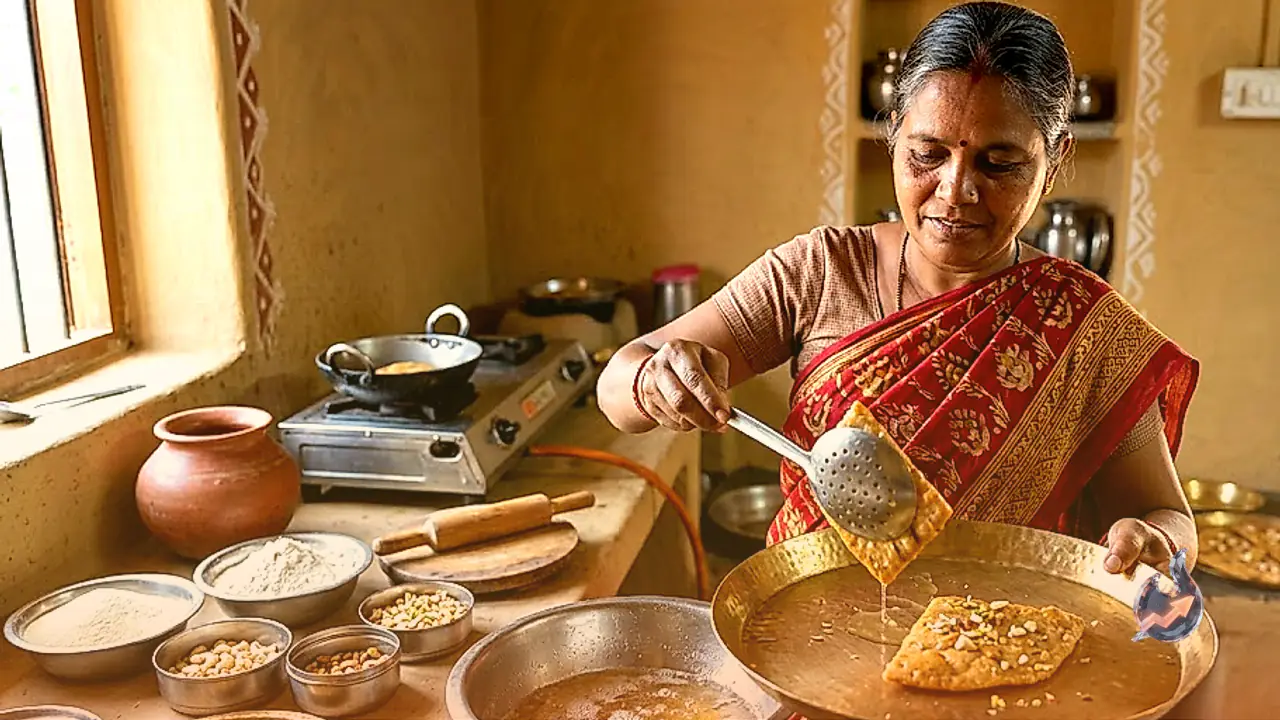

Traditional recipes from Bilaspur carry a distinct culinary legacy within Chhattisgarh's rich food heritage. The native cuisine reflects local cultural roots, nutritional values, and time-tested cooking methods passed down through generations. Among these cherished preparations stands Paag Khurmi Roti, a sweet delicacy renowned for its unique texture and abundance of rich dry fruits. Its preparation relies on cashews, almonds, raisins, sesame seeds, and peanuts. Roasting each of these components in pure ghee enhances both the depth of flavor and the inviting fragrance of the dish. Combining semolina, wheat flour, ghee, assorted dry fruits, and sweet sugar syrup, the finished sweet features a crisp outer crust and a rich nutty center, capturing the quintessential sweetness of regional festive cooking.
Roasting Dry Fruits and Creating the Nut Filling
The culinary process behind this regional delicacy begins by prepping the aromatic dry fruit core. A suitable quantity of pure ghee is warmed in a pan. Cashews, almonds, raisins, sesame seeds, and peanuts are transferred into the melted ghee and roasted gently over a low flame. Gentle stirring ensures that the ingredients develop a crisp bite and release their natural aromatic oils without scorching. Once roasted to an even golden color, the dry fruits are removed from the heat and allowed to cool down. They are then placed into a grinder and processed into a fine powdery mixture. This grounded nutty blend is transferred into a clean container and set aside to serve as the core filling for the rotis.
Toasting Wheat Flour and Semolina
With the nut filling ready, the base dough preparation begins. Pure ghee is poured into a broad kadhai and allowed to warm thoroughly. Semolina and whole wheat flour are added to the hot ghee and stirred continuously over a moderate to low heat setting. As the flour and semolina toast, they turn slightly golden and give off a warm roasted aroma. At this exact stage, the previously ground dry fruit mixture is incorporated into the pan. Everything is mixed thoroughly with a spatula to ensure a balanced blend of flour and nuts throughout the batch. Once evenly combined, the mixture is taken off the burner and left undisturbed for approximately 10 to 15 minutes to allow the ingredients to settle properly.
Infusing Sugar Syrup and Shaping the Rotis
After the roasted mixture has rested, sweetness is introduced to bring the components together into pliable dough. In a separate vessel, a batch of smooth sugar syrup is boiled to the right consistency. This freshly made syrup is gradually poured into the bowl containing the roasted flour, semolina, and ground nuts. The mixture is whisked and kneaded vigorously by hand until it turns cohesive and soft. Small portions of this sweetened dough are divided into smooth balls. Each dough ball is flattened slightly between the palms to form a pocket, stuffed with a spoonful of the dry fruit mixture, and sealed neatly along the edges before being pressed into the traditional round shape characteristic of Paag Khurmi Roti.
Slow Frying to Crisp Perfection
Once all the stuffed discs have been assembled, they are set aside on a tray while the cooking oil is readied. Cooking oil is poured into a deep frying vessel and heated steadily. Once the oil reaches frying temperature, the flame is turned down to low. The shaped khurmi rotis are carefully lowered into the warm oil in small batches to prevent overcrowding. Frying them slowly on low heat is essential because it allows the thick discs to cook thoroughly down to their core while the exterior develops an even golden-brown hue and a delightfully crunchy texture. Once uniformly browned and thoroughly cooked, they are lifted out using a slotted spoon to drain excess oil.
Final Sugar Glaze Coating
To finish the dish, a second batch of fresh sugar syrup is brewed in another container. The freshly fried, hot Paag Khurmi rotis are immediately immersed into this simmering sweet liquid. Dipping them while warm allows a delicate, glossy crust of hardened sugar to coat the outside of each piece without making the center soggy. After resting briefly in the syrup, the sweets are removed to cool. The finished Paag Khurmi Roti, composed of semolina, wheat flour, pure ghee, and rich nuts, highlights the authentic flavors and culinary traditions cherished across households in Chhattisgarh.