






















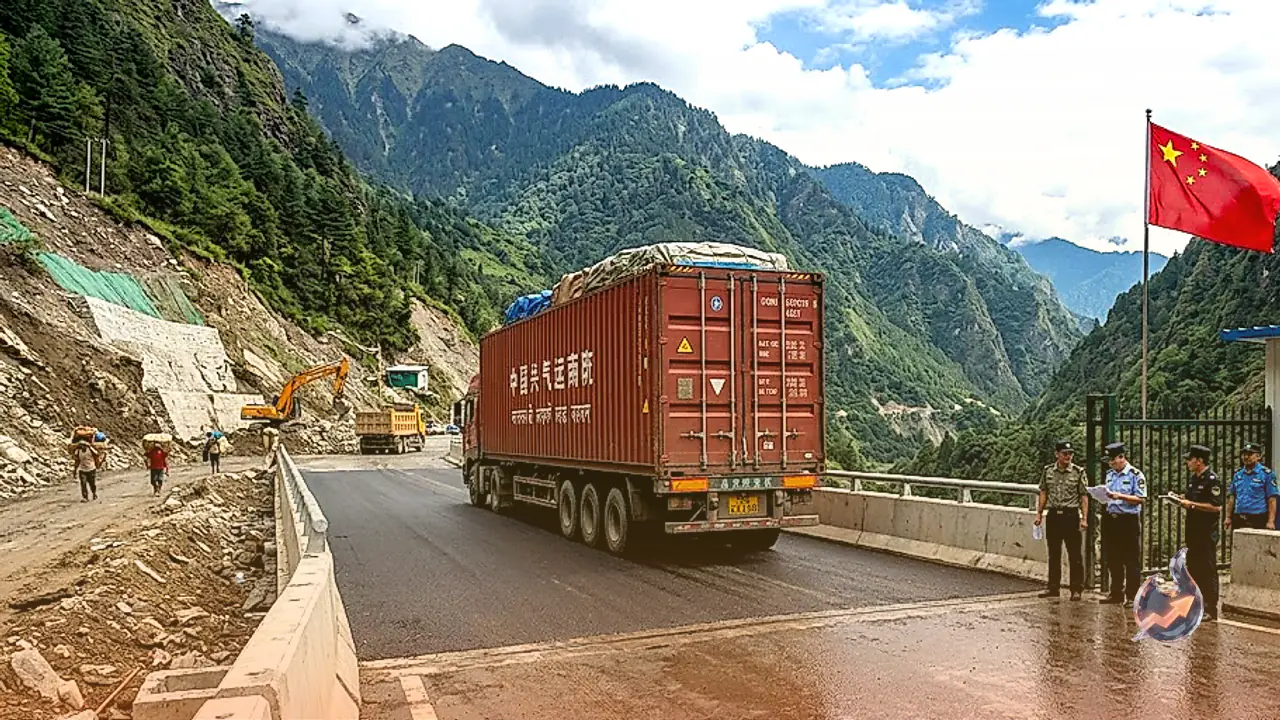

China has completed the reconstruction of a critical border highway linking Tibet to Nepal in just seven days after severe flooding washed away large sections of the infrastructure. The swift repairs along the Gyirong border route re-establish vital ground transport to Nepal's Rasuwagadhi region, allowing emergency relief operations, cargo transit, and cross-border civilian movement to resume without prolonged delay. The sudden destruction caused by recent natural disasters had completely severed the land link, stalling bilateral movement at a critical period.
Rapid Restorations restoring Essential Connectivity
The damaged section of the road was located near the border zone where heavy floodwaters tore through the terrain, cutting off direct highway access to Nepal. Chinese authorities noted that the road collapse created severe bottlenecks for disaster relief efforts, preventing rescue workers and medical supplies from reaching northern Nepal. In response, specialized defense and rescue teams equipped with heavy machinery were deployed along the corridor to clear debris and reconstruct the missing structural segments, successfully reopening the passage within a single week.
Strategic Economic Corridor for Bilateral Trade
The Gyirong border passage serves as the primary commercial artery connecting China's Autonomous Region of Tibet with Nepal. Situated near the Trishuli River and Lende Khola, the road connects China's National Highway 216 directly with Nepal's National Highway 42 via the China-Nepal Friendship Bridge. Over the past decade, this specific border crossing has handled approximately 30 percent of total trade volume between the two nations. Transit figures indicate strong movement along this route, with over 100,000 travelers crossing the border in 2026 alone.
Border Controls and Fee Regulations
Along this border entry point, Chinese border management enforces strict entry procedures and set visa fee tariffs for Nepalese travelers. Under established regulations, Nepalese visitors seeking a 15-day visa are charged $25 (approximately ₹2,500). A 30-day visa requires a fee of $40, while a longer 90-day visa costs $100 (around ₹9,600). The temporary destruction of the highway had halted both commercial freight and visa-based transit, highlighting why Chinese authorities prioritized completing the complex engineering repair in just seven days.