




















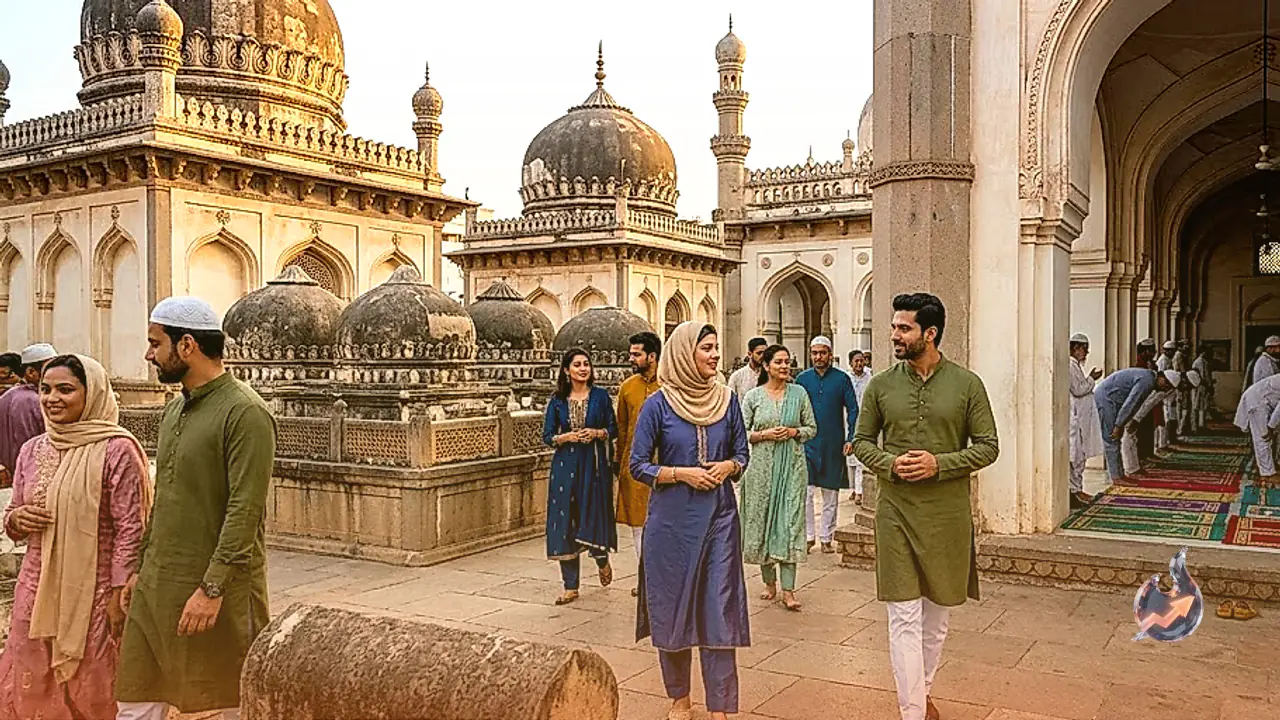

Located in the historic King Kothi neighborhood of Hyderabad, Telangana, Masjid-e-Judi stands out as a unique architectural marvel that draws significant historical and cultural interest. Under conventional Islamic Sharia rules and traditions, believers generally avoid offering namaz facing directly toward graves or inside a burial ground. However, this heritage complex houses 32 royal tombs of the Asaf Jahi dynasty while simultaneously functioning as an active daily place of worship, raising curiosity about how religious services are conducted alongside these graves.
Architectural Separation Preserves Sanctity
The spatial design of the mosque resolves this potential conflict through precise structural partitioning. According to local expert Mohammad Sarwar Raza, the architecture of Masjid-e-Judi was planned meticulously to comply with religious directives and cultural decorum. The designated prayer zone and the royal tomb enclosure are divided into completely distinct physical segments.
Worshippers forming lines for prayer do not face the graves directly. A substantial physical distance and structural division separate the primary mosque building from the mausoleum area. This deliberate layout preserves the spiritual sanctity of Islamic prayer services while ensuring that the dignity of the historical royal resting places remains uncompromised.
Commissioned by the Seventh Nizam in Memory of His Son
The origins of Masjid-e-Judi are rooted in a poignant royal memory. Mir Osman Ali Khan, the Seventh Nizam of Hyderabad, commissioned the construction of this mosque during the 1930s. He erected the sanctuary in memory of his young son, Mir Jawad Ali Khan, who had passed away during childhood.
Over the decades, the surrounding complex became the resting site for 32 members of the royal family. Among all the graves present within the precincts, the most prominent tomb belongs to Mir Osman Ali Khan himself, marking the site as a focal point of regional history.
Final Resting Place of the Royal Family and Present Continuity
When the Seventh Nizam passed away on 24 February 1967, he was buried at Masjid-e-Judi in accordance with his explicit personal will. Rather than being interred at the famous Mecca Masjid, he chose to be laid to rest beside his mother, Zohra Begum. The tomb of his wife, Azam-un-Nisa Begum, is also situated within this royal enclosure.
To this day, local residents gather at the mosque to observe all five daily prayers without interruption. Following their prayers, worshipers regularly recite Durood and Fatiha for the departed Nizam and his family members interred there. This enduring synthesis of active worship and royal heritage provides Masjid-e-Judi with a distinct identity among the historical monuments of Hyderabad.