


















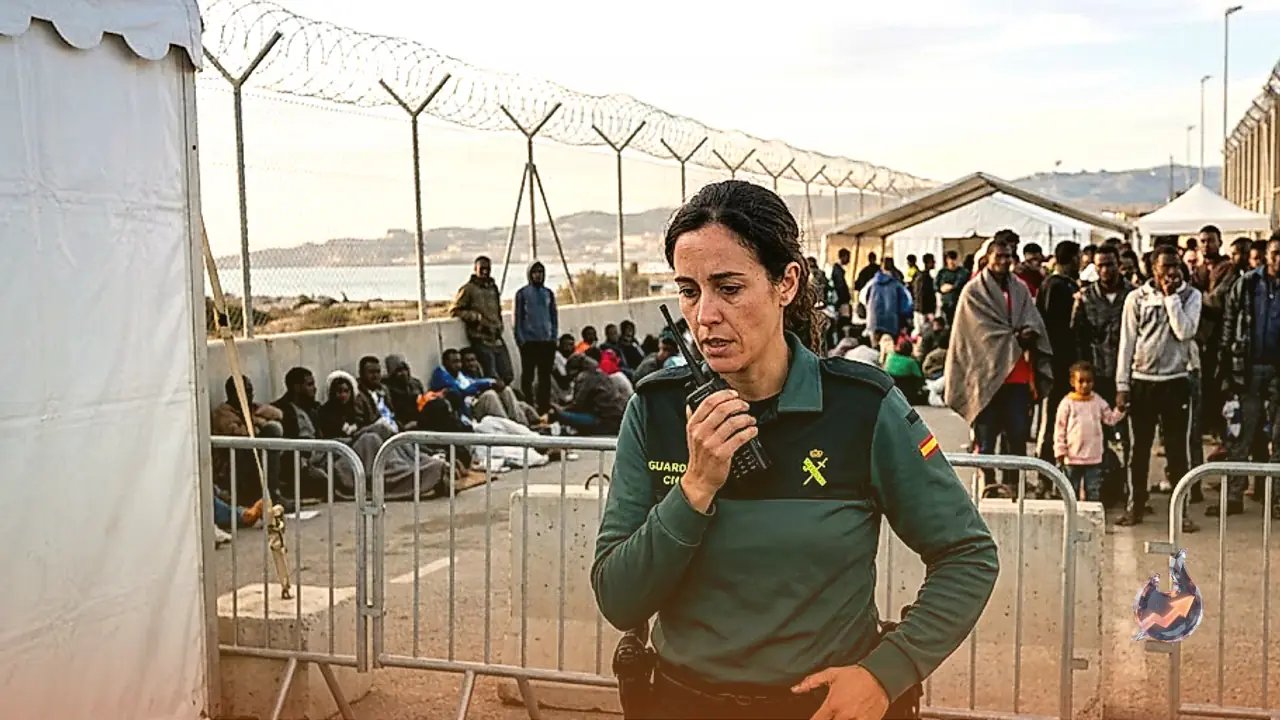

The situation in the Spanish autonomous enclave of Ceuta remains intensely critical as the region grapples with severe security and social fallout following a massive influx of migrants from neighboring Morocco. Spanish prosecutors have revealed that 23 separate sexual assault cases, including nine involving children, have been officially recorded in Ceuta since the large-scale migrant crossing at the end of July. These alarming figures have underscored a deep humanitarian crisis within the territory, placing immense pressure on local law enforcement agencies and testing the governance of Spanish Prime Minister Pedro Sánchez.
Daily Incidents and Vulnerable Migrant Status
Ceuta Chief Prosecutor Silvia Rojas highlighted the staggering frequency of the crimes, noting that the tally translates to nearly one sexual assault case occurring every single day. In statements given to the El País newspaper, Rojas emphasized that young migrant girls are uniquely vulnerable to exploitation and abuse due to their irregular legal status within the territory. The crisis originated when an estimated 72,000 migrants crossed the border from Morocco into Ceuta on July 30 and July 31. Although the vast majority have since returned, as many as 5,000 individuals remain stranded in the North African city, igniting persistent civil unrest and friction between migrants and local residents.
Demographics of the Remaining Migrants and Suspects
According to the figures provided by Rojas, between 1,400 and 1,600 of the roughly 5,000 migrants currently lingering in Ceuta are unaccompanied minors. Authorities have also made initial headway in identifying those suspected of carrying out the assaults. Reports from the Efe news agency indicate that the suspected attackers currently include four Moroccan nationals, three Spaniards, and one Belgian individual. Rojas further pointed out that a significant number of victims choose not to report the crimes to authorities, driven either by paralyzing fear or by concerns surrounding their precarious living conditions and legal status in Ceuta.
Political Fallout and Prime Minister Pedro Sánchez's Response
The compounding crises have left Prime Minister Pedro Sánchez facing bitter and unrelenting criticism from opposition factions over his administration's handling of the situation. On Tuesday, Sánchez convened his national security committee for the second time in a single week to formulate effective countermeasures. The hard-right Vox party launched a fierce verbal assault, asserting that the prime minister had not merely lost control of Ceuta, but had actively handed it over. In contrast to his political adversaries, Sánchez has carefully avoided directly accusing the Moroccan government of orchestrating the surge, stating on Monday that no intelligence reports pointed toward any official involvement by Moroccan authorities.
Disinformation, Foreign Allegations, and Social Media Influence
Rather than placing blame on Rabat, Prime Minister Sánchez pointed toward digital disinformation campaigns circulating on social media, linking them to actors associated with Russia, Israel, and an international far-right movement. Speaking in an interview with the Spanish radio network Cadena Ser, he argued that such groups leverage migration to destabilize not just Spain, but the wider European continent, though he clarified this did not necessarily imply state-sponsored action. These remarks drew swift denials and sharp rebukes from both Moscow and Israel. Israeli Foreign Minister Gideon Sa'ar condemned the prime minister's comments as a blatant lie, while the Russian foreign ministry spokesperson demanded concrete proof to substantiate the claims.
Border Crossing Realities and Fact-Checking Findings
Throughout August, numerous social media posts propagated the false narrative that the border fence dividing Morocco and Ceuta was entirely secure and easy to bypass, despite local mayoral figures confirming that at least 100 people lost their lives attempting to swim around the barrier. Spanish fact-checking organization Maldita noted that prior to the July 30 surge, encrypted and open messages circulated widely across Moroccan social media platforms, actively encouraging individuals to attempt the crossing following a June ruling by Spain's Supreme Court. The opposition People's Party has sharply criticized Sánchez for attempting to exonerate Morocco while deflecting blame elsewhere, with party spokesperson Borja Sémper arguing that tens of thousands of people could not have mobilized toward the border without official Moroccan awareness.
Economic Aid, Royal Visit Plans, and Local Business Despair
In response to the mounting pressure, Economy Minister Carlos Cuerpo announced that the cabinet has approved a multi-million euro financial aid package designed to fund essential services and support the care of unaccompanied minors. Meanwhile, Ceuta's conservative mayor, Juan Jesús Vivas, has urged citizens across mainland Spain to participate in solidarity demonstrations scheduled for Wednesday, coinciding with the city's annual holiday. Arantxa Campos, president of the Ceuta Employers' Confederation, expressed utter despair in an interview with the BBC, stating that local businesses remain powerless and entirely devoid of government planning or screening timelines. Adding another layer of geopolitical complexity, the prime minister announced that King Felipe VI would visit Ceuta as soon as conditions permit, a move intended to project Spanish sovereignty despite the risk of reigniting historical territorial disputes with Morocco.