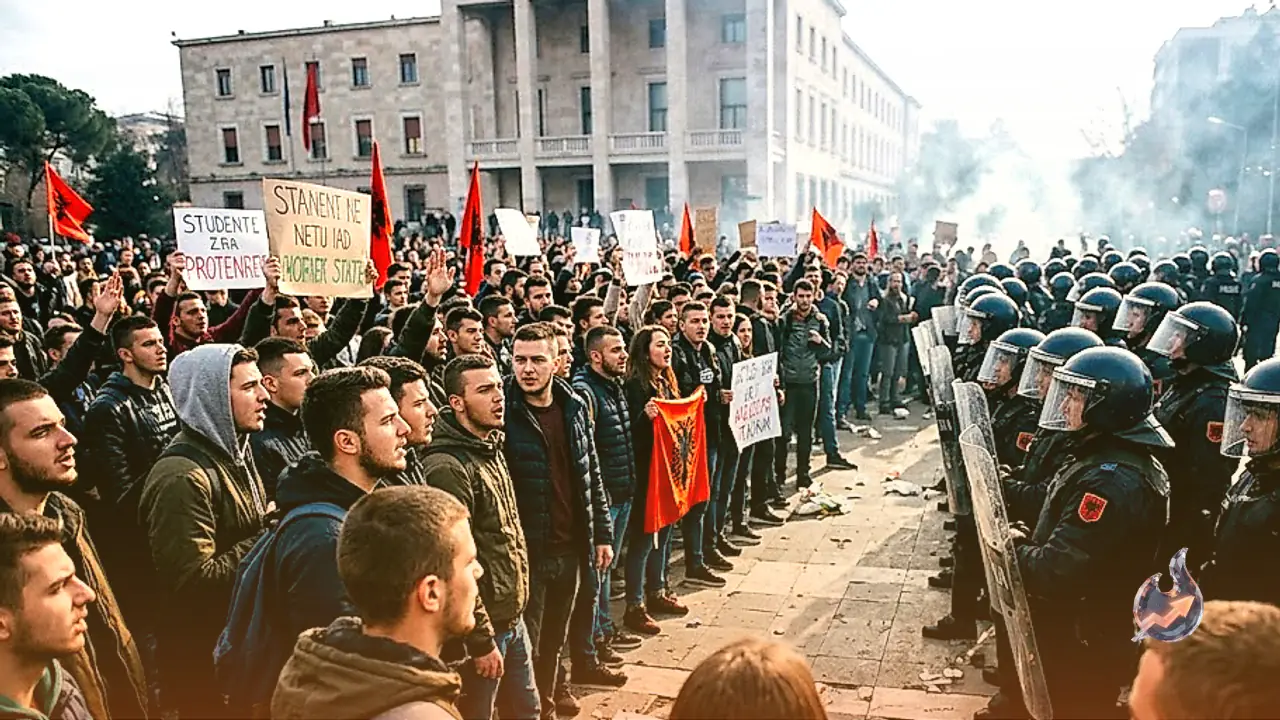
















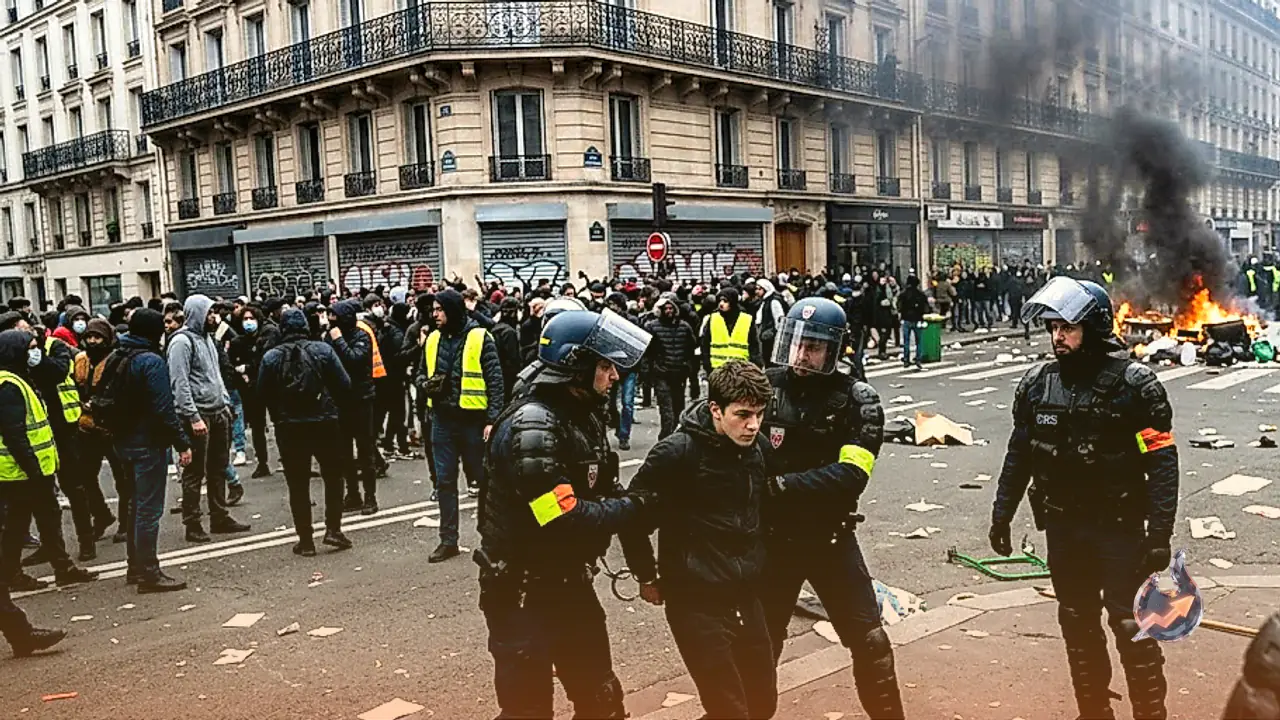

A wave of severe unrest, property destruction, and clashes with law enforcement swept through multiple French metropolitan areas on Saturday as massive demonstrations focused on educational standards and escalating living costs turned violent. An estimated 550,000 individuals gathered nationwide to voice frustration over economic strain and failing public services, but the gatherings rapidly escalated into widespread disturbances that authorities identified as an acute escalation in violence. Police forces across the territory detained at least 400 people, while 60 officers sustained injuries during the confrontations, including two who were transported to medical facilities in an unconscious state.
Riot Police Deploy Water Cannon, Tear Gas, and Batons in Paris
In the French capital, early afternoon marches followed a predominantly peaceful course, led in part by young demonstrators who expressed deep disillusionment with policy inertia, stating that while they remained committed pacifists seeking meaningful reform, the political process had completely stalled. As dusk approached, however, the atmosphere deteriorated sharply as agitated contingents ignited barricades, torched vehicles, and defaced public spaces. Street furniture and automobiles were set on fire across prominent downtown locations, including the iconic Place de la République. In response to advancing fires and projectile attacks, rapid-response riot police cordoned off key arteries, driving back crowds with volleys of tear gas, high-pressure water cannon, and baton charges. Vandals simultaneously targeted commercial avenues, smashing shopfronts, plundering apparel and grocery outlets, and leaving at least one restaurant completely gutted by fire.
Severe Fires Ravage Municipal Centers in Limoges and Lyon
Public administration buildings became prime targets for destruction well beyond Paris. In Limoges, a raging fire engulfed the town hall, triggering a partial structural collapse of the building's roof and leaving the landmark municipal center largely lost according to the local prefecture. In Lyon, demonstrators torched the municipal tourist office, a treasured historical landmark located in the urban core. Lyon Mayor Grégory Doucet lamented the ruin of the iconic, well-known historic building, calling the incident a tragedy for the city. Police officials in Lyon confirmed that hostile individuals actively barred emergency fire crews from safely accessing the premises to extinguish the flames.
Severe Injury in Saint-Étienne and Widespread Retail Raids
Casualties and destruction were reported in numerous other regions throughout the evening. In the south-eastern city of Saint-Étienne, Mayor Régis Juanico confirmed on social media that a young man suffered an amputation of his hand caused by an exploding grenade, emphasizing that such a tragedy should never have taken place. According to France's interior ministry, organized, hooded individuals executed targeted acts of violence not only in Paris but also across Marseille, Rennes, Toulouse, and Angers. Retail centers endured substantial ransacking; an Apple store located in Lille was forcibly breached and stripped of its inventory. Additional structural destruction and municipal property damage occurred in Grenoble, Avignon, Pau, Montpellier, and Valence. In Grenoble, masked agitators commandeered a local tourist train through a narrow downtown street, driving it directly toward a defensive line of at least three riot police officers.
Roots in Secondary School Crises and Coalition with Veteran Protest Groups
The unrest follows weeks of sustained mobilisations by hundreds of thousands of French secondary school students enrolled in lycées, institutions catering to teenagers aged 15 to 18. These students launched walkouts to protest chronic personnel shortages, overcrowded classrooms, and severely dilapidated campus facilities. By Saturday, their ranks were reinforced by organized trade unions and established protest networks. Among those swelling the demonstration rosters were activists affiliated with the gilets jaunes, or yellow vests, a grassroots movement originating in 2018 that demonstrated against rising fuel and living costs for more than a year to form one of the longest continuous campaigns in modern French history. The French government had sought to diffuse student anger when Education Minister Édouard Geffray appeared in a television interview on 8 October offering 3,000 additional supply teachers, but the concession failed to contain expanding public grievances.
Deepening Political Turmoil Ahead of French Presidential Race
The latest eruption of street disorder arrives amid intense political fragility as France approaches the twilight of the current administration. French President Emmanuel Macron is scheduled to step down next year, leaving a power vacuum that electoral polls indicate may materialize into a decisive April contest between National Rally figurehead Marine Le Pen and hard-left La France Insoumise leader Jean-Luc Mélenchon. Mélenchon marched in the protests and subsequently condemned looting and arson while accusing security forces of unleashing excessive aggression on marchers. Prime Minister Sébastien Lecornu fired back, branding Mélenchon's remarks dangerous and cynical, arguing that law enforcement had encountered violence of extreme intensity. Lecornu asserted that certain factions were deliberately using public protests as an electoral warm-up, insisting that no group would be permitted to impose a political agenda through force. Concurrently, Le Pen argued that genuine public grievances had been held hostage by far-left agitators. Responding to the crisis, President Emmanuel Macron stated that all individuals who attacked prefectures, plundered town halls, and vandalized private enterprises would face rigorous prosecution and punishment.