




















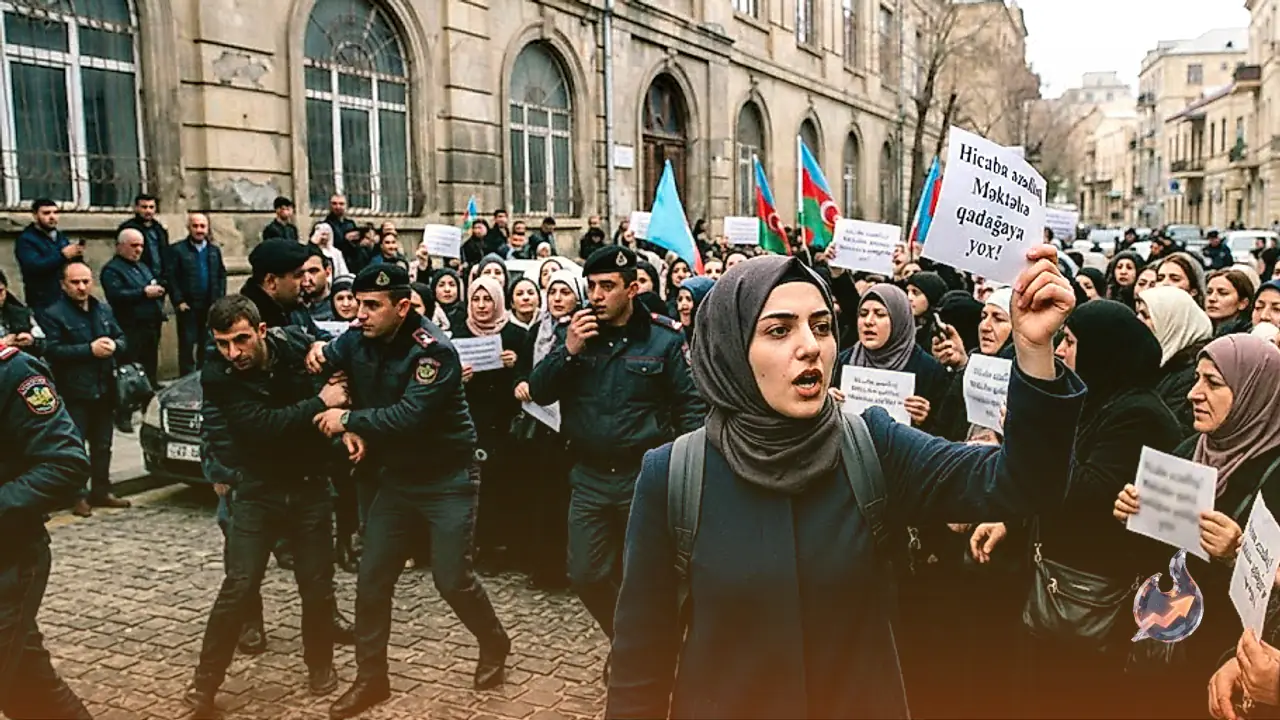

A newly enforced school uniform directive in Azerbaijan has triggered rare street demonstrations after female students wearing Islamic headscarves were systematically turned away at the entrances of state institutions. Video recordings circulating widely across social media networks capture heated confrontations between staff and pupils, including one clip featuring a teenage girl in a navy blue hijab questioning school administrators on why she should be forced to abandon her religious practices simply to attend class, supported by her clapping peers. What began as individual administrative disputes quickly transformed into coordinated protests outside academic buildings in the capital city of Baku as well as multiple southern regions.
Secular Uniform Directives and Enforcement at School Gates
The operational framework behind the classroom exclusions dates back to regulations formally approved on 21 September, which explicitly prohibit any clothing deemed contradictory to the foundational principle of secularism within state educational facilities. Although the legal text avoids naming the hijab specifically, authorities began implementing the mandate with strict oversight last Monday by denying entry to headscarf-wearing students. The policy perimeter was subsequently widened on 6 October, when parallel clothing restrictions were extended to schoolteachers across the state sector. Outside School No. 69 in Balakhany, a community near Baku, congregating students displayed banners proclaiming that wearing a hijab does not hinder anyone from acquiring an education.
Police Crackdown, Arrests, and Disappearance of Activists
Public dissent remains an exceedingly uncommon sight across this oil- and gas-reliant Caspian nation of 10.5 million citizens. Security forces acted rapidly to suppress the gatherings, with the interior ministry confirming the detention of 37 individuals on Monday for allegedly attempting to obstruct statutory rules and committing gross violations of public order. In the capital's Mashtaga district, Shahiza Huseynova was detained on Tuesday after demonstrating outside an academic institution. Her husband, Agha, subsequently recounted to Meydan TV, an independent broadcaster operating from Germany, that officials issued a stark ultimatum demanding that she either remove their child's headscarf for school attendance or face imprisonment.
Civil initiatives organized in support of excluded students have similarly encountered heavy state pressure. Ilkin Huseynov, an activist who launched a digital initiative entitled 'Let Leyli Go to School' to deliver free educational sessions via volunteer instructors, has vanished. Friends reported that Huseynov departed his Baku residence at roughly 16:00 on Wednesday accompanied by unidentified men, with his mobile phone remaining unreachable ever since. While government representatives have offered no official status update regarding his situation, associates suspect he was placed under custody. By Thursday, the platform's Instagram profile had become unreachable, coinciding with widespread public reports indicating severe disruptions when accessing TikTok and Instagram without the assistance of a virtual private network (VPN).
Cross-Border Sensitivities Along the Iranian Frontier
The geographical distribution of the unrest highlights profound cultural and religious undercurrents, with demonstrations heavily concentrated within conservative suburban settlements around Baku and across southern districts bordering the 765-kilometre (475-mile) frontier with Iran, such as Masally and Jalilabad. President Ilham Aliyev, who has exercised firm control over the country since 2003, maintains an unyielding stance against political opposition, keeping numerous critical journalists and opposition figures behind bars. While Azerbaijan is constitutionally dedicated to secular governance, more than 60 percent of its populace identifies as Shia Muslim, creating persistent geopolitical wariness regarding ideological influence from neighbouring Iran, which hosts a larger ethnic Azerbaijani population than Azerbaijan itself.
Security strains manifested directly on the evening of 13 October, when Azerbaijan's State Service for Special Communications and Information Security announced that a hostile cyber entity had compromised over 100 official government portals. Responsibility for the coordinated breach was subsequently claimed by a pro-Iranian hacker collective identifying as the 313 Team (Cyber Islamic Resistance). Domestically, ruling figures have mounted a robust defense of the school regulations. Lawmaker Nigar Arpadarai argued in remarks to the 1news.az portal that young students do not independently select religious coverings but are steered by familial pressure, asserting that minors lack the developmental capacity to choose a religious creed and describing such choices as the conscious prerogative of adult guardians.
Ankara Clashes With Baku Over Faith and Secularism
The fallout has generated unprecedented tension between Azerbaijan and Turkey, traditional strategic partners who famously refer to their alliance as 'one nation, two states.' Ankara provided pivotal military and diplomatic backing during Baku's 2020 conflict against Armenia over the Nagorno-Karabakh territory. However, sharp cultural contrasts persist: while Azerbaijanis share Turkic ethnic and linguistic heritage, Turkey's population is overwhelmingly Sunni Muslim. Turkish President Recep Tayyip Erdogan has openly prioritized cultivating a pious generation during his tenure, and prominent figures within his circle have openly condemned Baku's school regulations.
Erdogan's senior adviser, Oktay Saral, publicly rebuked the measures as entirely unacceptable, urging Azerbaijani authorities to correct their course. Taking to social platform X, Saral insisted that the headscarf constitutes a fundamental religious obligation rather than an obstacle to learning. Several parliamentarians belonging to Turkey's governing AK Party echoed similar criticisms. Grassroots Islamist organizations staged targeted demonstrations within Turkey, including a gathering organized by the Hizb ut-Tahrir-affiliated movement Koklu Degisim outside the Azerbaijani embassy in Ankara, alongside a rally led by conservative body Ozgur-Der in front of the consulate in Istanbul. In response, President Aliyev's New Azerbaijan Party denounced the commentary from Turkish figures as an overtly defamatory pressure campaign built on baseless allegations, warning that Saral's remarks endangered fraternal ties and admonishing foreign actors against meddling in domestic matters, mirroring Aliyev's recent assertion that outside parties should refrain from interfering in their national lifestyle.
The Israeli Factor and Geopolitical Friction
Beneath the surface of the religious debate lies an even more delicate geopolitical fracture involving Israel. Demonstrators in Turkey have explicitly tied the school dress code dispute to Azerbaijan's burgeoning security and commercial partnership with Israel, which purchases Azerbaijani crude oil while supplying high-grade military hardware to Baku. While diplomatic channels between Ankara and Tel Aviv have disintegrated amid the Gaza conflict, Azerbaijan has persistently attempted to maintain productive relationships with both states simultaneously.
The strain of this intricate balancing posture was laid bare during a regional security gathering hosted in Baku on Thursday. When Israeli President Isaac Herzog took the podium to address attendees, official delegations representing Turkey, Iran, and several other regional nations collectively staged an abrupt walkout from the summit hall, underscoring the severe international fault lines running through the South Caucasus.