




















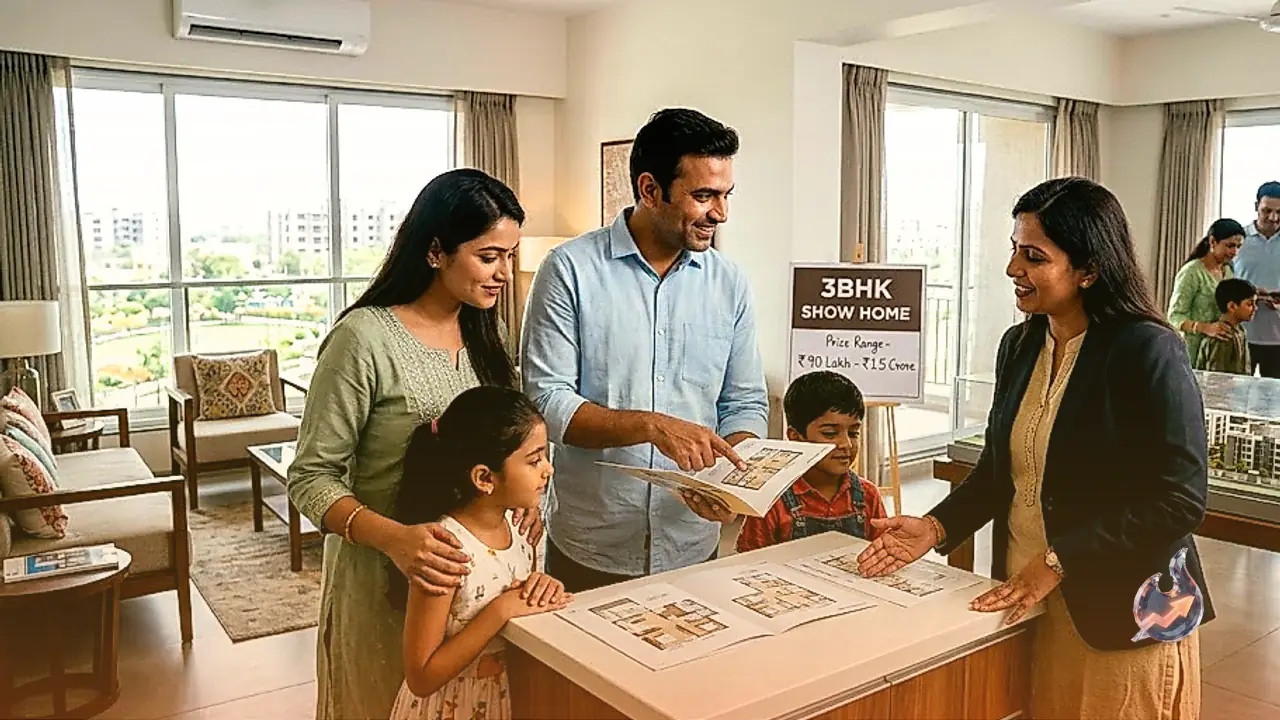

Indian housing demand is moving toward more space rather than simply the lowest-priced option. The H1 2026 survey places 3BHK homes and the ₹90 lakh to ₹1.5 crore price band at the center of buyer interest. Respondents are balancing larger living areas, stronger layouts, added amenities and long-term usefulness against a higher total outlay. This preference is visible across the surveyed markets, where 3BHK interest ranges from 39% to 57%. Rising prices remain a serious concern, but they have not eliminated buying intent; many respondents are instead reassessing timing, location or a temporary rental arrangement.
City preferences show a broad pull toward larger homes
Ahmedabad recorded the strongest preference for 3BHK homes at 57%. Chennai and Delhi-NCR were next at 53-53%, followed by Hyderabad at 52%. Pune stood at 47%, while Bengaluru and Kolkata each recorded 46%. MMR posted the lowest figure among the surveyed markets, with 39%. The spread shows that larger configurations are not a niche choice in any listed market, and the overall pattern is close to half of respondents favoring 3BHK homes. Local conditions still matter, since the level of preference changes noticeably from one city to another.
The ranking has two clear messages. Larger-home demand is not confined to one city, and the intensity of that demand varies by market. Ahmedabad provides the strongest support for 3BHK choices, while MMR still records 39%. For developers, that means recognizing the appetite for more space while reading each city's location and pricing conditions separately.
The preferred budget has shifted upward
The most favored budget is now ₹90 lakh to ₹1.5 crore. Buyers are showing greater willingness to spend more when a property offers a better location, more space and improved quality. Preference for homes below ₹45 lakh has declined over the past few years, while the share choosing higher-priced homes has increased. The change is taking place against a backdrop of rising housing costs, yet premium interest is not confined to investors. End-users are also participating, which suggests that many households see larger homes as a long-term lifestyle and value decision rather than a short-term purchase.
The upward shift does not mean that every buyer has moved into a higher budget. The survey's concern figures show that affordability still limits decisions. Instead, the mix has changed: the lower-price segment has lost some preference, higher-price segments have gained share and the ₹90 lakh to ₹1.5 crore band has emerged at the front of the market.
For builders, the budget shift also changes the kind of supply that can attract attention. A lower-priced project still has to explain its value clearly, while a higher-priced project needs a careful mix of location, planning and facilities. The survey does not say that every expensive home will sell; it says preference has moved toward the segment where more space and a clearer long-term proposition come together.
Self-use buyers form the main base of demand
Of the respondents, 68% are buying for their own use and 32% are buying as an investment. That split keeps the housing market anchored in actual residential needs even as larger homes attract attention. It also means the shift toward premium configurations cannot be explained by investment demand alone. Space, comfort, amenities and future usefulness are influencing the majority decision, while resale and rental considerations still affect how buyers assess a property.
This split helps explain how premium interest and price anxiety can exist together. Most buyers are entering the market for their own residence, so they are thinking about how space and facilities will serve them over time. In the 32% investment group, rental income and resale value add a financial layer to the same purchase decision.
Named real estate figures see a change in how buyers define value
Anuj Puri, chairman of Anarock Group, sees the H1 2026 figures as confirmation of a continuing move toward the premium segment. Strong 3BHK demand, interest in higher-budget homes and growing attention to 4BHK and larger residences indicate that buyers are prioritizing space and quality despite higher prices. Puri identifies end-users as the force carrying the trend forward. For him, a larger home is increasingly viewed through the lens of long-term lifestyle and value, not merely as an expensive acquisition. Developers therefore face both an opportunity and a challenge: match the demand with the right location, configuration and value at the asking price.
Sudeep Bhatt, director-strategy at WhiteLand Corporation, links the preference for larger homes to changing expectations among today's buyers. Nearly half of respondents in the Anarock H1 2026 survey selected 3BHK, and the figure reached 53% in Delhi-NCR. Bhatt's reading is that buyers now attach greater importance to extra space, comfort and a lifestyle designed for future needs. The choice is therefore about how a home will support daily living over time, not only about the number of rooms.
Rishabh Periwala, senior vice president at Pioneer Urban Land and Infrastructure Limited, says demand is moving toward residences that provide more space, better amenities and greater comfort for contemporary families. He sees the shift clearly in Gurugram. Buyers there are looking for carefully planned homes with larger living spaces, premium facilities and a stronger lifestyle experience. The preference reflects a search for a complete living environment rather than simply a bigger unit.
Adil Altaf, CEO of Anhad Developers, says buyers are more certain than before about the kind of home they want for daily life. Nearly half put 3BHK first, and 53% did so in Delhi-NCR. Altaf connects the demand with space, comfort and lifestyle, while privacy, premium amenities and a better living experience also influence priorities. Rising interest in higher-priced homes points to wider acceptance of premium residential projects among end-users.
Varun Garg, director of Karyan Group, describes the trend as an important change in the thinking of NCR homebuyers. He sees the same pattern in Delhi-Gurugram and Ghaziabad. End-users increasingly want to upgrade to larger, better-planned homes. The growing appetite for higher-priced residences reflects rising aspirations and changing lifestyle requirements across the region. The pattern is therefore not limited to Delhi-Gurugram, but is visible in nearby markets as well.
Harvinder Singh Sikka, chairman of Sikka Group, points to stronger demand for larger configurations with more space and better facilities. A 3BHK home can address a family's present requirements while retaining usefulness for the future. Higher prices have made buyers more cautious about budget and location, but the underlying need for a home remains. Sikka says developers must bring price, amenities, location and quality together in a balance that matches genuine buyer needs.
Sanjay Sharma, director of SKA Group, says the ANAROCK Consumer Sentiment Survey shows a steady change in buyer preferences. Customers are revisiting their budget, location and purchase timing because of higher prices, yet their basic desire to own a home has not weakened significantly. The fact that 68% are buying for self-use keeps demand primarily need-based. Sharma emphasizes the importance of offering the right balance among long-term value, budget, location and quality.
One message runs through the responses
Across these responses, the same message appears: buyers are not accepting a higher price only because a project carries a bigger tag. They want more space, a sound layout, privacy, amenities and a home that remains useful later. Premium demand is therefore being linked to a better product. At the same time, caution over budget and location shows that buyers are not spending without a plan; they are filtering choices according to long-term use and value.
Higher prices remain a major source of concern
Enthusiasm for larger homes has not removed anxiety about cost. 65% of respondents expressed at least moderate concern about the increase in current prices, and 40% believe the rise will continue over the long term. At the same time, 44% intend to move ahead with the purchase according to their existing plan. Another 38% may delay the purchase slightly, while 18% are considering postponing it indefinitely or canceling it. The figures separate concern from action: prices are influencing the pace and certainty of decisions, but they have not wiped out the overall desire to buy.
Reading concern and action together shows that higher prices do not affect every buyer in the same way. The 44% who plan to proceed are willing to move forward within their existing framework. The 38% and 18% groups show that preparation, payment capacity and available choices are producing different responses across the buyer pool.
Affordability and limited stock are changing buyer behavior
For respondents who are delaying or canceling, affordability is the largest obstacle, cited by 44%. A further 32% point to the limited number of properties available within their budget. These pressures are producing different responses. Some buyers are searching in outer areas of the city, others are pushing the purchase date forward, and some are choosing to remain in a rented home for a while. The result is not a simple fall in the desire for ownership; it is a change in how buyers try to make ownership fit their finances and available choices.
The three responses work in different ways. Looking farther outside the city can widen the set of options within a budget, waiting gives buyers more time to prepare and staying in a rental home avoids an immediate purchase commitment. The survey presents these as separate routes chosen according to each buyer's circumstances, not as one universal solution.
New launches gain ground over ready-to-move homes
About 34% of respondents prefer new-launch projects, compared with 18% who favor ready-to-move-in (RTM) homes. In H1 2026, the ratio of RTM homes to new launches was 18:34. In H1 2022, that ratio was 30:25, showing how the relative preference has moved toward new projects. Developer credibility is the leading consideration for buyers choosing a new project, with 34% giving it priority. Initial price advantages matter to 21%, including early-bird pricing or a lower initial financial commitment.
The movement in the ratio shows that new projects have gained relative ground. RTM had the stronger position in H1 2022, while new launches moved ahead in H1 2026. The continued 18% preference for RTM also shows that ready-to-move homes have not disappeared from consideration. Developer credibility and early financial advantages help explain why new projects are attracting more attention.
Real estate keeps its investment appeal
Residential real estate remains a strong investment choice, with 60% of respondents selecting it. Stocks attracted 20%, gold 11% and fixed deposits 9%. Among respondents investing in assets other than real estate, 44% plan to use future gains to buy a home. The survey also shows that financial returns matter even to people purchasing for their own use. At least 77% consider rental income important or very important when assessing a property, and regular rent plus potential appreciation makes ownership more attractive. A further 67% regard potential resale value as important or very important. Buyers are therefore treating a home as both a place to live and a long-term financial asset.
This dual view asks buyers to connect two goals with the same property. Self-use buyers are also examining the possibility of rental income and the price they may receive later. The 44% planning to put future gains from other assets into a home shows how real estate remains connected to the wider investment plan.
The market is adjusting rather than losing demand
The overall conclusion is that rising prices are not weakening housing demand so much as reshaping the decision around it. Buyers are reconsidering what they will purchase, where they will look and when they will commit. Larger homes, 3BHK configurations, the ₹90 lakh to ₹1.5 crore band and new launches are gaining attention because buyers want more space and lasting value. At the same time, affordability, limited choices and price anxiety are making them more deliberate about the route they take.