




















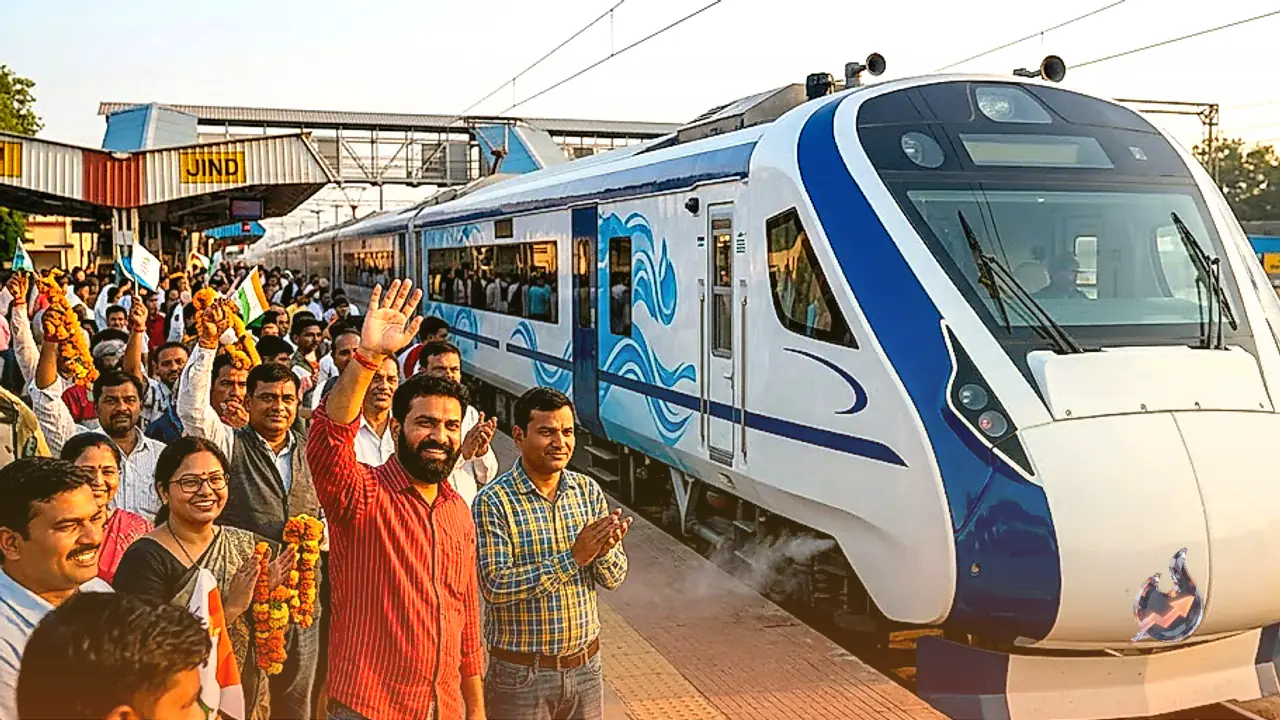

On the morning of 17 July, a train unlike any other in the country will pull out of Jind station in Haryana. It needs neither diesel nor overhead power lines to move. It leaves behind no smoke and no ash. The only thing it releases is water. This is India's first hydrogen train, and it will run the 89-kilometre stretch between Jind and Sonipat carrying 682 passengers, placing it among the most powerful hydrogen trains anywhere in the world.
So why does India's experiment matter so much? What exactly is the story of hydrogen gas, and can the very gas that once turned an airship into a ball of fire become the fuel of tomorrow? Let us walk through it step by step.
A story that began with a single bubble
The tale starts about 250 years ago, inside a laboratory in London. In 1776, a scientist named Henry Cavendish dropped zinc metal into acid. Suddenly, bubbles began rising out of the container. These were bubbles of a gas that no one had identified until then.
When Cavendish set this colourless gas alight, it made a soft whoomph and produced droplets of water. That revealed something remarkable: water is not a single substance at all, but is made of two different gases, hydrogen and oxygen. Think about it, the water we drink every day holds the very gas that is now powering a train.
Naming the newfound gas
The gas had been discovered, but what should it be called? That job fell to a French chemist. He joined two Greek words, 'hydro', meaning water, and 'genes', meaning born. So hydrogen literally means 'born from water'.
In 1800, two English scientists pulled off the reverse. They passed an electric current through water and split it into hydrogen and oxygen. This process came to be known as electrolysis, and it is the same method by which hydrogen is produced across the world today.
From a 'gas battery' to the first fuel cell
The next big question was whether hydrogen could actually serve as a fuel. In 1838, a chemist found that combining hydrogen and oxygen produced not just water but energy as well. Building on that idea, the English scientist and judge William Grove created a working machine he called a 'gas battery'. It could store the energy of hydrogen inside a battery. This was the world's first fuel cell, and it is why Grove is remembered as the 'Father of the Fuel Cell'.
The Hindenburg disaster and hydrogen's bad name
Hydrogen's history also carries a great tragedy. In 1937, a giant airship called the Hindenburg, filled with hydrogen gas, suddenly burst into flames as it came in to land.
Hydrogen is an extremely light gas. In the Hindenburg, it was used to lift the craft into the air, much like a balloon. For some reason a fire broke out near the tail, and because hydrogen catches fire so easily, the entire airship was swallowed by flames within seconds. After the accident the whole project was abandoned, and hydrogen came to be seen as 'dangerous'.
Why the world turned back to hydrogen
The real turning point arrived in 1973, when Middle Eastern countries abruptly cut off oil supplies. The world realised that depending entirely on oil was a serious risk. From that moment on, hydrogen began to be taken seriously as an alternative.
In 1998, the small nation of Iceland announced that it wanted to become the world's first fully hydrogen-based economy by 2030. In 2018, Germany rolled out the world's first commercial hydrogen passenger train. Japan, China and the United States have since launched hydrogen trains of their own. India's first hydrogen train, launching on 17 July 2026, is nearly five times longer than Germany's original hydrogen train. The journey that began with a single bubble in a London laboratory some 250 years ago is now reaching a fresh milestone at Jind station in Haryana.
The lightest element in the universe
Remember the periodic table from Class 10, the one where every element in the world is neatly arranged? In that table, hydrogen sits right at the very start. Its nucleus holds just a single proton, which makes it the lightest of all elements. It is also the most abundant element in the entire universe, present even in the Sun and the stars.
But hydrogen comes with a catch. On its own it is so unstable that it cannot exist independently. It always needs a partner, either another hydrogen atom or a different element altogether. That is why whenever you hear the term hydrogen gas, it really means an H₂ molecule, never a lone hydrogen atom.
Most often it is found bonded with oxygen in water, that is H₂O. To get pure hydrogen, it first has to be separated from oxygen, and that process is called electrolysis. You can even carry it out yourself in a laboratory.
How a fuel cell turns hydrogen into motion
But how does hydrogen gas actually generate energy, and how does it drive trains and cars? The smartest way is through a fuel cell. A fuel cell is essentially a kind of battery. It produces electricity by combining hydrogen with oxygen drawn from the air. The only by-products of this whole process are energy and water vapour. No smoke, no carbon, no pollution. That is exactly why a hydrogen train is described as a 'zero-emission' train.
Not all hydrogen is clean
There is, however, a twist. Hydrogen itself may not pollute, but the method used to make it often does. The cleanest approach is the third one, in which electricity generated from the Sun or wind is used for electrolysis to produce hydrogen. This is precisely what India's hydrogen train aims for, to run on green hydrogen.
A conventional electric train has to pull power from overhead wires. A hydrogen train needs none of that. It makes its own electricity on board.
What runs on the Jind–Sonipat route
The train will make two round trips a day on the 89-kilometre Jind–Sonipat route, covering a total of 356 kilometres. In doing so it will consume around 300 kilograms of hydrogen. The train carries a total of 440 kilograms of hydrogen on board.
The challenges holding hydrogen back
Producing just one kilogram of hydrogen takes about 50 units of electricity. Yet the energy packed inside that one kilogram of hydrogen is equal to only three and a half litres of petrol. In plain terms, it is an expensive proposition.
Hydrogen has to be stored at 200 to 500 times normal atmospheric pressure, which is measured as one bar. That is why the Railways has built a special fuelling facility at Jind that can hold 3,000 kilograms of hydrogen at a time.
The fuelling centre also has a chiller plant installed to keep the hydrogen cooled to minus 15 degrees Celsius. At such low temperatures hydrogen turns liquid, which makes it far easier to load into the train. Sitting at the heart of the whole system is a fuel cell built by the Canadian company Ballard, counted among the world's leading firms in this technology.
The technology is still very young
Hydrogen train technology is still very new. The French company Alstom first showcased it at an exhibition in Berlin in 2016. In 2018, Germany put the world's first hydrogen passenger train into service. Yet by the end of 2024, Germany had already pulled several of its hydrogen trains out of operation, choosing instead to favour battery-powered trains because they are cheaper and more convenient.
Japan began testing a hydrogen train in 2022 but has still not deployed it on a large scale. In China and the United States, too, the technology remains confined to short-distance runs. Making and running hydrogen continues to cost more than battery technology.
All told, hydrogen is no magic wand, but a fuel that carries both strengths and challenges. Its greatest advantage is that when used it gives off nothing but water, with zero pollution. The challenge is that producing, storing and transporting it is far from easy, and most of the hydrogen made today is still not clean.
Will India go big on hydrogen?
So will India roll out hydrogen trains at scale? If the experiment on the Jind–Sonipat route succeeds, several heritage and hill routes across the country, such as Kalka–Shimla, could also shift towards hydrogen in the years ahead. These are stretches where laying electric lines is difficult and where the emissions from diesel engines remain a real worry. But if the experiment fails or turns out to be too costly, India, much like Germany, may end up walking away from it.