






















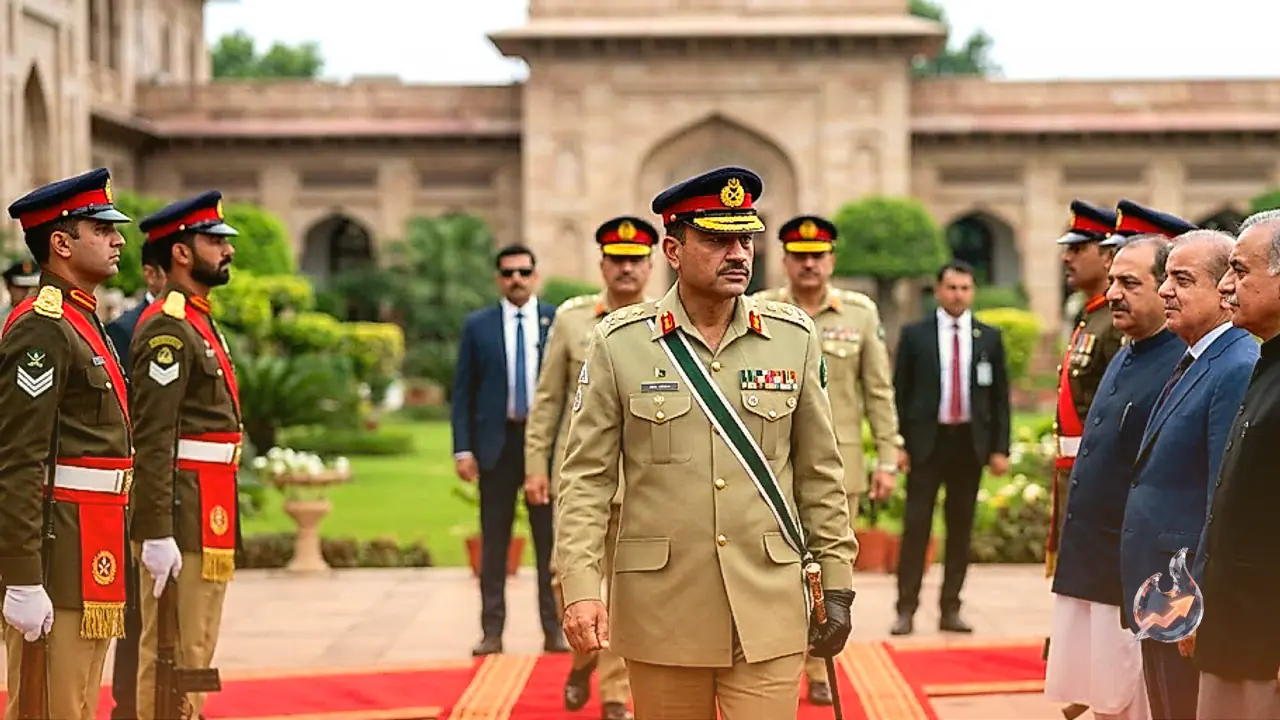

Pakistan has witnessed a fifth instance of power concentration orchestrated by a top military general. The primary distinction of this transition is that it was executed through parliamentary legislation rather than traditional tanks and physical force. Through a series of sweeping legal changes, Field Marshal Asim Munir has firmly established himself as the most formidable authority in the nation.
Asim Munir assumed office as Pakistan's 17th Army Chief in November 2022. Six months prior to the scheduled conclusion of his tenure, in May 2025, India initiated Operation Sindoor. Following the military engagement, Pakistani authorities asserted victory and portrayed Asim Munir as a national hero, which catalyzed a steady expansion of his political and military influence.
Ascension to Field Marshal and Chief of Defence Forces
On May 20, 2025, Munir was elevated to the rank of Field Marshal, representing the highest military designation within the Pakistani armed forces, commonly referred to as a five-star general. Prior to Munir, General Ayub Khan was the only other military figure to attain this distinction in the country's history. Subsequently, in November 2025, the 27th Amendment to Article 243 of the Constitution established the office of Chief of Defence Forces, appointing Munir as the inaugural holder of the title until 2030, with provisions for tenure extensions.
On August 20, 2026, the Pakistani Parliament enacted two legislative measures granting the Chief of Defence Forces five expansive authorities. Three of these powers are embedded within the Defence Forces of Pakistan Act, 2026. A centralized Defence Forces Headquarters will operate under Munir's direct command to oversee all three military branches and direct strategic decisions regarding wartime operations. Furthermore, the Chief of Defence Forces holds the authority to retire, terminate, retain, or grant service extensions to officers across all branches, excluding the individual service chiefs, while also serving as the Prime Minister's principal advisor on national security.
Nuclear Oversight and Lifelong Immunity
Additional authority was established under the National Command Authority Act, 2026, granting Munir enhanced control over the nation's nuclear arsenal. While the Prime Minister retains chairmanship of the authority, the Chief of Defence Forces secures a dominant institutional role. Crucially, the legislation grants Munir legal immunity equivalent to that of the sitting President, shielding him from criminal prosecution for life.
Munir's upbringing was rooted in religious traditions. Born in 1968, his father, Syed Sarwar Munir, migrated from Jalandhar in 1947 and served as a school headmaster and religious sermon leader in Rawalpindi. According to journalist Ejaz Syed, his family directed him toward religious education, leading him to memorize the Quran at a madrasa before attending local institutions, including Sir Syed College in Rawalpindi, and later pursuing higher education in Japan, Malaysia, and the National Defence University in Islamabad.
His formal military career commenced on April 25, 1986, with an initial posting in the Frontier Force Regiment. During his tenure as a Lieutenant Colonel stationed at the Pakistani embassy in Saudi Arabia, he dedicated his annual holidays over three consecutive years to memorizing the Quran. His service record includes postings in the Siachen Glacier and Pakistan-occupied Kashmir, leading to his promotion as Major General in 2014, Director General of Military Intelligence in 2016, and Lieutenant General in September 2018.
Munir was appointed Director General of the Inter-Services Intelligence on October 25, 2018, but served for only eight months before his dismissal in June 2019, prompted by reported friction with then-Prime Minister Imran Khan regarding allegations involving his wife, Bushra Bibi. Following Imran Khan's removal via a no-confidence motion in April 2022 and the subsequent premiership of Shehbaz Sharif, Munir's alignment with the incoming political administration facilitated his appointment as Army Chief in November 2022.
Consolidation of Authority and Institutional Control
Analytical institutions such as Chatham House indicate that Pakistan's hybrid governance model has effectively dissolved, leaving the civilian administration entirely dependent on Munir. The rapid legislative approval of the recent defense acts by political coalitions, including the PPP and PML-N, demonstrated a lack of parliamentary resistance, with presidential assent granted immediately.
Even if opposition factions led by Imran Khan secure electoral victories in the future, legal barriers prevent Munir's removal without a constitutional two-thirds majority in Parliament. Simultaneously, judicial restructuring through the 2026 amendments has subordinated the Supreme Court to a newly established Constitutional Court, prompting protests and the resignations of senior judges Mansoor Ali Shah and Athar Minallah.
Munir's strategic stance continues to emphasize traditional geopolitical postures regarding India, underscored by recent defense agreements finalized with Saudi Arabia and Turkey in August 2026, which position Pakistan at the center of a tripartite security pact.