




















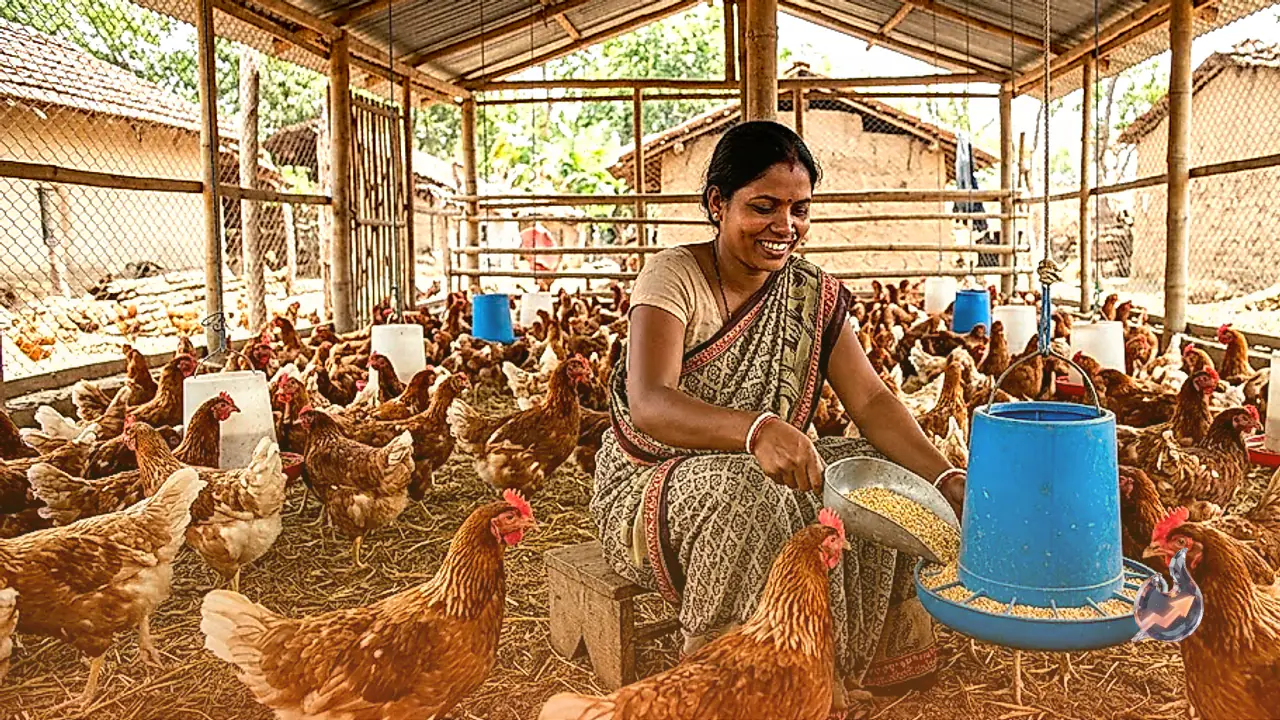

Poultry farming is rapidly transforming into a viable livelihood opportunity for women in rural areas. Manisha Mehta, a resident of Bhelwatand village in the Domchanch block of Koderma district, Jharkhand, has set a benchmark for financial self-reliance by launching an egg-production venture directly from her homestead. Her initiative demonstrates how micro-enterprises can thrive in village ecosystems with modest capital and strategic support.
Setting Up the Farm with a 20000 Rupee Capital Outlay
In 2025, Manisha initiated her poultry farming operations on a modest plot measuring 1,000 square feet. The setup revolves around a commercial cage system designed to accommodate 100 hens. Establishing a standard cage unit of this size normally incurs an expenditure of approximately 1,08,560 rupees. However, by leveraging an 80 percent subsidy provided under the Jharkhand State Livelihood Promotion Society scheme, her effective initial investment was reduced to just around 20,000 rupees, significantly lowering the entry barrier for her enterprise.
High Egg Production Yields from the BV 300 Hen Breed
To optimize output, Manisha selected the BV 300 hen breed, which is widely recognized for high egg-laying capacity. Her single cage of 100 birds yields a steady output of 80 to 100 eggs every day. After accounting for daily recurring expenses such as poultry feed, veterinary medicines, and general maintenance, she secures a net profit of around 400 rupees per day. This consistent yield provides a dependable daily revenue stream that covers both operational costs and personal savings.
Generating 10000 to 12000 Rupees Monthly Alongside Household Work
Maintaining the small-scale poultry unit requires only a few hours of daily attention, allowing Manisha to manage the farm without disrupting her routine household responsibilities. The venture generates a steady monthly income ranging from 10,000 to 12,000 rupees, giving her financial independence and the capability to fulfill family needs. Encouraged by her success, Manisha advocates that rural women form self-help groups and capitalize on government welfare programs to achieve economic stability through small-scale animal husbandry.