




















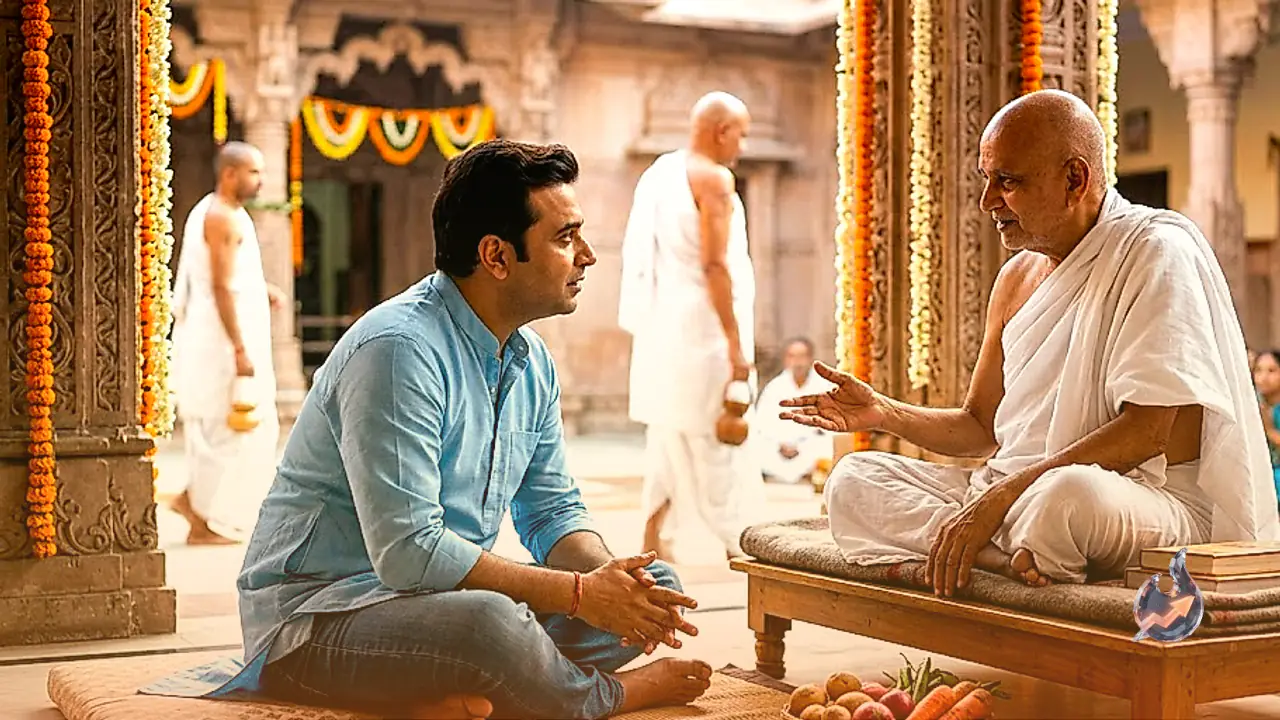

A conversation between actor Saanand Verma, widely recognized for his role in the television series Bhabiji Ghar Par Hain, and Jain spiritual leader Munipungavshri Sudha Sagarji Maharaj has garnered widespread attention online. During their interaction, the actor sought clarification regarding the reasons why the Jain community strictly abstains from consuming onions, garlic, and other underground root vegetables. In response, the spiritual leader outlined the core principles of non-violence and spiritual discipline that guide dietary practices within Jain philosophy.
Saanand Verma Questions the Dietary Code
At the start of the interaction, actor Saanand Verma sought the blessings of Sudha Sagarji Maharaj before posing his inquiry regarding the spiritual basis for excluding onions and garlic from meals. Responding in an approachable tone, the spiritual leader offered his personal interpretation connecting food consumption with intellectual and physical faculties. He noted that vegetables that mature beneath the soil remain enclosed in darkness, dampness, and continuous contact with dirt, whereas fruits and vegetables developing above ground receive sunlight, fresh air, and oxygen.
Building upon that premise, the spiritual leader observed that, according to his personal view, foods originating beneath the soil are connected with physical force, whereas those cultivated above ground in open light and air correspond with intellect. However, these specific assertions should be understood as the spiritual leader's personal perspective and informal commentary, as they are not established scientific facts. An online post referencing this dialogue drew further public focus to the interaction and the rationale discussed.
Root Crops and Protection of Microorganisms
Sudha Sagarji Maharaj detailed an additional fundamental reason rooted in traditional Jain practice concerning underground crops. He explained that harvesting a plant entirely from its root inevitably disturbs the surrounding soil, bringing a high probability of harm to subterranean microorganisms living within the earth. Because Jain dietary rules prioritize minimizing unintended injury to living organisms, community members consciously avoid consuming underground produce such as potatoes, onions, garlic, carrots, and radishes to prevent the violence associated with uprooting these plants.
The Non-Violence Doctrine and Spiritual Cultivation
The principle of ahimsa, or non-violence, serves as the central foundation of Jain religious thought. In Jain philosophy, every living being possesses a soul, and causing avoidable suffering or harm to any creature is categorized as violence. This fundamental conviction is not confined solely to personal conduct and ethics, but extends directly into daily dietary selections. Consequently, food choices within the Jain tradition are guided by the objective of causing the least possible distress to life forms. Furthermore, strict dietary restraint is treated as an instrument for mastering the senses, maintaining mental tranquility, and advancing personal spiritual practice.
Monastic Guidelines versus Household Practices
While ingredients like onions and garlic remain common staples across standard Indian household cooking, their exclusion within Jain practice represents far more than a dietary preference or nutritional stance. The dietary obligations mandated for Jain monks and nuns are substantially more rigorous than those expected of lay householders. Therefore, abstention from onions, garlic, and subterranean vegetables must be evaluated through the broader lens of Jain commitment to absolute non-violence, ecological consideration for microscopic life, and rigorous spiritual devotion.