
















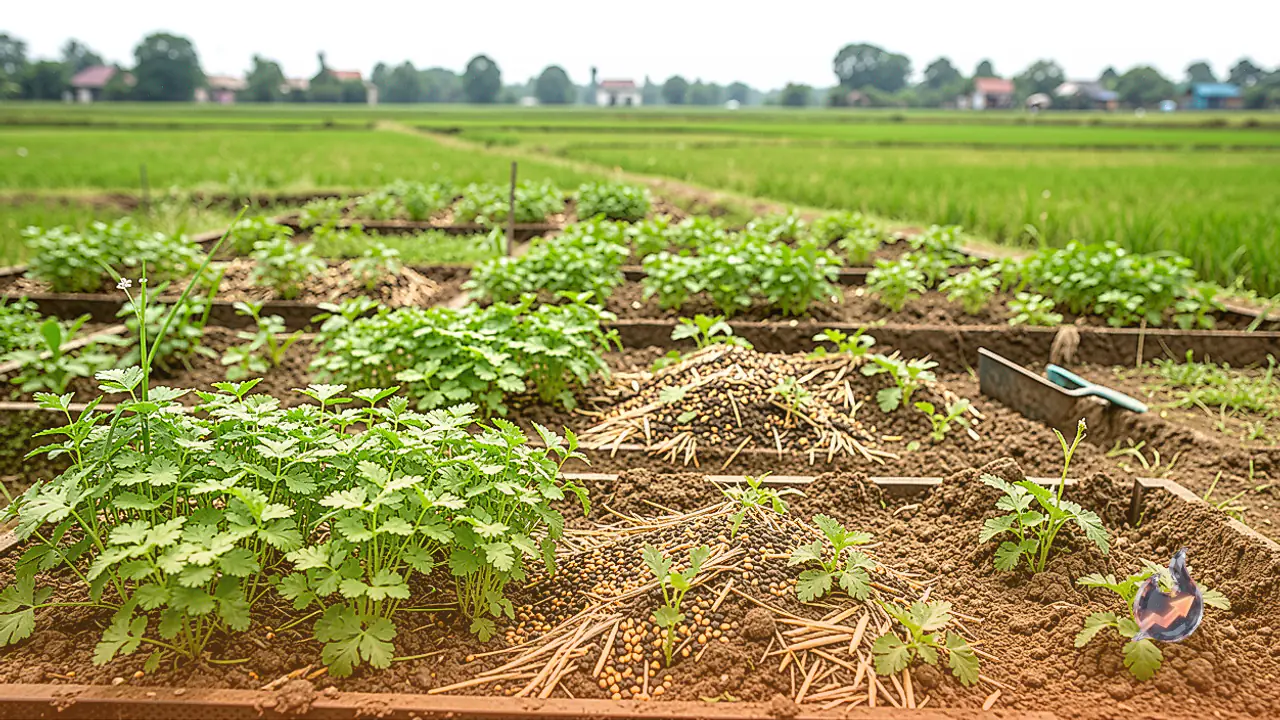

Growing fresh, lush coriander in a kitchen garden is a favorite pursuit for home gardening enthusiasts, yet achieving an even and rapid germination rate often presents a stubborn challenge. Conventional sowing frequently results in patchy growth or slow seedling emergence because raw coriander seeds carry a tough, protective outer casing. By applying a straightforward agricultural method involving seed splitting and surface mulching with paddy straw, home growers can secure a full 100 percent germination rate while completely bypassing synthetic fertilizers and chemical inputs.
Splitting Seeds Before Sowing to Accelerate Germination
Coriander seeds possess a robust, durable outer shell that significantly delays the natural absorption of moisture when planted whole. Progressive young farmer Ranjodh Singh explained that the exterior of the coriander seed is remarkably hard, and dividing it into two halves before planting drastically speeds up the entire germination cycle. Applying gentle pressure with a flat, weighted object separates each seed into its two natural segments without crushing the internal embryos, promptly breaking the seed's dormant phase and allowing moisture to penetrate instantly.
Achieving healthy coriander starts with selecting high-grade, disease-free seeds. Once these seeds are gently parted into two distinct halves, they should be distributed evenly across a freshly prepared bed of loose, lightly moist soil. Maintaining uniform spacing across the planting area ensures that emerging seedlings will not compete aggressively with each other for root space, light, and nutrients as they begin their initial vegetative growth.
Mulching with Paddy Straw to Preserve Vital Soil Moisture
Immediately after dispersing the split seeds across the moist bed, the entire soil surface must be shielded with an even layer of clean paddy straw. In formal agricultural science, covering topsoil with plant residues in this manner is known as mulching. This protective barrier stops vital soil moisture from evaporating into the air under daily exposure to wind and direct heat. Consequently, the seeds remain cradled within a constantly humid, warm microclimate that consistently achieves up to 100 percent sprout emergence.
In addition to regulating microclimate temperature and moisture, the straw canopy acts as an effective physical defense against environmental threats. The straw shields young, vulnerable embryos from intense, scorching sunlight during mid-day hours. Furthermore, garden birds frequently scavenge uncovered seeds strewn across freshly tilled ground, but a secure blanket of straw conceals the seeds entirely from foraging pests until sturdy roots take hold below.
Suppression of Weeds and Continuous Organic Nutrition
A frequent nuisance when cultivating coriander is the rampant emergence of invasive weeds that swiftly rob young herbs of vital ground nutrition and root space. Spreading a protective shield of paddy straw starves hidden weed seeds of necessary sunlight. Denied ambient solar radiation, wild grasses and unwanted weeds fail to germinate or establish themselves, sparing home gardeners the repeated physical labor of weeding and hoeing around fragile young herbs.
Beyond conserving ground hydration and checking unwanted plant growth, decaying straw significantly enriches soil fertility. With routine, delicate watering, the moist paddy straw naturally breaks down and decomposes across the garden bed. Within a relatively brief span, the decomposing straw transforms into rich, all-natural organic compost. This self-generated biological fertilizer feeds a steady stream of essential macro and micronutrients directly to the coriander roots, eliminating any requirement to purchase synthetic fertilizers or supplementary soil amendments from commercial markets.