




















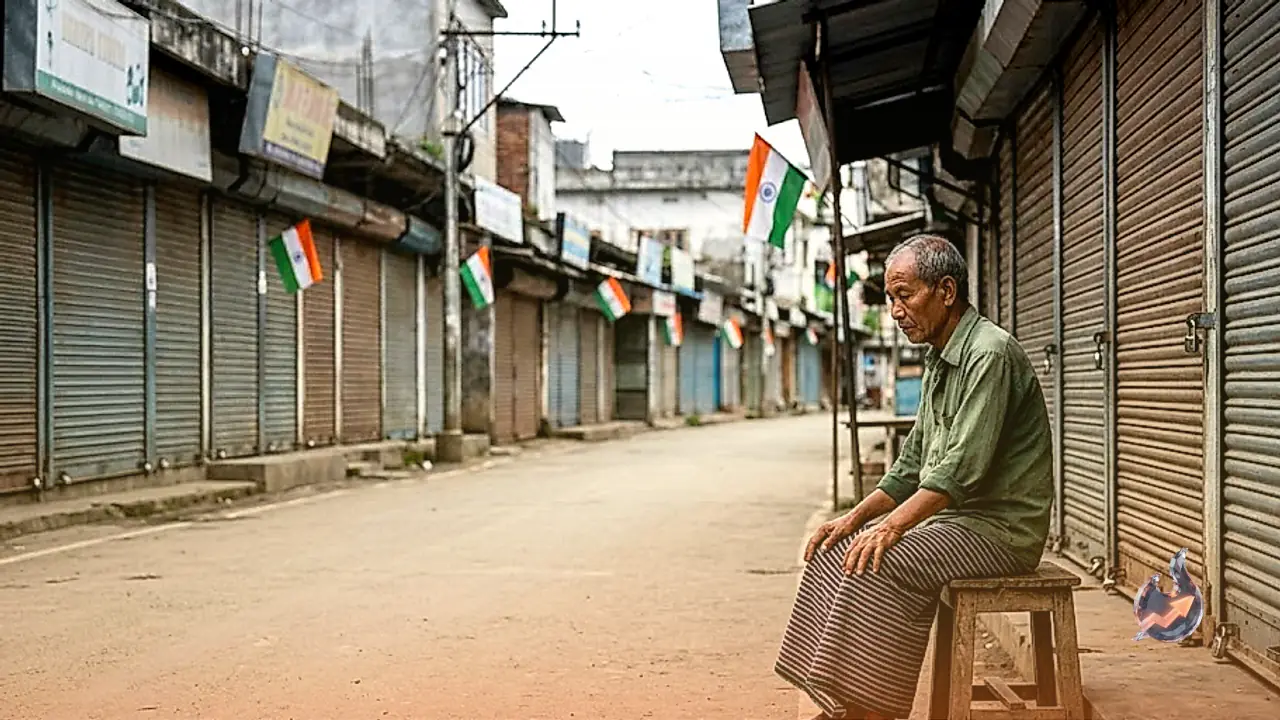

A coalition of six banned underground groups in Manipur has called for a statewide bandh and urged people to boycott India's Independence Day events on August 15, adding fresh tension in the state just days before the national holiday.
What the strike will look like
The Coordination Committee, known by its acronym CorCom, said the general strike will begin at 1 am and run until 6:30 pm on August 15. Public transport and normal business activity across Manipur are expected to be disrupted through those hours. In a statement circulated to the media, the group said it would exempt essential services from the shutdown, including medical emergencies, electricity supply, water supply, fire services, the press and religious ceremonies, so that these functions can continue uninterrupted even as the rest of the state comes to a halt.
The six groups behind CorCom
CorCom operates as an umbrella body bringing together six separate outfits. These are the Kangleipak Communist Party (KCP), Kanglei Yawol Kanna Lup (KYKL), the People's Revolutionary Party of Kangleipak (PREPAK), a splinter faction called PREPAK-Progressive, the Revolutionary People's Front (RPF), and the United National Liberation Front (UNLF). Together, these banned organisations coordinate statements and calls for action such as this one under the CorCom banner.
Why the coalition is targeting August 15
CorCom argues that August 15 holds no historical or political significance for Manipur, a region it refers to throughout its statement as Kangleipak. The group also criticised state leaders for what it called praising the central government, and it urged the public to stay away from the Har Ghar Tiranga campaign, which is being observed nationwide from August 9 to 17.
A decades-old claim to sovereignty
The statement repeats a political position CorCom has held for years, that Manipur functioned as an independent and sovereign entity in Asia before it entered into a merger agreement on October 15, 1949. The coalition described that 1949 merger as an alleged violation of international law and of Article 2(4) of the United Nations Charter. It went further, arguing that the ongoing conflict in Manipur should be understood as an international armed conflict rather than treated as an internal insurgency.
Comparing Manipur with sovereign nations
To support its case that Manipur could function as a viable sovereign state, CorCom compared the state's population and geographical area with those of other countries, claiming that several existing member states of the United Nations have smaller populations and smaller territories than Manipur's historical boundaries once covered. The group cited records from the first session of the Manipur National Assembly, held on October 18, 1948, to claim that this historical territory extended across 15,650 square miles, or around 40,530 square kilometres.
Legal arguments and a warning about the future
CorCom further alleged that the central government is attempting to alter Manipur's territorial integrity and its geographical boundaries. To back this claim, it invoked the legal principle of uti possidetis juris along with international case law, pointing specifically to the International Court of Justice's 1986 ruling in the boundary dispute between Burkina Faso and Mali. The coalition warned that if what it calls the right to self-determination is not pursued, indigenous cultures and populations in the region risk gradual erosion over time. It said the movement for independence remains necessary, in its view, to secure the region's future.