























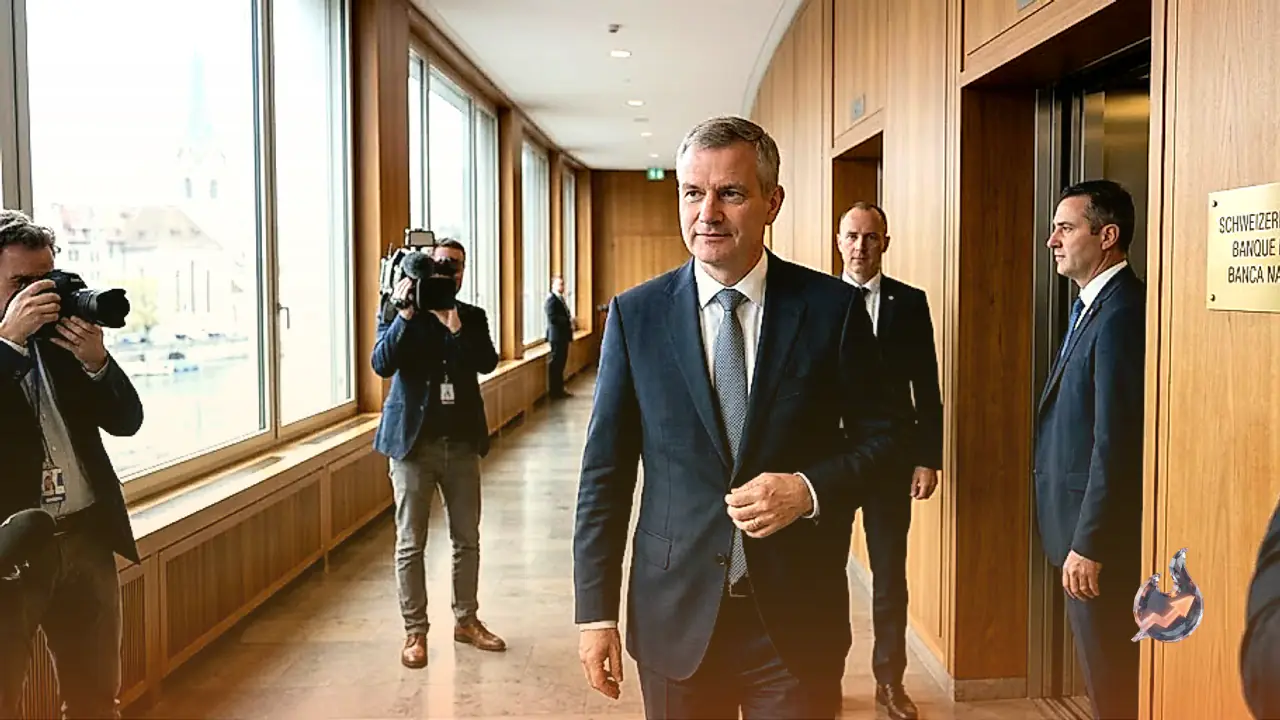

Financial markets are closely watching central bank moves across Europe as monetary policymakers balance local price trends with broader international shocks. Nomura's European economics team, headed by Josie Anderson, George Buckley, and Andrzej Szczepaniak, anticipates that the Swiss National Bank will keep its benchmark interest rate steady at 0.00% during its September 2026 gathering. The analysts emphasize that despite robust domestic economic expansion, a recent tick upward in consumer inflation, and a softening currency, borrowing costs are unlikely to rise anytime soon, ruling out rate hikes until at least 2028.
Energy Costs Push Swiss Inflation Higher
Recent price statistics in Switzerland showed an unexpected surge in headline consumer figures. Year-on-year inflation jumped to 0.8% in August, doubling the 0.4% rate registered in July and marking the fastest annual pace recorded since September 2024. However, the details behind the numbers reveal that higher energy prices were the primary driver of this acceleration. Underlying core inflation, which filters out volatile components like fuel and power, remained comfortably muted at 0.4% year-on-year.
The analytical group led by Josie Anderson, George Buckley, and Andrzej Szczepaniak stated, "We expect the SNB to leave its policy rate unchanged at 0.00% at its September meeting." The economists project third-quarter inflation to print in line with the central bank's forecast of 0.7% quarter-on-quarter before picking up speed to 1.0% quarter-on-quarter in the final quarter of the year.
Currency Dynamics, Franc Valuation, and Geopolitics
The performance of the Swiss Franc remains central to the policy calculus in Zurich. A weaker Franc may encourage policymakers to transition back to conventional foreign exchange intervention terminology. The EUR/CHF currency pair is hovering near its highest mark since early 2025, which might make officials feel that signaling an aggressive readiness to enter currency markets is currently unnecessary.
At the same time, unpredictable external conflicts complicate this outlook. As the war involving Iran re-escalates, global risk appetite could retreat quickly, prompting capital flows toward traditional havens like the Swiss Franc. To guard against sudden upward pressures on the domestic currency, the central bank is widely expected to keep its June policy guidance firmly in place for now, preserving flexibility while monitoring geopolitical developments.
Global Market Moves: US Dollar Pauses, Gold and Currencies Rebound
Broad currency and commodity markets saw notable repositioning during Thursday's Asian trading session. The strong rally in the US Dollar, which had lifted the greenback to its highest marks since late July following hawkish rhetoric from the Federal Reserve, came to a temporary halt. This consolidation allowed other major assets to stage meaningful recoveries.
The Australian Dollar gained fresh momentum against the greenback, with AUD/USD reclaiming the key 0.7100 handle. Sentiment was buoyed by persistent expectations that the Reserve Bank of Australia might raise rates further, alongside fragile hopes surrounding diplomatic outreach between Washington and Tehran. This combination supported risk-correlated currencies across the board.
Meanwhile, USD/JPY rebounded after briefly dropping below 156.00 in Asian hours, working to halt a three-day winning streak that had driven the pair to a nearly two-week high a day earlier. While the dollar paused after its climb to seven-week highs, market expectations that the Bank of Japan will continue normalizing its ultra-loose framework offered fresh support to the Japanese Yen. Market participants are keeping upside gains capped ahead of Friday's pivotal Bank of Japan interest rate decision.
Gold registered an impressive advance on Thursday, surging to weekly peaks around the $4,480 per troy ounce zone. The yellow metal decisively snapped a three-day slide, finding strong upward momentum from the retreating US Dollar and concurrent weakness across crude oil contracts.
Japan's Historic Era of Ultra-Low Rates Faces Policy Shift
Japan's protracted period of zero and negative interest rates served as an engine for cross-border finance for over a decade. Ultra-low borrowing costs enabled the Japanese Yen to function as one of the world's cheapest funding vehicles, funneling trillions of dollars into global assets. While virtually all other major central banks aggressively hoisted rates to confront soaring inflation, Japan stood apart as the world's solitary monetary outlier.
That dynamic is approaching a significant turning point. With expectations mounting that the Bank of Japan could tighten its policy levers again this week, the long-standing advantage of low-cost yen borrowing is transitioning into an unchartered phase. A shift in Tokyo's monetary posture could carry far-reaching consequences for global liquidity and carry-trade strategies worldwide.