























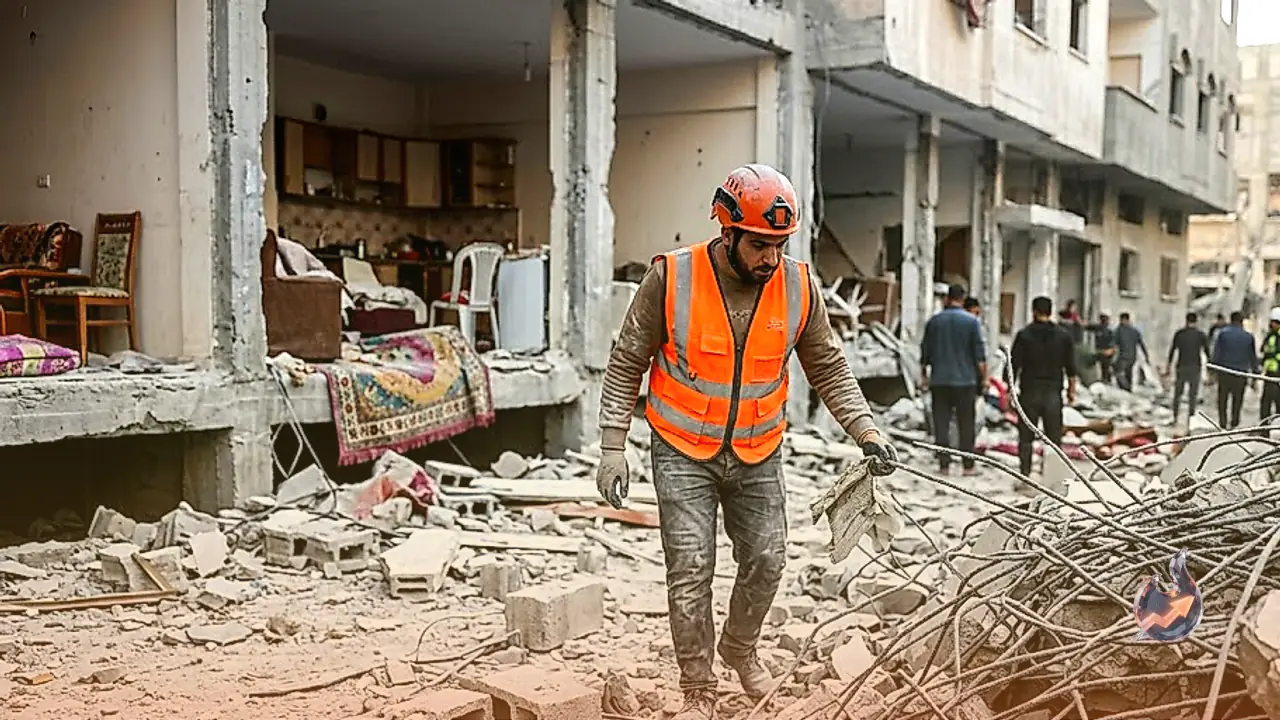

Military tensions in the Gaza Strip remain severe despite recent diplomatic movements surrounding a proposed disarmament accord. Israeli military aircraft launched a second consecutive night of bombardments targeting residential areas across multiple sectors of the enclave, resulting in the deaths of at least eight Palestinians and destroying several housing units. Civil defence officials in Gaza confirmed that the aerial strikes hit targets in Gaza City, Khan Younis, and Deir el-Balah.
Casualties Recorded Across Multiple Sectors
Health officials in the region detailed the casualties resulting from the overnight bombardments. In Gaza City, an air strike on a residential structure killed two occupants, including a young child. Near Jabalia in northern Gaza, another strike caused a civilian fatality. In Khan Younis, a strike on a home resulted in the deaths of a father, a mother, and their nine-year-old son. Meanwhile, an attack on an apartment building in Deir el-Balah led to the deaths of a man and a woman.
Military Statements and Targeted Strikes
A spokesperson for the Israel Defense Forces stated that the air operations were specifically targeting active military operatives in the territory. In a official statement shared on X, the IDF reported that two Hamas commanders had been killed during the operations, identifying one as a member of the elite Nukbha unit and another belonging to the Maghazi Battalion. Additionally, military authorities noted that a separate strike conducted last week in northern Gaza had killed a Hamas operative from the Jabalia Battalion.
Disarmament Proposals and Political Friction
The escalation follows announcements that Hamas had agreed to a framework involving the surrender of heavy weaponry to US President Donald Trump's Board of Peace. President Donald Trump described the agreement as a significant step for the Middle East, noting that Israel appeared satisfied with the framework. However, Israeli Energy Minister Eli Cohen clarified that no operational agreement had been finalized to halt military actions in the Gaza Strip, pointing out that Israeli forces currently maintain control over 70 percent of the territory.
Ceasefire Framework and Operational Obstacles
Skepticism remains high within the Israeli administration regarding the willingness of Hamas to fully relinquish military control. Far-right Israeli National Security Minister Itamar Ben Gvir publicly rejected the initial draft agreement, labeling it unacceptable. The wider peace roadmap, originally introduced as a 20-point plan in September and supplemented by a 15-point implementation schedule, outlines an inventory process for heavy weaponry, military infrastructure, and underground tunnels. Transfer of military hardware is planned under the oversight of the Palestinian National Committee, an independent technocratic group operating out of Cairo. Implementation remains contingent on mutual compliance, against a backdrop of over 1,100 Palestinian fatalities since the initial ceasefire framework took effect last October and UN estimates indicating approximately 60 million tonnes of war debris accumulated across Gaza since October 2023.