





















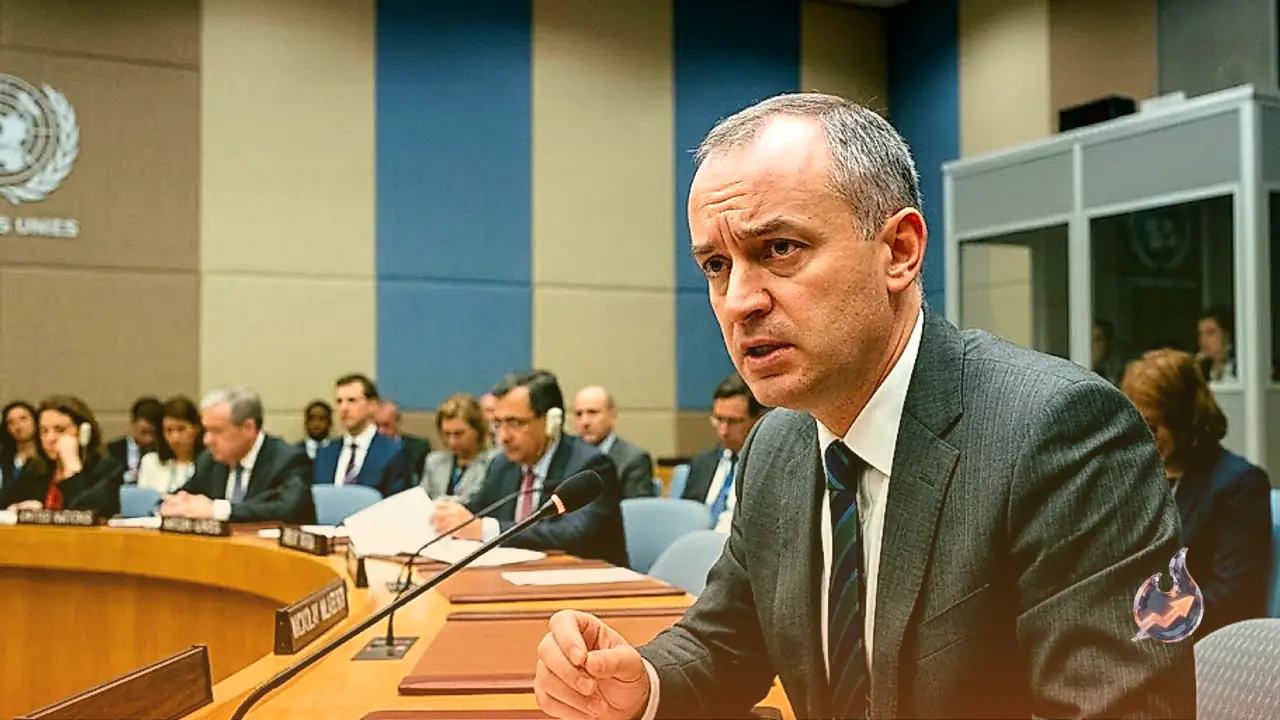

Diplomatic efforts to maintain stability in Gaza reached a critical juncture at the UN Security Council as senior officials issued stern warnings regarding ongoing violations. Nickolay Mladenov, high representative for Gaza on US President Donald Trump's Board of Peace, has publicly criticized both Israel's persistent military air strikes in Gaza and the continued operations of Palestinian armed group Hamas. Speaking before international diplomats, Mladenov warned that any collapse of the ceasefire established last October would mark a point of no return for the entire Middle East. This statement follows Israel's recent rejection of the Board of Peace's 15-point roadmap for the disarmament of Hamas, raising deep concerns over the viability of long-term peace initiatives.
Displaced Population and Rising Casualties Since the Ceasefire
The humanitarian conditions across Gaza remain catastrophic, with United Nations figures indicating that approximately two-thirds of Gaza's two million residents are currently living in tents or makeshift shelters. Despite the official cessation of hostilities agreed upon under US mediation, violence has continued to claim lives. Records provided by the Hamas-run health ministry in Gaza—whose estimates are treated as reliable by the UN—reveal that at least 1,303 Palestinians, including 300 children, have been killed in Israeli military attacks since the ceasefire came into effect. Over the same timeframe, the Israeli military has reported the deaths of four of its soldiers resulting from Palestinian attacks within the territory. These casualties underline the fragility of the current arrangement and the persistent security risks on the ground.
The Disarmament Dispute and the 15-Point Peace Roadmap
The peace framework presented last month by the Board of Peace laid out a phased roadmap designed to reconcile security requirements with territorial withdrawal. Under this plan, Hamas was expected to surrender its arsenal to a neutral Palestinian technocratic committee responsible for governing Gaza under the supervision of the Board of Peace. In exchange, Israel was scheduled to conduct a verified, step-by-step withdrawal of its armed forces. However, Israel rejected the sequence, demanding complete and total disarmament by Hamas before any troop movement takes place. Mladenov disclosed to the Security Council that during his latest meeting with Israeli Prime Minister Benjamin Netanyahu, both parties agreed on a structured mechanism and formed joint committees to resolve Israel's outstanding concerns. He emphasized that the diplomatic pipeline remains active, though unceasing civilian losses in Israeli strikes pose an existential threat to progress.
Contrasting Diplomatic Visions: Mladenov Versus Jared Kushner
Highlighting the reality of the situation in Gaza, Mladenov stated that a ceasefire under which civilians remain buried under rubble is not a state of peace that the population can experience in practice. He pointed out that every non-essential application of military force and every failure to utilize agreed deconfliction channels exacts a high toll on the peace process. Simultaneously, Mladenov held Hamas accountable for its shortcomings, acknowledging that the group has failed to completely halt its military operations. He remarked that every brandished weapon, functional tunnel, and obstructed transport convoy undermines confidence and emboldens advocates of open warfare.
Observers have noted a distinct difference between Mladenov's position and earlier remarks made by President Trump's envoy, Jared Kushner. Following discussions with Prime Minister Netanyahu two weeks prior, Kushner indicated that Israeli troop withdrawals would only be evaluated after the complete demilitarization of Gaza was achieved. This position effectively mirrored Israel's core demand, whereas Mladenov reaffirmed that the Board of Peace roadmap specifies a reciprocal, synchronized timeline where withdrawal directly accompanies verified weapon turn-ins.
Security Council Debates and the Hazard of Total Breakdown
During the Security Council session, representatives of both factions articulated opposing stances. The representative for Israel affirmed her country's commitment to the US-brokered agreement of last October but reiterated that permanent peace is impossible while Hamas maintains weapons, underground tunnels, and military infrastructure. She asserted that complete disarmament must precede any diplomatic concessions. Conversely, the Palestinian representative accused Israeli forces of acting with impunity in killing civilians and demanded immediate international intervention to safeguard the populace.
Mladenov concluded his address with a sobering assessment of the stakes involved. He warned that if the existing ceasefire is allowed to disintegrate entirely, no fallback roadmap will remain, no administrative apparatus will be available for deployment, and no infrastructure will be left to reconstruct. He emphasized that such a breakdown would not be a mere political setback, but rather an irrevocable turning point for all parties involved in the conflict.
Historical Context of the Conflict
The present military confrontation originated with the Hamas-led attacks on southern Israel on 7 October 2023, during which approximately 1,200 people were killed and 251 individuals were captured as hostages. The subsequent Israeli military offensive in Gaza has resulted in extensive destruction and loss of life, with health ministry statistics recording more than 73,430 fatalities since the start of operations. The deadlock at the UN Security Council highlights the extreme difficulty of transitioning from temporary ceasefires to durable governance and peace structures in the region.