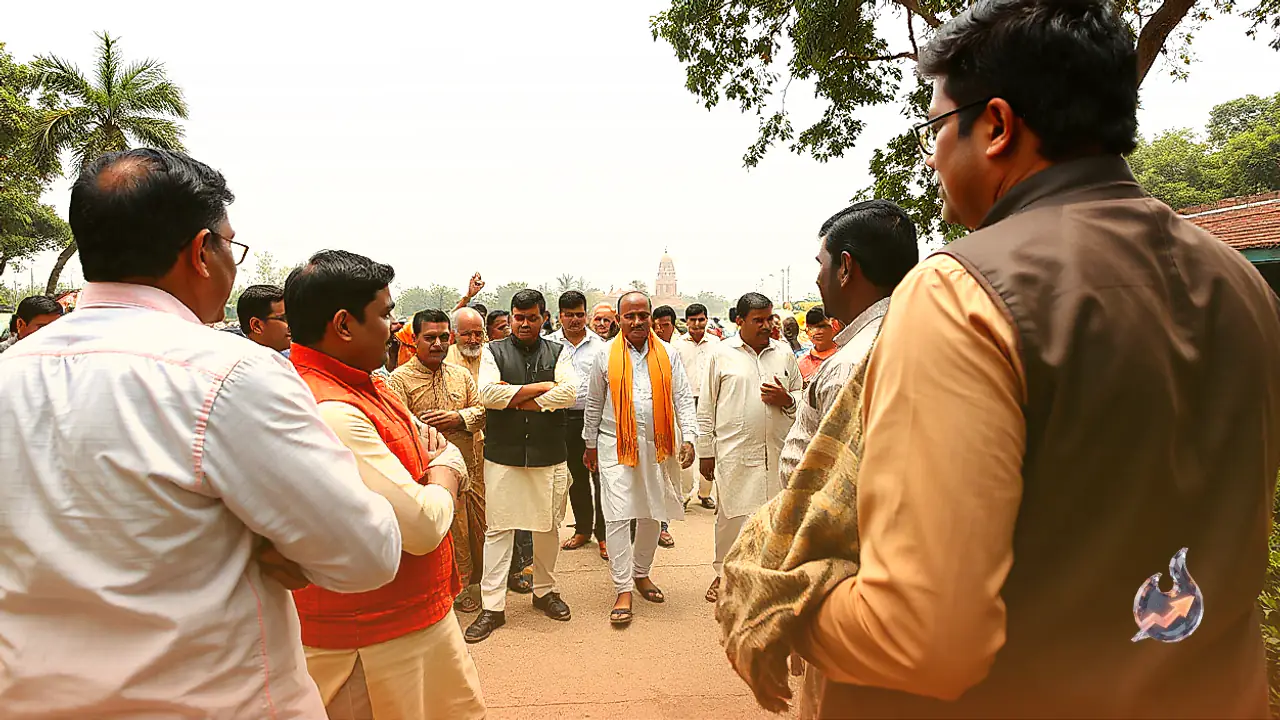



















The political bond shared by Shiv Sena founder Balasaheb Thackeray and Member of Parliament Sanjay Raut remains one of Maharashtra's most discussed relationships. While their later association was marked by immense mutual trust and political alignment, its origins were anything but smooth. During the earliest phase of their acquaintance, Bal Thackeray harbored a strong dislike for Sanjay Raut. Tensions ran so high that the Sena patriarch consistently refused to grant interviews to Raut and would vent his anger whenever the journalist's name surfaced. Yet, an extraordinary chain of events during a face-to-face interaction completely flipped Thackeray's perspective, turning initial resentment into lifelong professional respect.
Raj Thackeray Shares Memories at Book Launch
This behind-the-scenes political episode was recounted by Maharashtra Navnirman Sena chief Raj Thackeray during the launch event of Sanjay Raut's new book titled 'Bodh Kirtan'. Raj Thackeray was present as a central speaker and reflected on the days when Sanjay Raut was just finding his footing in the competitive landscape of Mumbai journalism. He pointed out that the road to mutual understanding between Bal Thackeray and Raut was fraught with confrontation. During one heated encounter, the senior Thackeray directed an intense barrage of verbal reprimands at Raut, language so severe that Raj Thackeray remarked it was impossible to repeat from a public podium.
Crime Reporting at Lokprabha and the Initial Rift
Raj Thackeray explained that Sanjay Raut had crossed paths with his uncle Bal Thackeray long before their own acquaintance blossomed. In those formative years, Raut frequently found himself at the receiving end of Balasaheb's temper. Raut was then working as a staff journalist for the weekly publication 'Lokprabha', where he earned significant acclaim for his relentless coverage of the Mumbai underworld and ongoing gang wars. The reports were so vivid and rooted in street-level realities that Raj Thackeray himself made it a point to follow his articles regularly.
Around the same time, Raj Thackeray was a frequent visitor to the Indian Express office, where he went to deliver his political cartoons. It was within those corridors that he first interacted with Sanjay Raut. In media circles of that era, Raut had built a distinct reputation as a courageous reporter whose prose captured the unfiltered reality of urban crime.
Editorial Criticism Around the Birth of Saamana
Raut's early journalistic track record included another dimension that provoked the ire of the Shiv Sena leadership. Around 1988 and 1989, when the party was in the process of launching its daily mouthpiece 'Saamana', Raut authored multiple articles critical of the Shiv Sena and its political moves. These outspoken commentaries deeply displeased Bal Thackeray. Looking back at that friction with good humor, Raj Thackeray noted at the book launch that the choice terms Balasaheb reserved for Sanjay Raut in those days could never be uttered in public.
The Tense Encounter at Shiv Sena Bhavan
The turning point arrived when Sanjay Raut approached Raj Thackeray, expressing an earnest desire to conduct an extensive interview with Balasaheb for 'Lokprabha'. Though Raj Thackeray admired Raut's craft, he was well aware of his uncle's antipathy toward the journalist. Nevertheless, he decided to pitch the idea directly to Bal Thackeray.
When Raj Thackeray broached the subject and asked whether Balasaheb would agree to be interviewed by Raut, the immediate response was an eruption of sharp reprimands and choice abuses. Raj Thackeray chuckled as he noted that he no longer remembered the precise words used. Undeterred by the outburst, Raj Thackeray reasoned with his uncle, emphasizing that Raut was an exceptionally competent journalist who would produce a compelling piece of work if given an opportunity.
Persuaded by the persistent pleading, Bal Thackeray finally consented to the meeting. A formal session was arranged at Shiv Sena Bhavan, attended by Bal Thackeray, Sanjay Raut, and Raj Thackeray. Once the questioning commenced, Raut held nothing back, posing sharp, provocative, and uncomfortable questions. The line of inquiry agitated Balasaheb, prompting another round of fiery reprimands right in the middle of the recorded conversation.
Publishing the Raw Exchange Without Editing
The most consequential part of the saga unfolded once the interview was set in print. When 'Lokprabha' published the conversation, Sanjay Raut chose not to edit out or soften any of the abrasive language or harsh rebukes Bal Thackeray had directed at him. He printed the transcript exactly as the spoken encounter had occurred, preserving every raw detail.
According to Raj Thackeray, while Balasaheb never formally issued an explicit compliment, the unedited piece generated immense personal respect in his mind for Sanjay Raut. He realized that this was a professional with true backbone. Raj Thackeray observed that an individual who possesses the courage to publish scathing personal attacks and abuses directed at himself, without reaching for a red pen, exhibits an extraordinary level of integrity and fearlessness.
The takeaway for Balasaheb was unambiguous: Sanjay Raut was someone who refused to conceal hostility or protect his own ego when presenting the facts. That unflinching honesty resonated with the Shiv Sena supremo.
Appointment to the Helm of Saamana
Not long after this episode, discussions commenced within the party regarding the editorial stewardship of 'Saamana'. One day, Balasaheb summoned Sanjay Raut for a private conversation. Following their discussion, Raut was officially designated as the editor of the party's flagship publication.
Thus, the very reporter whom Bal Thackeray once vehemently refused to meet, and against whom he had directed intense verbal fury, went on to become one of his closest ideological confidants and the editorial voice of his mouthpiece. The narrative shared during the release of 'Bodh Kirtan' underscores more than a routine political recollection; it serves as a testament to how uncompromising transparency and professional spine can fundamentally alter the perceptions of even the most formidable leaders.