




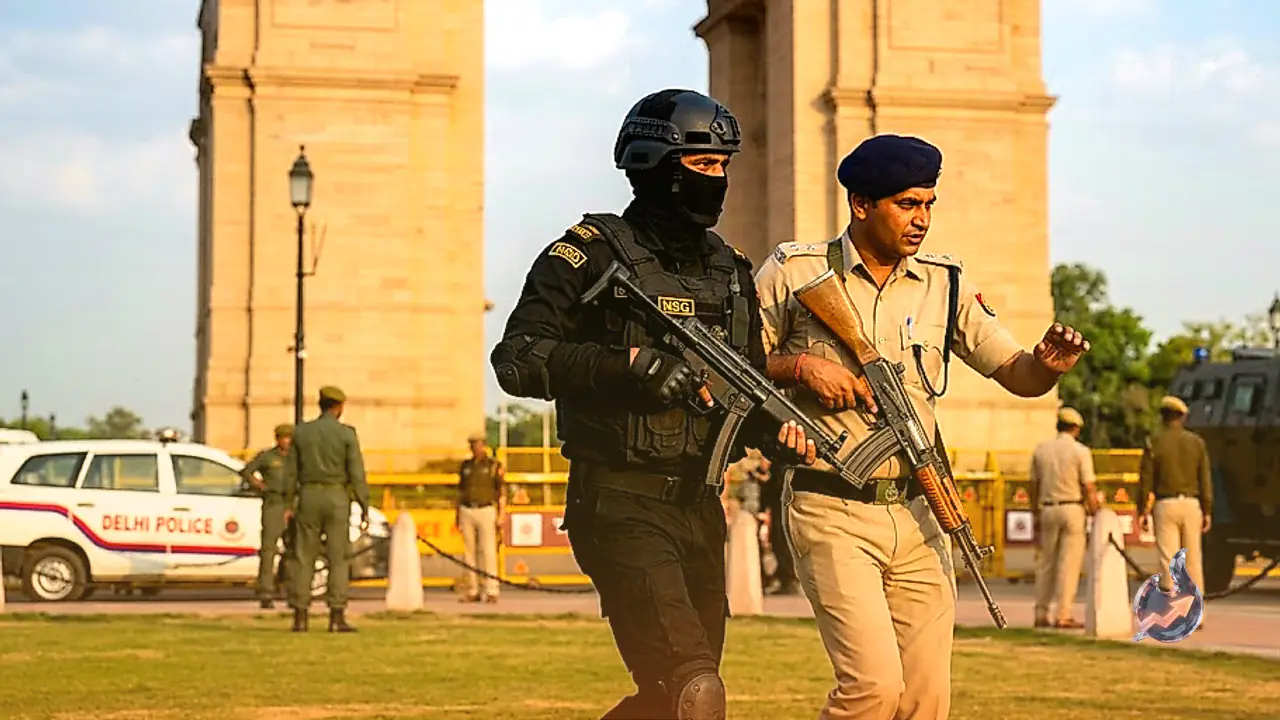
















Security agencies in New Delhi have stepped up operational readiness ahead of the upcoming Independence Day celebrations on August 15. In light of heightened threat perceptions and intelligence inputs surrounding the national festival and the flagship event at the historic Red Fort, Delhi Police along with central security organisations carried out a comprehensive counter-terrorism simulation exercise. Titled 'Sudarshan Shakti-V', the mega exercise created simultaneous terror attack scenarios across high-footfall and sensitive zones in the capital to test inter-agency coordination, tactical response times, and communication networks.
Exercise Duration, Governance, and Coordination Framework
The extensive exercise kicked off at around 10:00 AM on August 7 and continued uninterrupted until nearly 4:00 AM on August 8, spanning roughly 17 hours. Conducted under directives from the Ministry of Home Affairs (MHA), the multi-agency operation was jointly coordinated by the National Security Guard (NSG) and the Special Cell of Delhi Police. The primary objective was to evaluate how swiftly and cohesively various security, administrative, and emergency services act when confronted with a synchronized multi-target terror assault in the capital city.
Simulated Threat Scenarios: Explosions, Hostage Crises, and CBRNE Incidents
Sudarshan Shakti-V created realistic and challenging crisis simulations across multiple sectors. These included mock improvised explosive device (IED) blasts, active shooter incidents, and complex hostage situations inside crowded facilities. Furthermore, the participating units were tested against high-risk scenarios such as aircraft hijackings and Chemical, Biological, Radiological, Nuclear, and Explosive (CBRNE) threats. The exercise examined how rapidly information flows from first responders to specialized tactical teams and central control hubs during large-scale emergencies.
Key Locations and Public Infrastructure Covered
To ensure practical readiness across diverse urban environments, several high-density transit nodes, commercial hubs, government buildings, healthcare facilities, and religious institutions were integrated into the exercise. Key locations included Kashmiri Gate ISBT, Connaught Place, Nehru Place Market, Safdarjung Hospital, the Delhi Secretariat, and Jawaharlal Nehru Stadium. Additionally, drills were executed at IGI Airport, V3S Mall, Red Fort Metro Station, Sanskriti School, ISKCON Temple, and Kalkaji Temple to evaluate security protocols at places with large public gatherings.
Joint Mobilisation of Specialized Units and Tactical Squads
A wide spectrum of law enforcement, military, disaster response, and essential utility services participated in the exercise. Delhi Police deployed its Special Cell SWAT unit, local district police forces, Bomb Disposal Squads, Traffic Police, Crime Branch personnel, Airport Police, Metro Police, and Police Control Room (PCR) vehicles. Central and emergency partners included the NSG commandos, Indian Army units, National Disaster Response Force (NDRF), Central Industrial Security Force (CISF), Bureau of Civil Aviation Security (BCAS), Airports Authority of India (AAI), Delhi Metro Rail Corporation (DMRC), Delhi Fire Service, Forensic Science Laboratory (FSL), Central Ambulance Trauma Services (CATS), and the local health department.
Evolution from 'Operation All Out' to 'Sudarshan Shakti-V'
This annual counter-terrorism drill has reached its fifth iteration. Formerly conducted under the moniker 'Operation All Out', the exercise has evolved into the more structured 'Sudarshan Shakti' series. The fifth edition focused not only on neutralizing active threats and suspect apprehension but also on verifying bomb disposal procedures, casualty evacuation protocols, fire suppression, aviation security enforcement, and civil administration coordination under intense stress conditions.
Independence Day Imperatives and Comprehensive Security Grid
With the Prime Minister set to address the nation from the Red Fort on August 15, security protocols across New Delhi remain exceptionally stringent. Executing a exercise of this scale days before the main event enables security commanders to identify communication bottlenecks, streamline command structures, and validate response timelines. The exercise reassures citizens that safety forces remain fully prepared across all domains to counter any potential security threat effectively.