

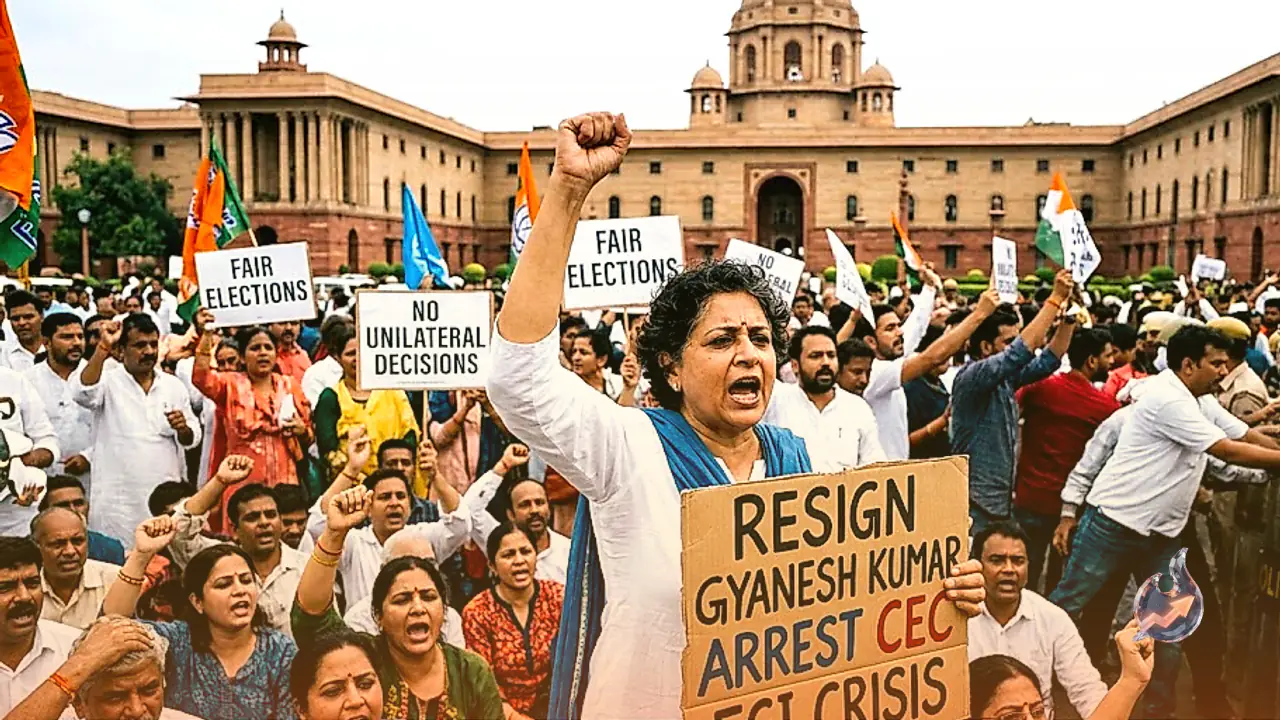


















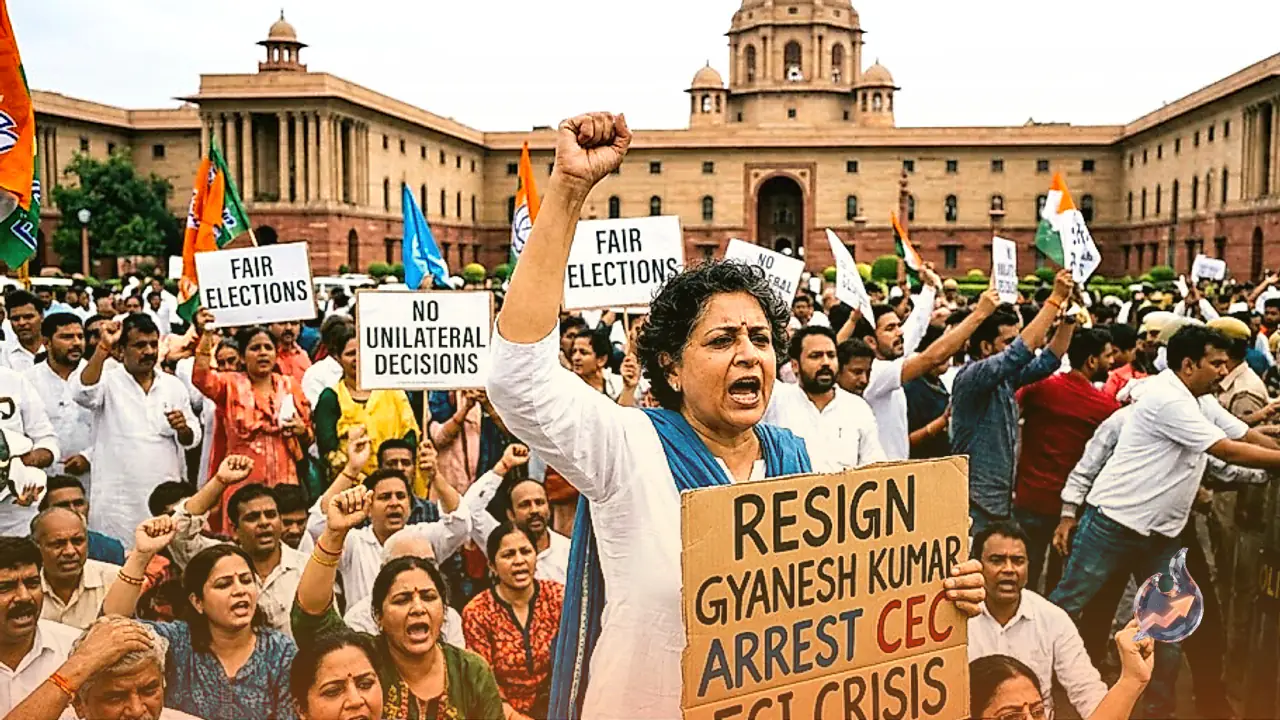

A massive political tempest has engulfed the Indian electoral landscape as several major opposition groups have launched coordinated nationwide protests, raising serious questions about the credibility of the Election Commission of India (ECI). The spark for this intense agitation is the growing controversy surrounding reported internal rifts within the three-member poll panel, specifically concerning the Special Intensive Revision (SIR) of electoral rolls. Demands for the immediate resignation and criminal prosecution of Chief Election Commissioner (CEC) Gyanesh Kumar have intensified, leading to volatile demonstrations, mass detentions, and a major political-legal battle stretching from the streets of New Delhi to the courtrooms of the Supreme Court.
High-Voltage Clashes and Detentions at Jantar Mantar
The national capital became the focal point of the agitation on Friday as hundreds of protesters gathered at the historic Jantar Mantar to voice their outrage. Organised by the All India Students’ Association (AISA) and various civil society members, the demonstrators raised slogans demanding the immediate arrest of CEC Gyanesh Kumar, alleging that he had compromised the integrity of the country’s democratic processes. In response, Delhi Police deployed a massive force, cordoning off the area and putting up multiple layers of barricades.
Among those detained by the authorities were Delhi Congress President Devender Yadav and AISA activist Nehra Bora. New Delhi DCP Sachin Sharma stated that approximately 40 to 50 protesters were taken into custody because no formal permission had been requested or granted for the demonstration at the venue. The detained activists were later released. A senior police official present at the scene dismissed allegations that security personnel were not wearing name tags, asserting that all deployed personnel were in full uniform with identification visible. The officer also denied allegations of physical manhandling, stating that police used only the minimum necessary force required to prevent the protesters from advancing towards the secure zone.
The police action also saw the detention of several high-profile leaders, including Communist Party of India (Marxist-Leninist) Liberation General Secretary Dipankar Bhattacharya and prominent activist-politician Yogendra Yadav. Despite the heavy police presence and the subsequent detentions, the CPI(ML) Liberation maintained that the resistance would continue. Sharing a video of leaders being loaded into police vans, the party declared that the struggle to protect democratic values would not be subdued by force.
Youth Congress Stages Chained March; Activists Demands Prosecution
In another symbolic protest in Delhi, members of the Indian Youth Congress (IYC), led by national president Uday Bhanu Chib, marched towards the Election Commission headquarters. The demonstrators wore realistic masks of CEC Gyanesh Kumar's face while their hands were symbolically bound in heavy chains. This creative demonstration was intended to portray the alleged capture of the poll panel by partisan interests. Police and paramilitary forces set up barricades and kept detention buses ready on Raisina Road to halt their progress.
Simultaneously, prominent activist and lawyer Prashant Bhushan condemned the police action on social media. Writing on X, Bhushan stated that the disruption of peaceful protests at Jantar Mantar revealed the government’s rising desperation. He warned that such suppression would only trigger thousands of protests across the nation, adding that Kumar must be prosecuted for what he described as enormous crimes against the electorate.
Volatile Demonstrations Across Bihar and Himachal Pradesh
The protests quickly spread to other parts of the country, with regional chapters of the Congress party leading aggressive rallies. In Patna, Bihar, the state unit of the Congress organised a massive march towards the office of the Chief Electoral Officer (CEO). When the rally attempted to breach the security perimeter, Bihar police resorted to using water cannons to disperse the crowd. Protesters, carrying banners and shouting anti-government slogans, accused the NDA administration and the CEC of systematically undermining the voting rights of citizens.
In Himachal Pradesh, a similarly intense confrontation unfolded in Shimla. State Congress workers gathered outside the local Election Commission office, where they burned an effigy of Gyanesh Kumar. In an act of defiance, the protesters blackened the Commission's official board and wrote "Chor Aayog" (Thief Commission) across it. A physical scuffle broke out between the party workers and the police as the forces tried to extinguish the burning effigy. Addressing the crowd, Deputy Chief Minister Mukesh Agnihotri claimed that recent media reports made it undeniably clear that the BJP was winning elections through organized "vote theft." He alleged that the ECI and CEC Gyanesh Kumar were the primary culprits, leaving millions of eligible voters unable to cast their ballots, which in turn allowed the ruling party to secure inflated victories.
Southern and Eastern States Rise in Rebellion
The wave of anger reached Bhubaneswar, Odisha, where local Congress leaders, led by State President Bhakta Charan Das, attempted to gherao the CEO’s office. The march, which started at the Additional District Magistrate's office, was halted by a heavy police deployment, leading to clashes and the detention of several workers. Das told reporters that the CEC had committed an unpardonable crime by facilitating voter exclusion and demanded his immediate removal. Congress Legislature Party leader Rama Chandra Kadam argued that the internal objections raised by other commissioners proved the validity of Rahul Gandhi’s previous warnings about systematic electoral manipulation.
In Shillong, Meghalaya, State Congress President Vincent H. Pala led a processing from Congress Bhavan to the Additional Secretariat, where workers set ablaze an effigy of Kumar. Pala accused the CEC of completely ignoring 14 written objections raised over a 10-month period by the other two Election Commissioners, alleging that Kumar had bulldozed decisions with the direct backing of the BJP. He also argued that the central government had amended the appointment laws specifically to facilitate this level of control and demanded a formal commission of inquiry.
In West Bengal, the state Congress unit, led by President Subhankar Sarkar, took out a rally from Calcutta University towards the CEO’s office on Strand Road. Police stopped the march at the B B Ganguly Street crossing, where protesters burnt Kumar’s effigy. Meanwhile, in Jammu, a march led by AICC General Secretary Dr Syed Naseer Hussain resulted in scuffles with security forces and the detention of several senior leaders, including former ministers and legislators.
In Guwahati, Assam, APCC President Gaurav Gogoi was forcefully detained along with other state leaders, including Manoj Chauhan, Deep Bayan, and Udit Bhanu Das, while attempting to cross police barricades near the CEO’s office. Congress spokespeople condemned the arrests, describing them as yet another direct threat to democratic expression.
Legal Battle Reaches the Supreme Court and Bombay High Court
The controversy has also taken a serious legal turn. A petition has been filed in the Supreme Court by advocate Shailendra Mani Tripathi, seeking to subject CEC Gyanesh Kumar to regular police investigation, evidence collection, and trial. The plea argues that the CEC does not possess personal immunity from criminal prosecution and accuses him of making unilateral, unauthorized decisions, including altering Form 6 without proper legislative authority. The petition specifically highlights West Bengal, where over 16.10 lakh appeals were reportedly filed to purge restored voters from the rolls.
Separately, a petition was submitted to the Bombay High Court demanding an immediate stay on the ongoing Special Intensive Revision (SIR) in Maharashtra, the restoration of deleted voter names, and absolute transparency in the roll revision processes.
National Leadership Demands Action; ECI Responds
From Wayanad, Congress leader Priyanka Gandhi Vadra dismissed the BJP’s defense as a "stale and weak story," stating that her brother, Rahul Gandhi, had already presented clear evidence of systematic voter deletions during various press conferences. She claimed that around 13 crore voter names had been deleted nationwide, warning that if the ruling party was indeed influencing the commission, it would amount to an act of treason. Congress General Secretary K.C. Venugopal accused Gyanesh Kumar of being in a criminal conspiracy with Prime Minister Narendra Modi and Home Minister Amit Shah to sabotage the country's democratic principles.
Former Kerala Chief Minister and Opposition Leader Pinarayi Vijayan also called for the immediate removal of Kumar and a halt to the SIR, stating on X that the right to vote belongs to the citizens and cannot be manipulated to serve the political interests of the BJP and Sangh Parivar. In Uttar Pradesh, Samajwadi Party Chief Akhilesh Yadav demanded the CEC's resignation from Rae Bareli, stating that those who caused such deep divisions within the commission should step down voluntarily, accusing them of snatching away the fairness of the election.
Biju Janata Dal (BJD) President Naveen Patnaik expressed similar sentiments in Odisha, urging Kumar to step down immediately. Patnaik stated that the BJD had opposed the SIR from its inception, alleging that over 25 lakh eligible voters in Odisha had been deleted during the exercise. Maharashtra Navnirman Sena (MNS) Chief Raj Thackeray also called for scrapping the SIR and demanding a return to paper ballots to restore public trust.
The Congress also took a historical swipe at Prime Minister Narendra Modi, recalling how Rajiv Gandhi in 1988 reduced the voting age from 21 to 18 to empower Gen Z, whereas the current administration is allegedly determined to snatch that vote away through underhanded means.
In its defense, the Election Commission of India released a statement asserting that highlighting specific internal notes presents only one side of the picture. The commission maintained that differences of opinion are normal in any democratic institution and affirmed that all final decisions, including those regarding the SIR, were taken unanimously and in complete compliance with the law.
However, former Election Commissioners have urged the ECI to disclose the exact details of its decision-making processes, emphasizing that transparency and majority backing are crucial to preserving the institution's credibility amid the ongoing crisis.
Adding a different angle to the debate, Abhijeet Dipke, founder of the Cockroach Janta Party (CJP), urged opposition parties to completely boycott what he termed "rigged" elections, arguing that participation only legitimizes the process. This was met with a strong counter by TMC's Derek O’Brien, who argued on X that boycotting would hand a walkover to the BJP, allowing them to legally amend the Constitution, and would also betray the lakhs of grassroots workers fighting on the ground.