



















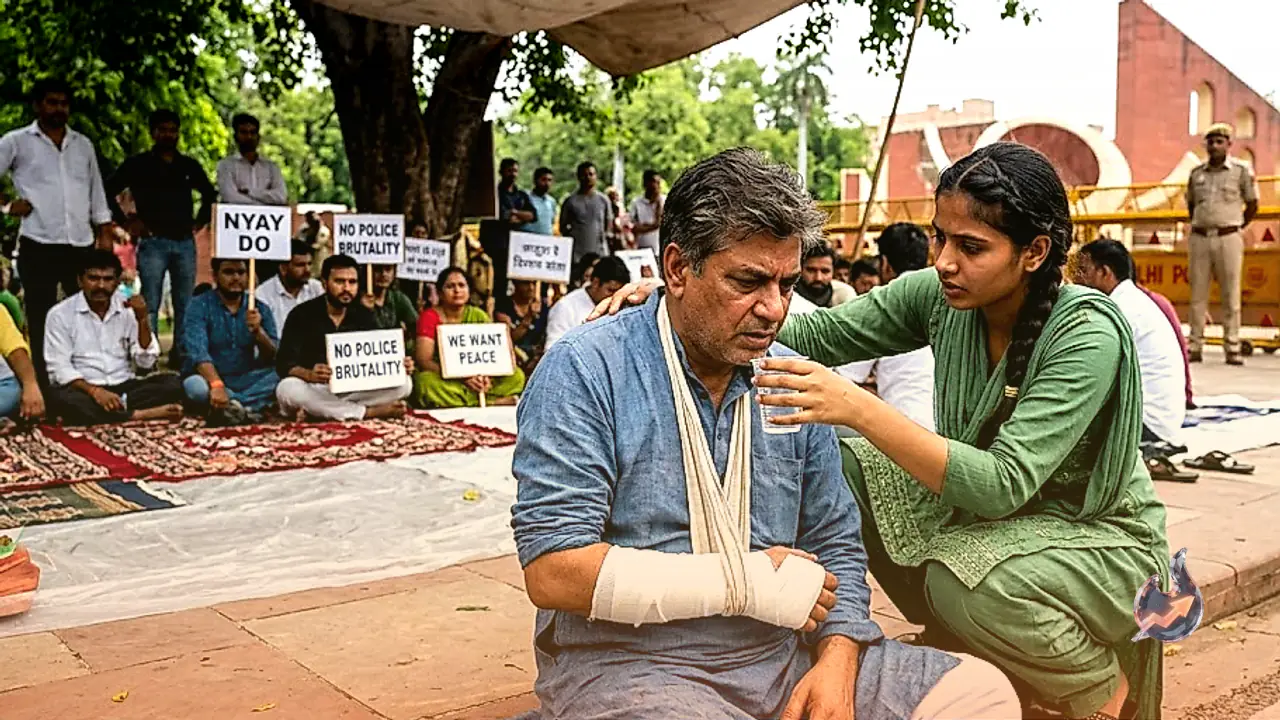

Addressing the controversial police crackdown on demonstrators at Jantar Mantar, the Supreme Court of India delivered a stern message on Monday, declaring that the mere existence of an agitation cannot serve as justification for police high-handedness. A three-judge bench headed by Chief Justice of India Surya Kant emphasized that peaceful and lawful protest is a fundamental right guaranteed by the Constitution, cautioning authorities against arbitrary force while handling public demonstrations.
Call for a Uniform National Protocol
During the proceedings, the apex court highlighted that the management of public agitations is not an issue confined to Delhi alone, but a matter of national significance. Chief Justice Surya Kant remarked that the country requires a Uniform National Protocol to establish clear, standard operating procedures for police forces dealing with public protests across all states. The court noted that while discipline remains essential in a functioning democracy, an ongoing protest does not grant law enforcement a blank check to deploy lathicharge or brutal measures against citizens expressing their grievances.
At the same time, the bench underscored that maintaining public order requires a balanced perspective. The court explicitly noted that the life and physical safety of every individual, including police officers deployed on duty, carry equal weight and must be protected under the law.
Independent Probe into Allegations of Police Excess
The bench, which also comprised Justice Joymalya Bagchi and Justice V. Mohana, made it clear that any instance involving excessive use of force by police officers must be subjected to an independent and thorough investigation. Addressing concerns from all perspectives, the Supreme Court agreed to hear a separate petition filed by family members of police personnel who sustained injuries from alleged attacks during the demonstration. This plea will be clubbed with the broader set of pending petitions related to the Jantar Mantar incidents.
Background and Timeline of the 36-Day Agitation
The legal scrutiny follows a high-profile, 36-day protest that began at Jantar Mantar on June 20 under the leadership of the Cockroach Janta Party (CJP). The student-led movement initially erupted over widespread public outrage concerning the NEET examination question paper leak, demanding systemic reforms in national competitive exams and calling for the immediate resignation of Union Education Minister Dharmendra Pradhan.
The scale of the agitation expanded significantly on June 28, when prominent social activist Sonam Wangchuk joined the students in solidarity and initiated an indefinite hunger strike at Jantar Mantar alongside six activists from the All India Students' Association (AISA). This move transformed the regional student demonstration into a major national topic.
Tensions escalated further on July 18, when Delhi Police forcibly removed Sonam Wangchuk from the protest site and transferred him to Safdarjung Hospital, triggering widespread anger among student groups and youth organizations nationwide. The confrontation reached a critical juncture on July 20, when protesting students attempted to march towards Parliament, leading to heavy police intervention and allegations of severe physical force.
The long-standing standoff finally concluded on July 25, after the central government agreed to key demands and Dharmendra Pradhan submitted his resignation from the post of Education Minister.
Court Schedules Further Hearings
Ordering all related and pending petitions on the matter to be tagged together for joint consideration, the Supreme Court announced that the next immediate hearing will take place on Tuesday. Additionally, the court scheduled a detailed hearing on July 28 to comprehensively review the legal guidelines and reports surrounding the events.