























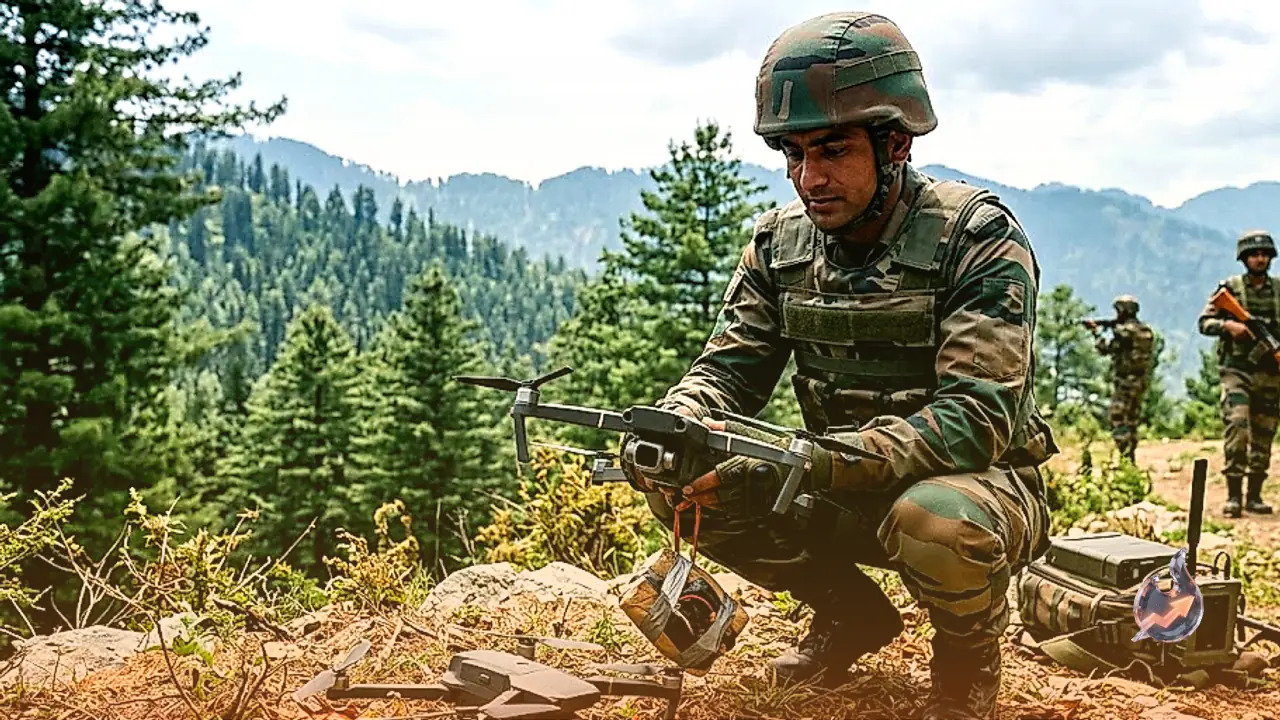

A fortified multi-tier counter-infiltration grid along the Line of Control has largely shut down traditional overland infiltration routes into Jammu and Kashmir. Confronted by dense wire obstacles, integrated ground sensors, and round-the-clock patrolling by frontline troops, cross-border handlers and military units have shifted their operational focus toward unmanned aerial systems. Rather than risking armed cadres on fortified mountain passes, high-tech drones are being utilized to ferry assault weapons, magnetic sticky bombs, and financial resources straight into the dense forest tracts of Baramulla. By establishing an aerial supply corridor, handlers attempt to sustain armed networks operating in the hinterland without incurring direct manpower losses. In response, a unified defensive perimeter mounted by the Indian Army, Border Security Force, and the Special Operations Group is actively dismantling these remote operations.
Deployment of High-Altitude Turkish Reconnaissance Drones
The cross-border inventory deployed near the border has evolved far beyond basic consumer quadcopters or modified commercial devices. Military units across the frontier are now stationing sophisticated, medium-altitude long-endurance platforms, including Turkish-built Bayraktar TB2 craft, along positions proximate to the Line of Control. These specialized aviation assets are tasked with orchestrating a three-fold operational reconnaissance mechanism designed to facilitate cross-border smuggling.
First, operating at high cruising altitudes well outside the immediate engagement zone of small arms, these platforms persistently monitor troop dispositions, perimeter movements, and routine logistical convoys of Indian forward formations. Second, the reconnaissance feeds are systematically analyzed to pinpoint momentary blind spots and elevation gaps within Indian radar coverage networks, identifying low-altitude terrain corridors where smaller multirotor craft can transit undetected. Third, these surveillance platforms relay live updates and real-time positional data directly to launch pads and operational controllers, allowing them to time illegal drops down to the minute.
Low-Altitude Multirotor Incursions Target Baramulla Woodlands
While larger long-endurance platforms maintain high-altitude reconnaissance, tactical execution relies on agile, low-flying multirotor craft designed to skim close to tree canopies and ridgelines. These unmanned devices cross forward boundaries under cover of darkness, pushing deeper into the wooded hinterland to deposit hazardous payloads away from frontline border observation posts. The forested region of Gogal Dara in Baramulla has been established as a primary dropping hub, chosen specifically because its dense overhead foliage and rugged contours offer concealment for ground operatives tasked with retrieving the packages.
The dropped payloads are calibrated specifically for rapid distribution among underground urban and rural cells. Recoveries indicate that these bundles contain compact automatic assault rifles, which can easily be disassembled or hidden beneath everyday attire for transport. In addition to small arms, the payloads frequently include magnetic sticky bombs engineered to attach instantly to the metallic undercarriages or doors of civilian and security vehicles, causing lethal damage with remote or timed detonators. Handlers also include specialized triangular-shaped Chinese grenades, as well as sizable packages of Indian currency intended to finance logistics, establish safe houses, and compensate couriers. This technical workflow eliminates the physical hazards of traversing fortified minefields and fences, ensuring that local operatives receive materiel while handlers remain insulated across the frontier.
Interdictions and Cache Seizures Across Jammu Border Sectors
To eliminate this low-altitude supply pipeline, Indian security formations have instituted an integrated anti-drone defensive umbrella combining visual spotters, kinetic interceptors, and electronic countermeasures. Coordinated sweeps across international border tracts have resulted in numerous unmanned platform downings and the recovery of critical arms consignments.
Near Palura village in the Ghagwal sector, a joint tactical initiative conducted by the Border Security Force and the Special Operations Group successfully intercepted an incoming drone arriving from across the border. Attached beneath its fuselage with heavy industrial yellow tape was a dense package that yielded pistols, high-capacity magazines, live ammunition rounds, and multiple fragmentation hand grenades. Further along the Akhnoor international border, vigilant troops detected and engaged a heavy hexacopter operating in poor visibility, bringing it down before it could complete its drop. Inspection of the six-rotor craft uncovered assault rifles, specialized M4 carbine magazines, and magnetic vehicle-mounted sticky bombs. A similar interdiction unfolded in the Kathua sector, where Border Security Force personnel engaged an incoming heavy-payload drone with concentrated ground fire, recovering dropped packets laden with Chinese pistols and military-grade explosive compounds.
Electronic Countermeasures Neutralize Aerial Corridors from Poonch to Samba
The aerial infiltration offensive extends across varied topographies, encompassing the rugged ridges of Poonch down to the riverine stretches of RS Pura and Samba. Despite the challenging geography, modern electronic countermeasures have consistently disrupted hostile flight profiles and recovery efforts.
Throughout the mountain corridors of Poonch, security forces executing cordons and targeted search operations uncovered multiple dropped packages hidden in dense undergrowth. These caches contained short-barrel firearms alongside Indian currency packets earmarked to sustain local logistics. Meanwhile, in the RS Pura sector, operational units deployed static and mobile counter-drone jamming installations with decisive effect. By systematically severing the radio control links and navigation telemetry of hostile multirotor aircraft, troops forced several drones into unguided descents or immediate ground crashes, subsequently securing AK-47 ammunition clips and sophisticated components designed for remote improvised explosive devices. In the Samba sector, ground forces shot down another unmanned craft carrying magnetic improvised explosive devices, which post-recovery forensic analysis revealed were intended to execute vehicular attacks inside crowded urban commercial districts.
Integrated Tri-Layer Defense and Technical Radar Upgrades
Neutralizing cross-border unmanned incursions has demanded a substantial overhaul of traditional border security doctrines. Rather than relying solely on manual observations, security agencies have established a unified tri-layer defense architecture across vulnerable border belts.
The primary tactical defense layer incorporates tactical anti-drone guns and specialized radio-frequency jammers that disrupt the command link between the drone and its remote pilot within seconds, triggering immediate fail-safe landings or navigational drift. The second layer deploys high-definition thermal imaging cameras, long-range optoelectronic sensors, and specialized night-vision equipment calibrated to track low-radar-cross-section platforms flying beneath standard air defense envelopes. Finally, these technological assets are supplemented by robust community engagement programs across border hamlets and rural villages. Local residents are trained to recognize the distinct acoustic signatures and navigational lights of intruding drones, feeding immediate warnings into security operations rooms to ensure that any dropped material is intercepted well before underground networks can complete a recovery.