



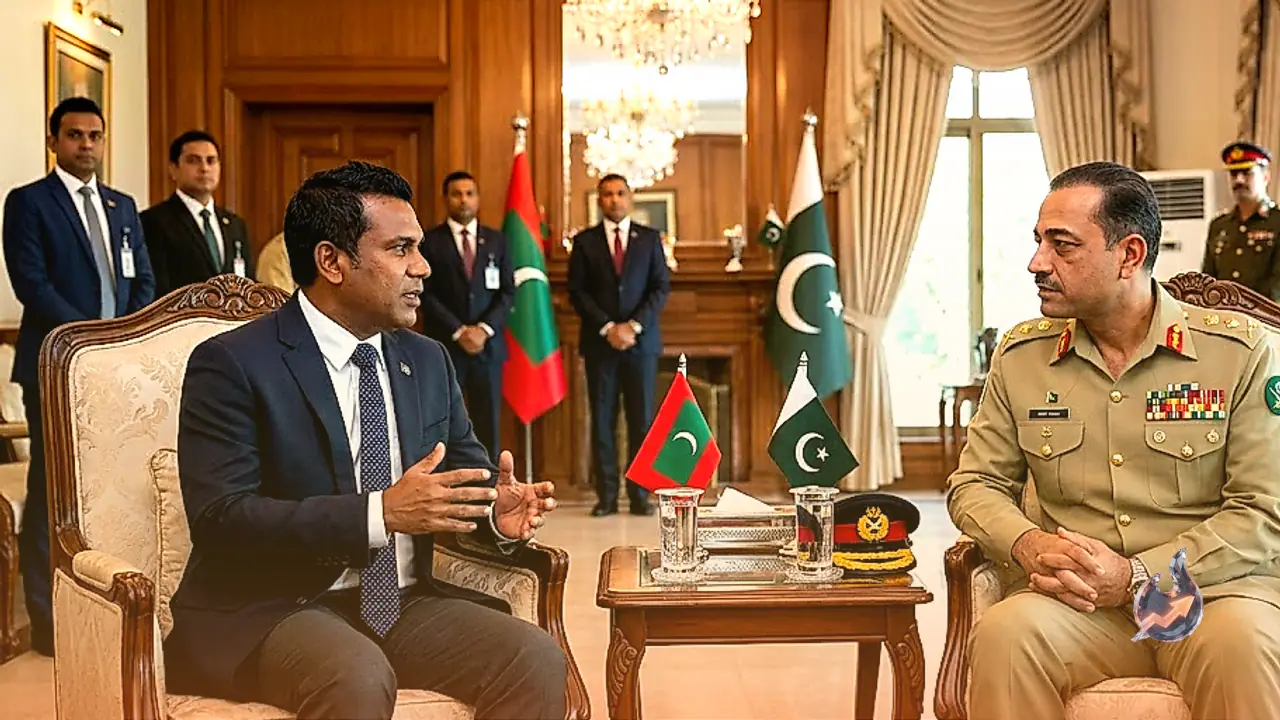



















In diplomatic circles, even a brief encounter can sometimes carry massive strategic weight. A meeting of this nature took place on September 24, 2026, when Maldives People's Majlis Speaker Abdul Raheem Abdulla traveled to Rawalpindi to meet Pakistan Field Marshal Asim Munir. During the high-level discussions, both sides focused extensively on regional security and bilateral cooperation. The Maldivian Speaker praised Pakistan for its role in maintaining regional peace, while Munir emphasized the need to advance bilateral relations to even stronger levels.
Why This Meeting Matters Strategically
While the meeting itself does not instantly amount to a formal military alliance, it cannot be ignored within the broader strategic landscape of the Indian Ocean. The primary reason lies in the geographical location of the Maldives. Situated close to vital maritime trade routes in the Indian Ocean, the Maldives holds immense importance for India's maritime security interests. If Pakistan manages to expand its defense and security cooperation with the Maldives, New Delhi will naturally have to keep a close watch on these shifting geopolitical equations.
Pakistan's Ambitions in the Indian Ocean
Pakistan has long sought to expand its maritime footprint and operational role within the Indian Ocean. Enhanced security cooperation with the Maldives could provide Islamabad with an opportunity to strengthen its diplomatic and strategic reach in the region. However, available information does not indicate any announcement of a pact that would grant Pakistan a military base or permanent military presence in the Maldives. Nevertheless, given the existing footprint of Chinese influence in the Maldives, it is evident that finding a strategic foothold there would not be overly difficult for Pakistan.
Growing Concerns for India
The foremost question for India is the ultimate trajectory of Maldivian foreign and security policy. Because the Maldives is situated extremely close to India and holds paramount importance from a national security standpoint, any future expansion of comprehensive defense cooperation, military training, maritime security, or strategic infrastructure could complicate India's security matrix in the Indian Ocean. Furthermore, bilateral ties between India and the Maldives experienced some strain over the past two to three years, making Male's growing proximity to Islamabad a matter of diplomatic and strategic concern.
India's Economic and Humanitarian Footprint
India's ties with the Maldives extend well beyond strategy into deep economic and humanitarian realms. India remains one of the primary tourist markets for the Maldivian economy. Prior to 2024, Indian travelers made a massive contribution to the tourism industry and overall economy of the Maldives. Although visitor numbers dipped following bilateral tensions over the past two years, statistics show that 1,31,625 Indian tourists visited the Maldives in 2025, while the figure surpassed 74,000 by July 2026. Beyond tourism, India has played a critical role in supporting the Maldives through infrastructure development, healthcare, and financial assistance. In 2025, India announced a new line of credit worth 4,850 crore rupees alongside measures to ease debt repayment for the Maldives.