















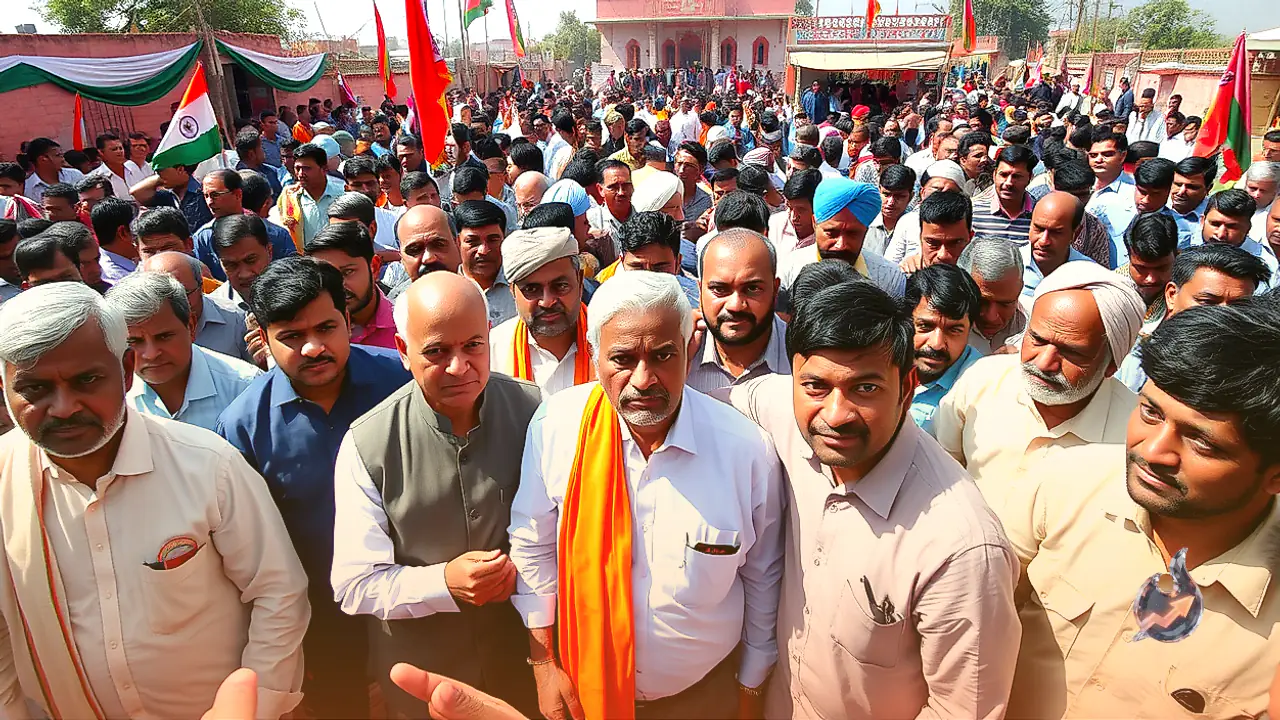

The political trajectory of Uttar Pradesh underwent a transformative shift during the 1991 parliamentary by-election in Etawah. When Bahujan Samaj Party founder Kanshi Ram resolved to translate grassroots social activism into electoral power, he turned Uttar Pradesh into his primary political laboratory. Born on March 15, 1934, in Punjab's Ropar district, Kanshi Ram had dedicated decades to mobilizing marginalized communities before testing his appeal directly at the ballot box. Etawah, traditionally viewed as an impregnable fortress of socialist organizing, became the unlikely battleground that opened the doors of the Lok Sabha to the Dalit icon for the very first time.
Triumph Across a Field of 48 Candidates in a Socialist Bastion
The 1991 Etawah by-election featured a crowded ballot with a total of 48 contenders vying for the seat. Contesting on the Bahujan Samaj Party ticket, Kanshi Ram launched an extensive grassroots outreach across the constituency. When the votes were counted, Kanshi Ram emerged victorious after securing 1,44,290 votes. His closest challenger, Bharatiya Janata Party nominee Lal Singh Verma, finished roughly 22,000 votes behind. This decisive electoral outcome marked Kanshi Ram's official entry into the national parliament and confirmed that the Bahujan movement had arrived as an undeniable political force in northern India.
Room Number 6 at Anupam Hotel and Mulayam Singh Yadav's Hospitality
Throughout his month-long campaign in Etawah, Kanshi Ram chose to reside at the local Anupam Hotel, occupying room number 6. The town was the political heartland of Mulayam Singh Yadav, who was consolidating his own base among backward classes and minorities. Mulayam Singh Yadav kept close track of his guest's stay, placing regular phone calls to the hotel reception to inquire after Kanshi Ram's well-being. Furthermore, he issued explicit instructions to the hotel management stating that Kanshi Ram was an honored guest and must not face the slightest inconvenience, signaling an early mutual respect between the two leaders.
The Social Calculus and Shifting Electoral Alliances
Kanshi Ram's victory went far beyond an ordinary parliamentary win, reflecting deep structural shifts in the political landscape of Uttar Pradesh. Mulayam Singh Yadav had built a formidable regional presence through the coalition of Yadav and Muslim communities. In that by-election, Ram Singh Shakya, a close associate of Mulayam Singh Yadav, ran as the Janata Party candidate and garnered 82,624 votes. The distribution of votes across key contestants created favorable electoral math for Kanshi Ram, enabling him to defeat the Bharatiya Janata Party candidate. This election set in motion an unprecedented convergence between Dalit mobilization and socialist backward-caste politics.
The 1993 Alliance and the Slogan That Shook State Politics
Following the 1991 triumph, tactical understanding between Kanshi Ram and Mulayam Singh Yadav deepened into an active political alignment. While both leaders represented distinct social bases, they recognized a shared imperative to counter the dominance of the Congress and the rising momentum of the Bharatiya Janata Party during the Ram temple movement. Kanshi Ram aimed to turn Dalits into decisive political masters, while Mulayam Singh Yadav commanded deep support among Other Backward Classes and minority voters. This ideological handshake birthed the famous political slogan, 'Miley Mulayam-Kanshi Ram, Hawa Mein Ud Gaye Jai Shri Ram,' establishing a formidable social coalition across the state.
From the 1993 Government to the 1995 State Guest House Rupture
The coalition achieved historic success in the 1993 Uttar Pradesh assembly elections, joining hands to form the state government. Under this power-sharing arrangement, Mulayam Singh Yadav took oath as Chief Minister with outside backing from the Bahujan Samaj Party. However, the partnership proved short-lived and fragile. On June 2, 1995, the infamous Lucknow state guest house incident involving Mayawati permanently fractured relations between the two political camps. The Bahujan Samaj Party promptly withdrew its legislative support, bringing down the government. Mayawati then became Chief Minister of Uttar Pradesh for the first time with external backing from the Bharatiya Janata Party, turning former partners into bitter rivals for decades to follow.
The 2019 Akhilesh-Mayawati Experiment and Its Eventual Collapse
Nearly twenty-five years later, the two parties attempted to resurrect the historic alliance ahead of the 2019 Lok Sabha elections. Samajwadi Party chief Akhilesh Yadav and Bahujan Samaj Party supremo Mayawati formed an electoral pact to halt the Bharatiya Janata Party's electoral juggernaut, projecting a unified bloc of Dalit, Yadav, and Muslim voters. Throughout the campaign, Akhilesh Yadav displayed visible deference and respect toward Mayawati on public stages. Yet the final election tally yielded sharply unequal rewards: the Bahujan Samaj Party secured 10 Lok Sabha seats across Uttar Pradesh, whereas the Samajwadi Party managed to win only 5. Following the results, Mayawati raised serious concerns over the transfer of Samajwadi votes to her party's candidates, triggering mutual recriminations that dissolved the alliance once again.