























Jodhpur Railway Division Generates 1.99 Million Units of Solar Power in Five Months, Nearing Last Year's TotalRajasthan
20 Sept 2026, 8:47 pm (53 min ago)· 0

Jodhpur Railway Division Generates 1.99 Million Units of Solar Power in Five Months, Nearing Last Year's Total

The Jodhpur division of North Western Railway generated roughly 1.994 million units of solar power between April and August, achieving nearly 87.5 percent of the entire previous fiscal year's output.

Harnessing the abundant sunlight of Western Rajasthan, the Jodhpur division of North Western Railway has registered a remarkable surge in clean energy generation. During the ongoing fiscal year 2026-27, the division produced approximately 1.994 million units of solar power in just five months up to August. This achievement underscores the division's systematic push toward expanding renewable energy capacity and fulfilling operational electricity demands through environmentally sustainable sources.

Surpassing 87.5 Percent of Previous Year's Annual Production

In the preceding financial year 2025-26, the Jodhpur division generated a total of 2.279 million units of solar electricity across all twelve months. In sharp contrast, the division has already generated 1.994 million units by August of the current financial year. Reaching around 87.5 percent of the previous full year's total generation in just five months highlights an aggressive and effective scale-up in solar power utilization across rail premises.

Also read

Meeting Round-the-Clock Demand with Clean Energy

Divisional Railway Manager Anurag Tripathi noted that the significant increase in solar energy production marks a vital milestone in adopting renewable power. He pointed out that the railway network is capitalizing on the region's generous year-round sunshine, steadily elevating the share of green energy within the division's total electricity consumption profile.

Major railway complexes, maintenance facilities, workshops, and busy stations across the Jodhpur division experience heavy, uninterrupted power demand. Solar electricity generated directly on-site is actively meeting these internal operational needs. Consequently, this shift is shrinking the division's reliance on conventional grid power while fostering more sustainable and optimal use of locally available energy resources.

Anticipated Cost Reductions and Passenger Facility Upgrades

The wider adoption of solar power is projected to bring down the railway's recurring expenditure on electricity. Authorities anticipate that financial resources preserved through these energy savings can be redirected toward core operational requirements and vital passenger amenities. This enables railway management to allocate freed-up operational funds into improving travel convenience, passenger comfort, and infrastructure maintenance.

Solar Infrastructure Deployed Across 102 Locations

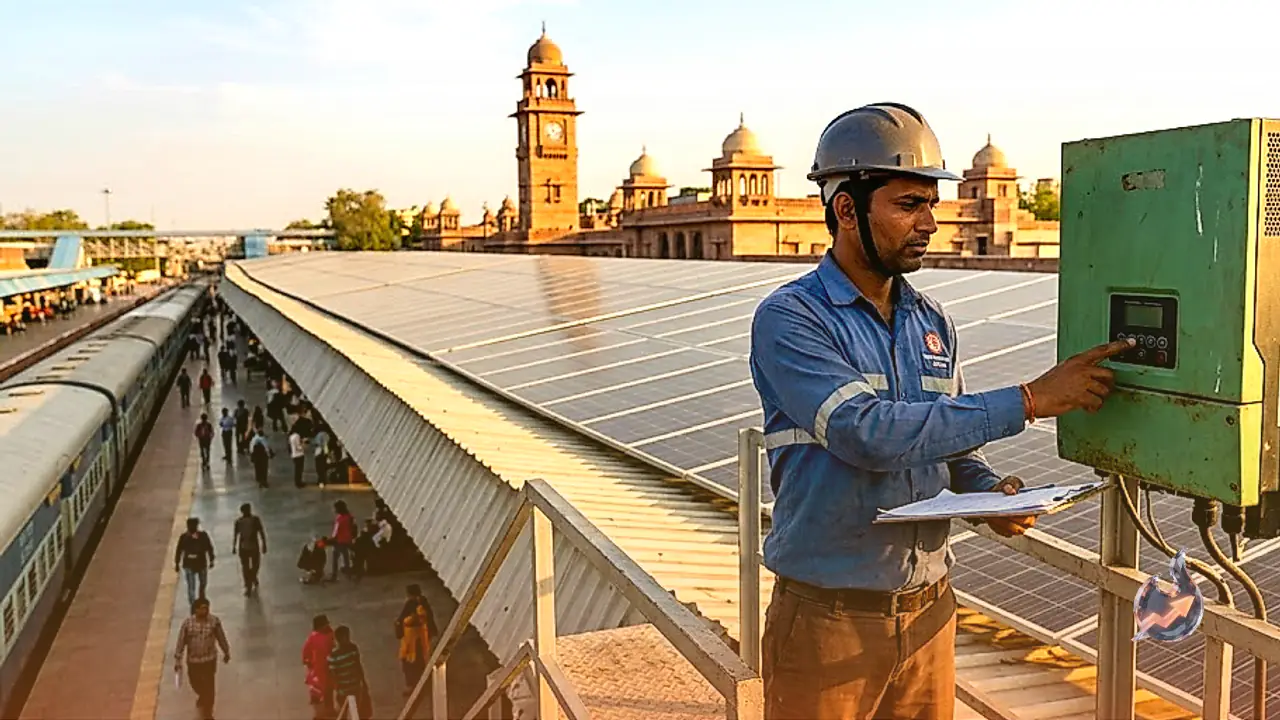
To establish a resilient decentralized power network, solar panels have already been installed at 102 distinct locations across the Jodhpur division. Primary sites generating solar power include Jodhpur Station, Bhagat Ki Kothi Station, the Bhagat Ki Kothi Diesel Shed, Merta Road Station, and the Merta Road DEMU Shed. In addition to these active installations, commissioning work is currently underway at three more locations to further bolster the division's clean energy output.


Questions & Answers

How much solar power did the Jodhpur division generate up to August in FY 2026-27?
The division produced approximately 1.994 million units of solar power in the first five months up to August.
How does this compare to the previous fiscal year's generation?
The division generated 2.279 million units in the entire 2025-26 fiscal year, meaning it reached about 87.5 percent of that annual total in just five months.
Which major installations are generating solar power in the division?
Key locations include Jodhpur Station, Bhagat Ki Kothi Station, Bhagat Ki Kothi Diesel Shed, Merta Road Station, and Merta Road DEMU Shed.
At how many sites have solar panels been installed across the division?
Solar panels are operational across 102 locations, with commissioning underway at three additional sites.
What primary benefits does the railway expect from this solar expansion?
It reduces dependency on conventional grid electricity, cuts utility costs, and frees up financial resources for operational upgrades and passenger amenities.

Comments 4

Arjun Mehta@arjun-mehta·11m ago

This development highlights a crucial aspect of public policy: the regional decentralization of national green energy targets. When central climate goals are successfully translated into action by divisional administrations like Jodhpur, it demonstrates effective governance. By reducing reliance on conventional grids, public enterprises can achieve fiscal resilience. Redirecting these energy savings to upgrade passenger amenities is an excellent model of self-sustaining public utility management that other government sectors should emulate.

Ravikash Gupta@ravikash·10m ago

Building on Arjun's perspective, this is a prime example of turning environmental sustainability into fiscal efficiency. From an economic standpoint, energy consumption remains one of the largest operating expenses (OPEX) for public transit infrastructure. By achieving 87.5% of last year's solar generation in just five months, the division is drastically lowering its recurring utility costs. This operational cost-cutting directly frees up capital that can be reinvested into upgrading passenger amenities and rail infrastructure (CAPEX). This transition from recurring expenditure to asset creation is a highly sustainable fiscal model.

Rohan Verma@rohan-verma·37m ago

This decentralized solar energy model adopted by the railways serves as an excellent blueprint for public infrastructure governance. By significantly reducing reliance on the traditional grid, such initiatives ease the fiscal burden on the public exchequer, allowing surplus resources to be channeled into passenger safety and regional infrastructure. Implementing similar localized solar strategies across expansive rail networks in states like Uttar Pradesh can accelerate the transition toward net-zero emissions while ensuring long-term financial self-sustainability for public transport.

Karan Malhotra@karan-malhotra·36m ago

From a public safety and law enforcement perspective, this self-reliant energy model of the railways is a vital asset. Continuous solar power ensures that critical security infrastructure—such as CCTV surveillance, platform lighting, and emergency communication networks—remains operational even during grid failures. Well-lit stations and active monitoring act as strong deterrents to crime, curbing incidents of theft and ensuring better security for women passengers. A resilient power source directly translates to safer transit environments.

Citizen journalism

Become a TrendKia journalist

Voice of the people

Share news, photos and videos from your area with TrendKia and let your voice reach the nation. Every citizen a journalist.

Join now
CH 01 LIVE
TrendKia TV ON AIR
Chamar no WhatsApp