















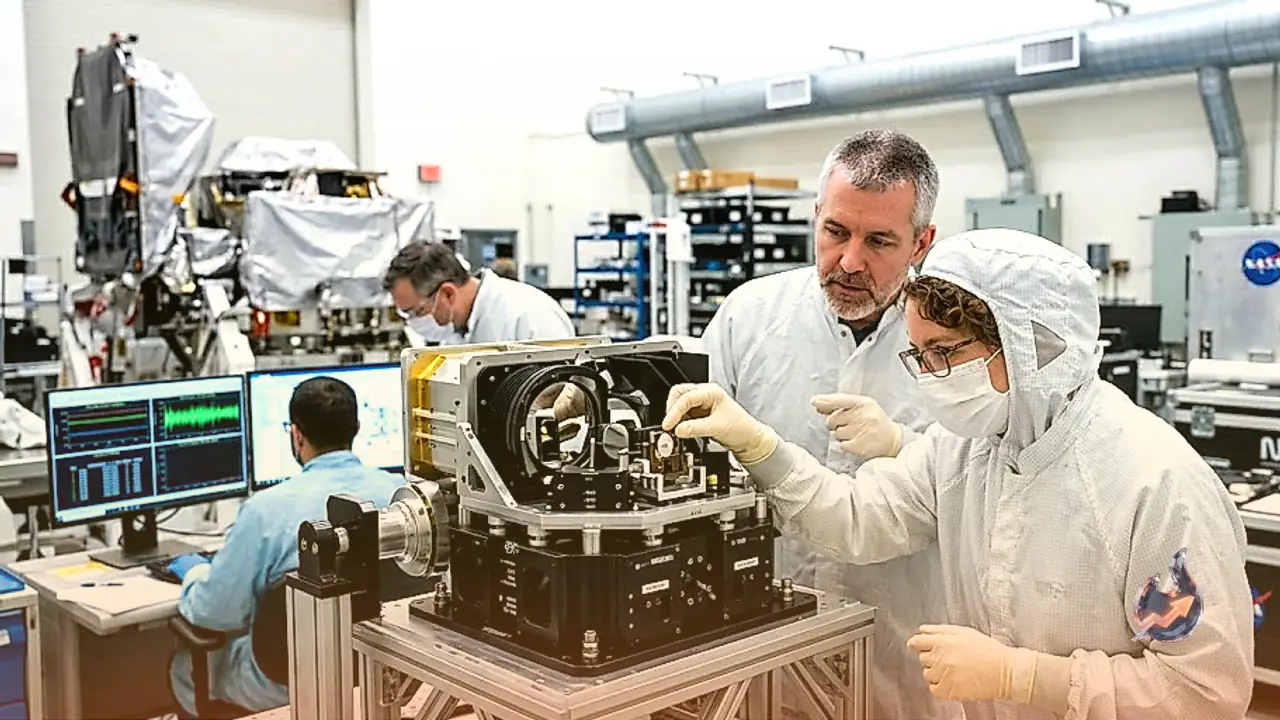

The launch window for NASA’s Nancy Grace Roman Space Telescope is drawing near, bringing an ambitious new chapter in astrophysics closer to reality. While the primary instrument is built to inform nearly every corner of the field, a specialized experimental coronagraph is tucked away inside the hardware. This unique apparatus will attempt to directly capture starlight bouncing off a planet’s surface for the very first time. It is a bold undertaking that space agency officials hope will eventually pave the way for future observatories capable of spotting Earthlike worlds orbiting distant sunlike stars.
Achieving such a feat remains far beyond the reach of contemporary engineering, making this test flight on Roman a crucial proving ground. Vanessa Bailey, an astrophysicist at NASA’s Jet Propulsion Laboratory and an instrument scientist for the project, notes that they will test the technology in space to understand what work still lies ahead. At its core, a coronagraph functions as an advanced scientific sunshade designed to block the glaring light of a primary star and expose faint objects that would otherwise remain hidden in the glare. While previous instruments like the Hubble and James Webb space telescopes have carried coronagraphs, the version aboard Roman is vastly more sophisticated.
The secret behind this leap is adaptive optics, a technology that actively deforms a mirror to cancel out optical distortions. Even with this advancement, the task remains monumental, with NASA comparing the challenge to photographing a tiny firefly perched beside a blazing floodlight from across an entire country. Margaret Turnbull, an exoplanet scientist at the SETI Institute and head of a Roman coronagraph science team, warns that any stray starlight reaching the wrong spot could easily ruin an entire image section. While ground-based facilities like the Very Large Telescope in Chile and Hawaii's Keck Observatory routinely rely on adaptive optics to combat atmospheric interference, space telescopes have never needed the technology for this specific purpose.
Because Roman is designed to spot older, cooler planets illuminated solely by reflected starlight, engineers equipped the instrument with two palm-sized mirrors. Each mirror features roughly 2,300 tiny actuators that expand upon receiving a small electrical jolt, minutely reshaping the glass to counteract interference. This marks the first time the agency has flown active deformable mirrors in space. However, the mirrors alone are not enough, as the system requires supersensitive detectors to amplify signals from individual photons, given how few particles the instrument will actually capture from a distant world.
At the heart of the coronagraph lie intricate star shades, which Bruce Macintosh of the University of California Observatories describes as beautifully complicated shapes unlike anything previously flown in space. Unlike Hubble's brute-force metal blocks, these detailed masks will allow engineers to gather extensive test data during operations. Scientists will evaluate performance by attempting to spot a handful of known exoplanets. Turnbull explains that failing to detect these verified planets would immediately signal a problem with the instrument.
Beyond exoplanets, the instrument will target stars surrounded by dust and debris disks, searching for gravitational gaps that hint at hidden worlds while shedding light on how typical our own solar system's clutter truly is. Every piece of data gathered by Roman will feed directly into future concepts, such as the proposed Habitable Worlds Observatory slated for the 2040s, which will require a coronagraph up to 100 times more effective. A similar instrument is also planned for the Lazuli Space Observatory announced by former Google CEO Eric Schmidt's research institution. Julie McEnery, senior project scientist for Roman at NASA’s Goddard Space Flight Center, emphasizes that the best way to demonstrate success is through compelling scientific discovery as the mission takes its vital first steps.