


















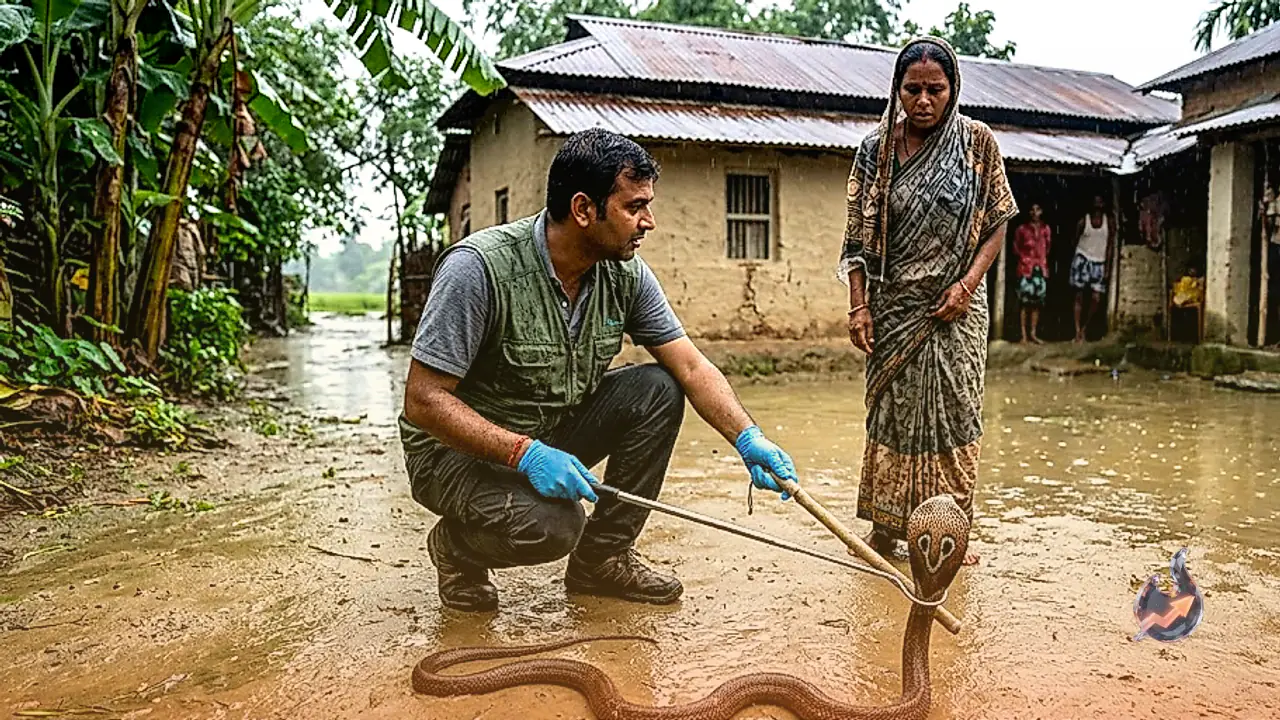

During heavy monsoon downpours, the fear of snake encounters spikes across villages and semi-urban settlements. As rainwater floods their underground burrows, these reptiles are forced to abandon their natural hiding spots in search of dry shelter. Spotting a snake in such circumstances can trigger panic, especially if the reptile happens to be a cobra. Knowing how to correctly identify a cobra and distinguishing it from other common or less venomous snakes is a crucial survival skill.
Essential Safety Measures During the Rains
Monsoon seasons frequently drive snakes out of their undisturbed natural habitats and into proximity with human dwellings, agricultural fields, residential gardens, and roadways. While these sightings are more common across open plains, stumbling upon a cobra in the vicinity requires calm composure rather than panic. Sudden fright can provoke the animal, leading to defensive strikes. Citizens are advised against making hurried attempts to chase the reptile away, and should instead maintain a safe distance, allowing the creature ample space to move forward on its own.
The Discovery of Four Distinct King Cobra Species
P. Gowri Shankar, a senior field biologist and researcher who has dedicated two decades to studying king cobras, released a landmark research paper detailing genetic variations. Back in 2021, he successfully identified four distinct genetic groups within the king cobra population, establishing a foundation for modern classification. This refined categorization is vital for conservation efforts, ensuring tailored protection protocols for each specific lineage. Furthermore, this scientific breakthrough promises better therapeutic options for treating snakebites, ultimately safeguarding both human populations and the king cobra species. Continued research into their behavioral patterns and ecological niches will enable more targeted conservation strategies.
Geographic Distribution of the Varieties
For roughly 188 years, the king cobra was universally classified as a single species under the scientific name Ophiophagus hannah. However, given its massive geographic distribution across diverse landscapes, visible variations in body coloration and morphology prompted scientists to reevaluate whether it truly represented a single species. The newly recognized lineages include specific regional variants.
The Northern king cobra is predominantly found across northern India, Nepal, Bhutan, Tibet, China, and sections of Southeast Asia. The Sunda king cobra inhabits southern Thailand, Malaysia, Singapore, Indonesia, and the southern islands of the Philippines. The Western Ghats king cobra is exclusively native to the rainforests and hill ranges of the Western Ghats in India. Meanwhile, the Luzon king cobra has adapted specifically to the unique ecological conditions of Luzon Island in the northern Philippines.
Scientific Nomenclature and Behavioral Traits
In the scientific community, the king cobra was historically documented as Ophiophagus hannah, a designation established in 1836 by Danish bioscientist Theodore Edward Cantor. Derived from Greek roots meaning snake-eater, the name reflects its primary dietary preference for consuming other snakes. Genetic divergences across different populations are mirrored in their physical adaptations and behavioral traits. For instance, the Northern king cobra demonstrates high adaptability across varied environments, ranging from dense forests to cultivated farmlands.
Conversely, the Western Ghats variant prefers thick rainforest canopies and hilly terrains. Sunda king cobras typically inhabit lowland tropical forests and coastal mangroves, while the Luzon variant remains uniquely attuned to its island ecosystem.
Color Variations and Distinctions From Other Snakes
Cobras display a wide spectrum of coloration that shifts depending on their species, age, and immediate habitat. Their skin tones range from earthy dark shades to vibrant hues, including copper, reddish-brown, mahogany, slate gray, light brown, and beige. Some individuals exhibit solid, uniform coloration, while others display distinct banding patterns featuring white, yellow, or dark rings. Distinct markings may also appear on their hoods.
In contrast, the Indian cobra is relatively smaller, typically growing up to five feet in length. When threatened, it raises the anterior portion of its body and spreads a broad, flattened hood that often bears a spectacle-like mark on the rear side. On the other hand, the king cobra is massive, occasionally reaching lengths of up to 19 feet. When agitated, it maintains an alert, steady posture, lifting the front third of its body straight off the ground while emitting a deep, sharp hiss.