





















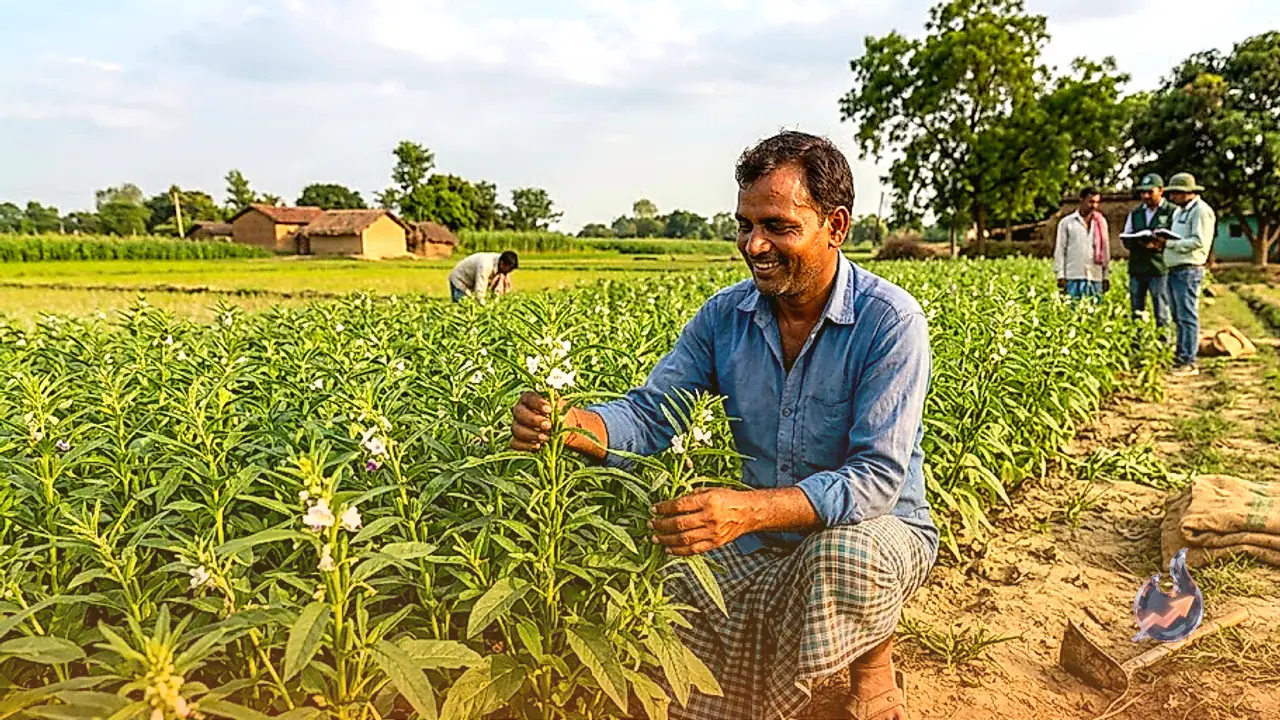
Across Bahraich district, agriculture has long revolved around the predictable, input-heavy rotation of paddy, wheat, and maize. Breaking away from this established routine, Brijesh Kumar, a farmer from Mirjapur village, has introduced a notable shift in local farming practices. Instead of transplanting water-intensive paddy during the peak Kharif season, he chose to cultivate sesame on his land. This calculated departure from convention not only helped him slash production expenses to bare minimums but also established a far more profitable model on a modest budget.
Scientific Guidance and Green Manuring Set the Stage
The transition began under the technical guidance of officers and scientists from Krishi Vigyan Kendra in Bahraich. Advising Kumar to steer clear of repetitive crop cycles, the agricultural experts encouraged him to adopt sesame and supplied the necessary seeds free of cost. Their recommendation involved preparing the soil naturally by planting dhaincha as green manure prior to sowing the main crop. Following this scientific advice, Kumar cultivated dhaincha, ploughed it directly into the ground to enrich soil fertility, and then broadcast the sesame seeds over the field.
Detailing the overall financial expenditure incurred on the crop, Kumar explained that seeds cost him nothing courtesy of Krishi Vigyan Kendra. His direct financial outlay was limited strictly to two rounds of tractor ploughing, amounting to approximately Rs 1,000 to Rs 1,200. Crucially, no chemical fertilisers or synthetic pesticides were introduced into the soil throughout the crop cycle. Because it remained entirely free of chemical interventions, the resulting harvest stands out as a purely organic agricultural product.
Five Quintals Expected from a Single Acre
Today, Kumar's one-acre sesame plot displays a dense, thriving stand of healthy plants. Scientists from Krishi Vigyan Kendra visited the agricultural field in person to inspect the stand, commending the farmer on his meticulous crop management and crop health. Initial agricultural estimates indicate that this single acre will yield roughly 5 quintals of sesame seed.
Market dynamics further enhance the economic outlook of this harvest. Sesame enjoys strong, round-the-year demand across retail food preparations, edible oil markets, and ritual applications. Because Kumar's produce is completely chemical-free, the premium attached to certified organic quality is expected to translate into lucrative returns upon sale, far outpacing the margins typically realized from paddy in the region.
A Push Toward Crop Diversification
Addressing other agricultural workers who frequently grapple with escalating input costs and diminishing returns from monoculture, Kumar emphasized the urgent necessity of adopting systematic crop rotation. He noted that growers in Bahraich must look beyond the traditional confines of wheat, paddy, and maize. Incorporating oilseeds and pulses such as sesame, mustard, and lentils requires significantly less working capital while delivering resilient profit margins to smallholders.