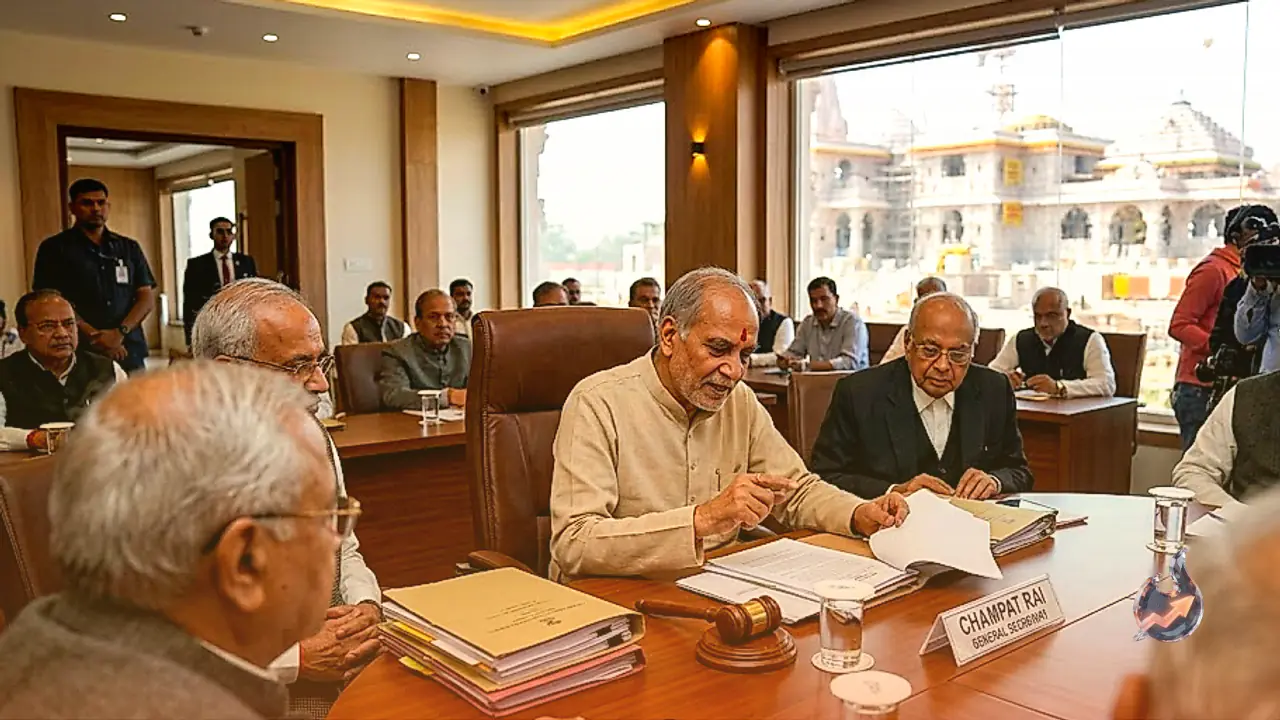




















During a high-level meeting of the Shri Ram Janmabhoomi Teerth Kshetra Trust in Ayodhya, three new trustees were formally appointed to the governing board. Alongside these appointments, the Trust is preparing to officially announce its first Chief Executive Officer (CEO) to oversee administration and management. The critical decision-making meeting took place at Maniram Das Chhawani, the official residence of the Trust President Mahant Nritya Gopal Das, where key office-bearers gathered to finalize the decisions.
Three New Trustees Join the Ram Mandir Board
The expansion of the Trust board brings in three prominent individuals from diverse backgrounds. Mahesh Bhagchandka, a resident of Delhi and a relative of senior leader Ashok Singhal, has been inducted as a new trustee. Additionally, Madan Mohan Pandey from Ayodhya has been appointed to the board. The third new inductee is Nirmala Yadav, hailing from Shikohabad. The addition of these three trustees is expected to strengthen the administrative operations and community outreach of the Trust.
Four Prominent Candidates in the Race for First CEO
To ensure professional and structured management of the temple premises, the Trust is establishing the post of CEO for the first time. The designated search panel has submitted its final report along with a panel of three shortlisted candidates. Former IPS officer Rajesh Pandey is currently considered the frontrunner for the top executive position. Another former IPS officer, Paresh Saxena, is also under active consideration. Alongside the former police officials, two IAS officers—Yogeshwar Ram Mishra and Dinesh Chandra Singh—are among the four key figures being evaluated by the Trust leadership.
Selection Journey: From 5,500 Applicants to Final Interviews in Ayodhya
The rigorous candidate selection process was managed by a specialized three-member committee comprising retired Justice Pramod Kohli, Suresh Havare, and Vishwankant Chaturvedi. The Trust received over 5,500 applications for the executive post. As part of the initial screening, applicants were asked to complete a Google Form carrying evaluation questions worth 600 total marks. More than 3,500 candidates completed and returned the assessment forms, after which detailed scoring was conducted.
Out of the 3,500 respondents, 108 candidates achieved high scores exceeding 470 out of 600 marks. These top candidates subsequently underwent virtual interviews, which narrowed the field down to 17 shortlisted individuals. The final 17 candidates were invited to Ayodhya for in-person interviews, where they were rigorously evaluated across several key metrics, including leadership capability, personal faith, problem-solving skills for complex challenges, and deep understanding of temple administration. Following these comprehensive evaluations, a final shortlist of three names was presented to the Trust board for the conclusive decision.