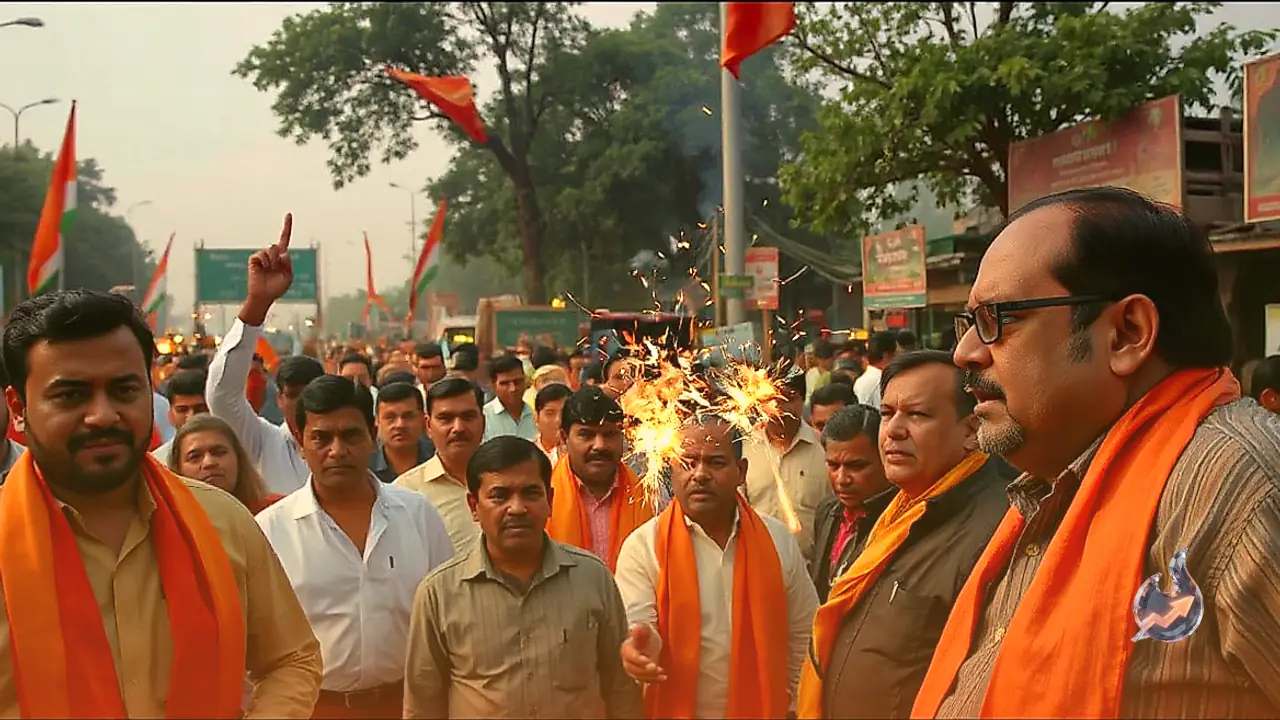


















Although the formal schedule for the 2027 Uttar Pradesh Assembly elections is still in the distance, political rhetoric and strategic maneuvers between the key contenders have begun in earnest. The Bharatiya Janata Party is preparing to secure power for a historic third consecutive term in the state, while Samajwadi Party chief Akhilesh Yadav is mobilizing a restructured caste coalition to unseat the ruling administration. The opening moves of this confrontation emerged when Union Home Minister Amit Shah addressed the BJP state executive committee meeting in Lucknow, describing the state government as Angad ka pair, an immovable presence that no rival could shake. Akhilesh Yadav swiftly seized upon the metaphor during a rally at Ramlila Maidan in Delhi, questioning where the party intends to place its foot when the political ground beneath it has already disappeared. With Chief Minister Yogi Adityanath leading the government apparatus and Akhilesh Yadav rallying his party base, both sides have set the terms of a fiercely contested electoral campaign.
The BJP Plan for a 300-Plus Seat Victory
The upcoming 2027 election is shaping up as a clash between two fundamentally distinct political narratives. The BJP is anchoring its campaign around organizational depth, sustained governance, and an explicit objective of winning more than 300 seats in the 403-member legislative assembly. Speaking to party cadres in Lucknow on October 30, Union Home Minister Amit Shah cited the outcome of the 2017 assembly elections, where the party secured 312 seats along with a vote share of nearly 40 percent. He urged party functionaries to replicate that performance and commit themselves to returning the government to office for a third straight term. This ambitious benchmark was reinforced on October 27 by Deputy Chief Minister Keshav Prasad Maurya, who stated publicly that the party would comfortably cross the 300-seat threshold in the next state election.
The ruling party's confidence relies on three central strategic pillars. The first pillar is its organizational strength, characterized by an extensive cadre network that reaches deep into the polling-booth level across every constituency. The second pillar is the administrative performance of the government led by Chief Minister Yogi Adityanath, emphasizing strict law and order policies and the wide delivery of basic welfare initiatives. The third pillar is the ideological and cultural agenda. During his address, Amit Shah highlighted the Ram Temple movement and told workers that a third consecutive victory would lead to the implementation of a Uniform Civil Code across Uttar Pradesh.
The Symbolic Clash Over Angad's Foot and Local Election Trends
The reference to Angad's foot draws from the Ramayana episode where the warrior prince Angad planted his foot firmly in Ravana's royal court, challenging anyone present to move it. Union Home Minister Amit Shah invoked the legend as an allegory for the BJP's institutional durability, organizational discipline, and unyielding position in Uttar Pradesh politics. However, the opposition has attempted to invert the image into a critique of the ruling party's standing.
Addressing a gathering on November 1 at Ramlila Maidan in Delhi, Akhilesh Yadav asserted that leaders who compare their administration to Angad's foot fail to realize that their political base has eroded. He questioned how anyone could stand firm when the underlying public support had vanished. To substantiate his argument, the Samajwadi Party chief highlighted the outcome of the legislative council elections in Varanasi, remarking that the electorate in Kashi had handed a double zero to the double-engine government, demonstrating growing voter disillusionment.
The Samajwadi Party PDA Formula and Social Outreach
At the center of the Samajwadi Party's campaign design is the PDA alliance, which originally stands for Pichhda, Dalit, and Alpsankhyak, representing backward classes, Dalits, and minorities. Akhilesh Yadav first introduced this strategic formula in June 2023 to broaden the party's core electoral base beyond its traditional Yadav and Muslim core. The goal is to establish deep, sustainable connections with non-Yadav backward communities, various Scheduled Caste groups, and broader minority segments across the state.
Over recent months, Akhilesh Yadav has adapted the definition of PDA to appeal to shifting electoral dynamics. On various occasions, he has expanded the acronym to incorporate upper-caste communities, suggesting that the letter P could denote Pandits and A could include Agarwals. Beyond traditional caste categories, the party leadership has also defined PDA as representing the पीड़ित, दुखी, and अपमानित, meaning those who are victimized, distressed, and humiliated. This framing seeks to transform the coalition from a simple caste arrangement into a wider political umbrella for groups feeling marginalized under current policies.
Candidate Allocation Plans and Electoral Obstacles
The primary organizational test for the Samajwadi Party is ensuring that the PDA framework translates into genuine political representation rather than serving purely as an electoral slogan. In preparation for 2027, the party is calibrating its candidate selection process to reflect this social composition. The leadership is actively exploring the option of fielding Dalit candidates even in general category constituencies. Strategic discussions indicate that the party is preparing to nominate Dalit and minority candidates across more than 100 legislative seats to build a competitive social matrix.
While this social alignment yielded substantial dividends in the 2024 parliamentary elections, converting it into a winning formula for the 2027 state assembly polls presents major hurdles. The first obstacle lies within the Dalit electorate, where different sub-castes and regional groups often hold distinct political preferences and do not vote as a single bloc. The second hurdle is winning the confidence of non-Yadav backward classes, where the BJP has cultivated strong local leadership, administrative alliances, and welfare networks over multiple election cycles. The third challenge involves maintaining consistent mobilization among minority voters while coordinating these varied groups into an enduring coalition. Whether the BJP's organizational discipline achieves its 300-seat target or the Samajwadi Party's social engineering shifts the balance of power remains the central contest heading into 2027.