
















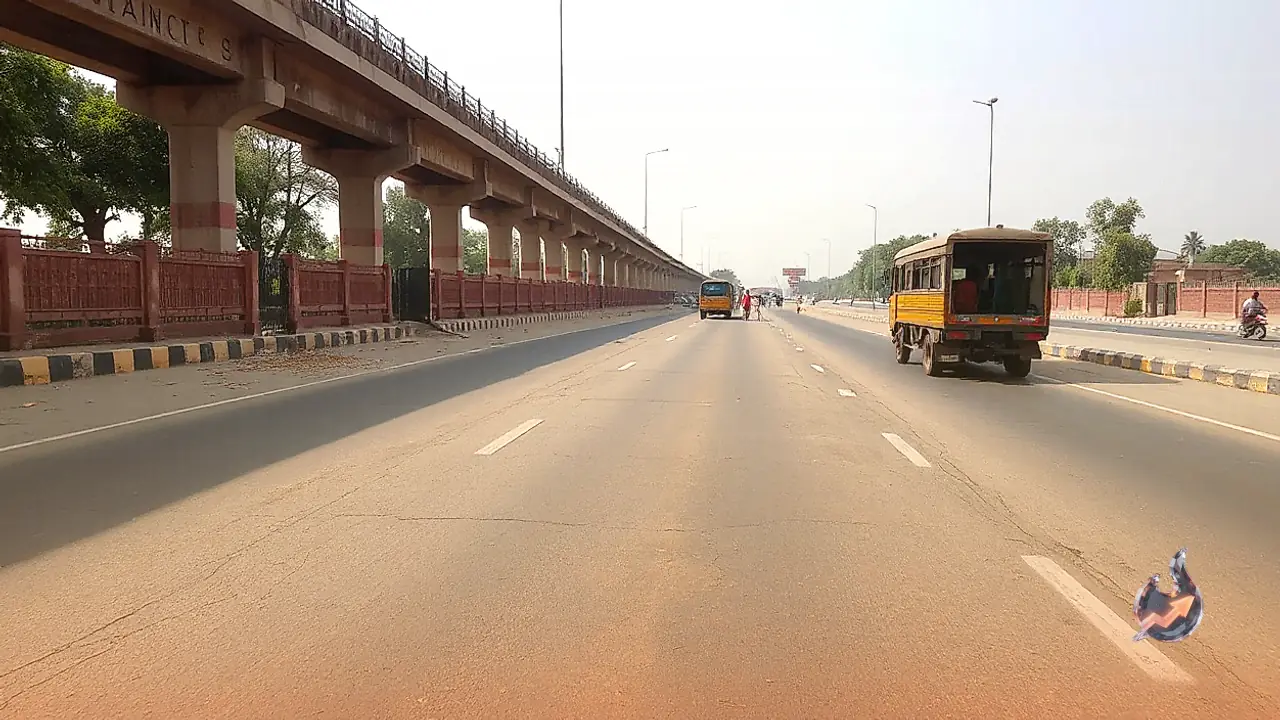

A major infrastructure push is underway in Uttar Pradesh following the Union Cabinet's approval, chaired by Prime Minister Narendra Modi, for the construction of an access-controlled National Highway-927 stretching between Barabanki and Bahraich. Designed to accommodate modern regional traffic, the proposed route will span roughly 101 kilometres. The project will initially feature a 4-lane configuration, engineered with the flexibility to expand into a 6-lane thoroughfare as traffic density rises in the future. The entire development carries an estimated expenditure of 6,969.04 crore rupees. Once completed, commute time between the state capital Lucknow and Bahraich will be drastically reduced to merely 1 to 1.5 hours.
Overcoming Congestion and Sharp Road Curves
The Barabanki-Bahraich highway functions as an integral section of the wider Lucknow-Rupaidiha transit corridor. At present, motorists on this alignment grapple with narrow carriageways and severe road bends that consistently trigger severe vehicular congestion. These structural shortcomings have also rendered the current road susceptible to frequent road accidents. To eliminate these bottlenecks, the new alignment will bypass densely populated urban pockets. Furthermore, by enforcing strict access control with zero intersections or direct crossings on the main route, vehicular movement will remain unimpeded, leading to a substantial drop in transit durations.
Hybrid Annuity Model and 48.28-Kilometre Bypass System
According to the Lucknow authority, the project will be executed under the Hybrid Annuity Model (HAM). Under this arrangement, private concessionaires shoulder the bulk of the initial construction costs, while the government releases annuity payments in a phased manner over time. To ensure that regional transit does not choke local settlements, the blueprint incorporates a 48.28-kilometre dedicated bypass. Dedicated service lanes will also run parallel to the expressway, enabling local commuter traffic to navigate without interfering with high-speed vehicles on the central corridor.
Enhanced Regional Reach Across Tarai and Purvanchal
Beyond connecting Barabanki and Bahraich, the new highway serves as a vital arterial link for several key towns and rural hubs. The route will provide direct access to settlements including Barabanki, Ramnagar, Jarwal, Kaiserganj, Kundasar, Fakharpur, and Bahraich. In addition, peripheral districts such as Gonda, Balrampur, and Shravasti will secure far smoother inter-district mobility. By establishing an unhindered link from Lucknow to the Tarai and Purvanchal regions of Uttar Pradesh, the highway opens up economic frontiers across northern and eastern parts of the state.
Catalysing Cross-Border Nepal Trade and Network Integration
The strategic utility of this corridor extends up to the international border with Nepal. By easing the movement of freight and travellers, the expressway is set to accelerate cross-border commerce, regional tourism, and international cargo transit. Furthermore, the route will integrate seamlessly with established transit links, including National Highway 27, 330N, and 730, alongside State Highways 13 and 30B. This cohesive grid will not only ensure safer transit conditions but will also yield significant savings in vehicular fuel consumption and travel hours across Lucknow, Barabanki, and Bahraich.
Economic Multipliers: Employment and Farm Logistics
On the economic front, the corridor is expected to unlock substantial employment and trade advantages. Projections indicate that the initiative will generate approximately 36 lakh direct jobs daily, accompanied by 43 lakh indirect employment opportunities. Real estate values along the corridor are poised to rise, benefiting land-owning farmers in adjacent belts. For the agrarian community in the Tarai belt, the road offers rapid freight routes to move fresh fruits and vegetables into urban wholesale mandis, enabling consumers in metropolitan Lucknow to access produce at more affordable rates.
Land Acquisition and Environmental Offsets
Land acquisition procedures for the corridor are currently progressing. Out of the gross financial allocation, approximately 1,574 crore rupees will be dedicated specifically to acquiring land parcels. The National Highways Authority of India (NHAI) noted that the chosen alignment encompasses 70 hectares of forest department land, requiring tree felling. To counteract the ecological impact, authorities are bound by statutory mandates to plant 10 times the number of felled trees. Additionally, the forest department will receive roughly 900 crore rupees as compensation for the 70 hectares of diverted land.