



















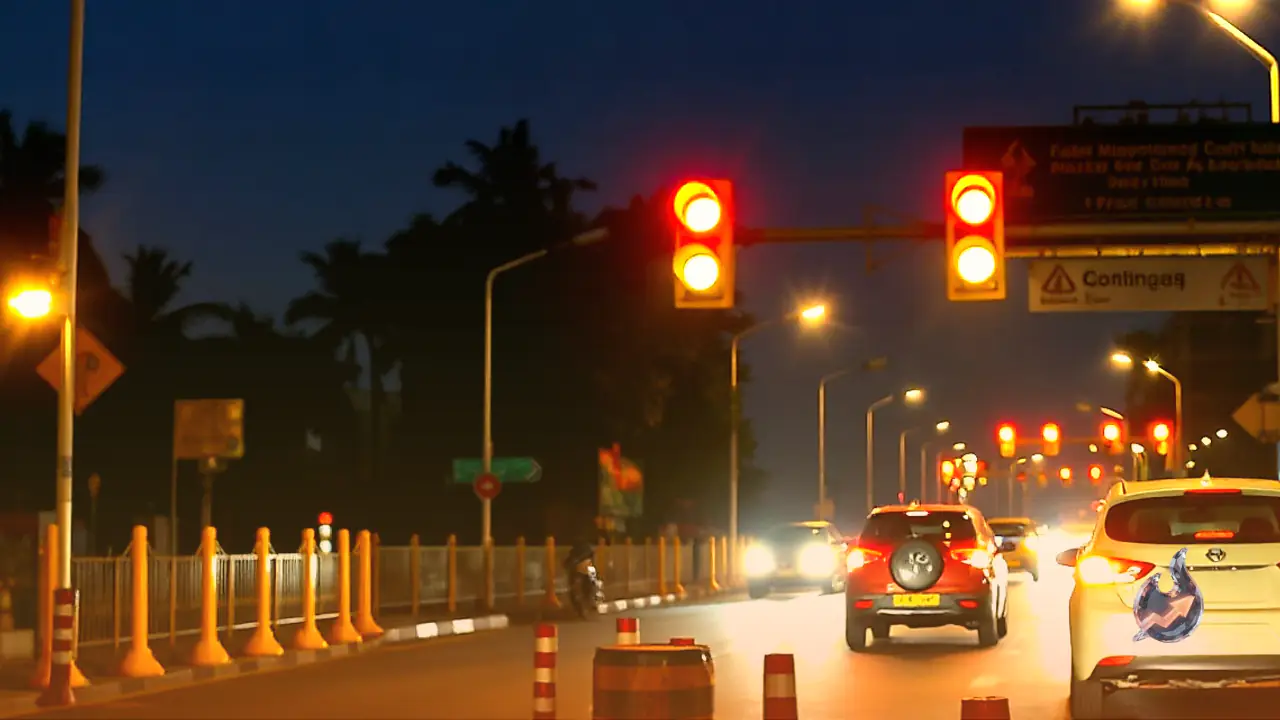

Many commuters driving late at night in urban areas often assume that empty stretches and flashing signals mean traffic enforcement has paused for the day. Upon encountering a blinking yellow traffic light at an intersection, motorists frequently maintain high speeds and cruise through without checking cross-traffic. Traffic authorities in Ghaziabad have issued a stern warning against this risky driving habit, clarifying that blinking signals are intended to signal caution rather than serve as a free pass to ignore road safety regulations. Failing to slow down can lead to severe road crashes and result in automated digital fines captured by advanced surveillance equipment.
Understanding Blinking Yellow Signals and Night Traffic Laws
During late-night hours when overall vehicle volume drops significantly, traffic management systems at several intersections across Ghaziabad transition into a caution-blinking phase. Ghaziabad Traffic Police DCP Trigun Bisen explained that a blinking yellow light requires every motorist to actively reduce their vehicle speed before entering the junction. Drivers must carefully look in all directions to verify that no approaching traffic is coming from intersecting roads before proceeding. Because visibility can be deceiving at night and other motorists might also be approaching at high speeds, entering an intersection without slowing down creates extreme collision hazards.
Moreover, the official emphasized that blinking yellow lights operate at specific locations to facilitate smooth traffic flow during low-volume hours, but they do not suspend general traffic laws. Motorists must remember that their duty of care on public roads remains mandatory regardless of the hour or the apparent absence of nearby vehicles.
Round-the-Clock Monitoring via ITMS and Speed Cameras
Contrary to popular belief that traffic monitoring ceases late at night, automated enforcement systems remain operational continuously across key transit points. DCP Trigun Bisen noted that several major intersections throughout Ghaziabad continue to operate standard three-color signal cycles round the clock, displaying regular red, yellow, and green lights. At these locations, strict compliance is compulsory: a red signal requires a complete stop, a yellow light commands drivers to prepare to stop or proceed with extreme care, and only a green light permits crossing. Passing a red light on empty night roads constitutes a direct violation of traffic laws and is treated with equal severity as a daytime offense.
To enforce compliance, high-definition Integrated Traffic Management System (ITMS) cameras are deployed at intersections and major arterial roads. These smart cameras automatically record severe violations, including red-light jumping, line cuts, and dangerous driving maneuvers, generating electronic challans without requiring physical police presence on the road. Additionally, dedicated speed enforcement cameras monitor vehicle velocity along major corridors. Vehicles exceeding prescribed speed limits are flagged instantly, leading to automated penalty notices sent directly to the registered owners.
Safety Guidelines and Essential Advisories from Traffic Authorities
In light of rising concerns over late-night speeding and intersection collisions, traffic police officials have urged all road users to exercise heightened vigilance. Drivers are strongly advised against accelerating on deserted roadways simply because traffic appears light. Approaching any intersection requires a deliberate reduction in speed, an explicit check of all surrounding lanes, and defensive driving posture.
Furthermore, authorities reminded citizens that nighttime surveillance covers comprehensive traffic compliance beyond signal adherence. E-challans are actively issued for riding without safety helmets, failing to wear seatbelts, driving on the wrong side of the road, and carrying excess passengers. Traffic officials underscored that a blinking yellow light or an deactivated signal light does not signal an end to legal obligations. Protecting personal safety as well as ensuring the physical security of fellow commuters remains a vital civic responsibility for every driver navigating public roads.