






















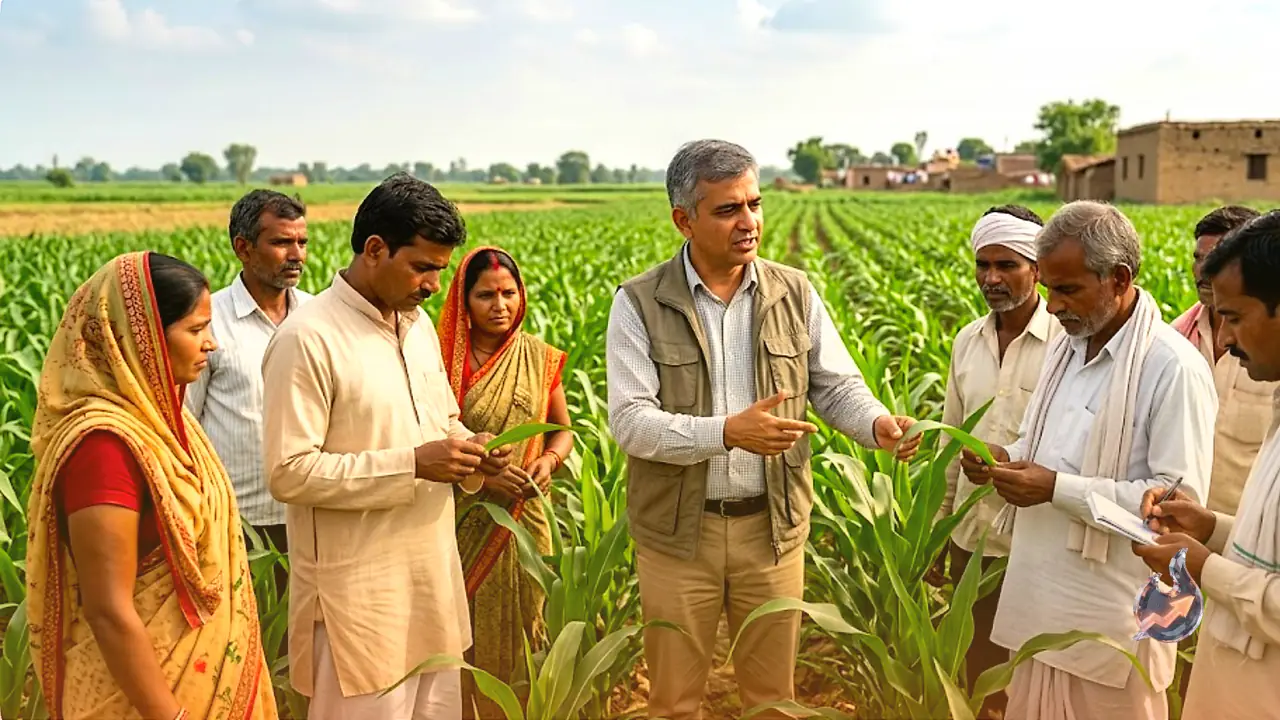

Farmers in Muradabad have a strong opportunity to significantly boost their income this season through maize cultivation, with experts identifying June and July as the ideal months for sowing the crop across western Uttar Pradesh. The financial case is made even stronger by a government subsidy that covers up to 50 percent of total farming costs, giving growers a genuine chance to pocket between Rs 30,000 and Rs 50,000 in a single growing season.
Start Sowing After the First Good Rain
Dr. Deepak Mehandiratta, an agricultural scientist from Muradabad, recommends that farmers wait for the season's first substantial rainfall before beginning to sow. Once that rain arrives, planting should begin without delay, as the soil moisture at that point provides the ideal conditions for germination and early root development. Seeds should be placed at a depth of 4 to 5 centimetres, and sowing in furrows rather than on flat ground consistently delivers better yields.
Seed Requirements Differ by Variety
The quantity of seed needed varies considerably depending on the type of maize a farmer intends to grow. For standard hybrid maize, the right amount is 8 to 10 kilograms per acre. Baby corn demands a much higher seeding rate of 16 to 20 kilograms per hectare, while sweet corn requires a more moderate 6 to 8 kilograms per hectare. Dr. Mehandiratta emphasises that both the seed quantity and the cultivation method must be matched to the specific variety chosen, so farmers should settle on their variety before purchasing inputs.
Plant Spacing Is Critical for Hybrid Maize
For hybrid maize in particular, maintaining the correct spacing between plants is one of the most important factors in achieving a strong harvest. Rows should be kept 60 to 70 centimetres apart, and within each row individual plants need 20 to 25 centimetres of space between them. This spacing ensures that every plant gets adequate access to sunlight, airflow, and soil nutrients, all of which directly influence how much the crop ultimately produces.
What to Expect From Yield and Earnings
Farmers who apply scientific cultivation techniques throughout the growing season can realistically harvest 25 to 30 quintals of maize per season. That level of output translates into earnings of Rs 30,000 to Rs 50,000, though the final figure will depend on the prevailing weather and the seed variety used. Dr. Mehandiratta is confident that growers who commit to the right methods will see a clear and meaningful improvement in their incomes.
Government Subsidy Cuts the Financial Risk in Half
The subsidy structure varies across maize varieties, but in most cases the government covers 50 percent of total input costs through its subsidy programme. This effectively halves the upfront investment a farmer needs to get the crop established and substantially reduces the financial risk involved. For farmers in Muradabad looking to increase their annual earnings, combining this subsidy support with scientifically guided farming practices could make maize cultivation one of the most dependable income sources of the year.