




















Ghazipur district in Uttar Pradesh is far more than a routine administrative region; it stands as a legendary land that has fortified India's defense across historic conflicts. From the First War of Independence in 1857 to the Quit India Movement of 1942, the 1947 Kashmir War, the 1965 Indo-Pakistani War, and the 1971 War, the brave sons of Ghazipur have left an indelible mark of valor. Widely renowned as the birthplace of Param Vir Chakra recipient Veer Abdul Hamid, this district has also nurtured numerous other iconic military heroes who laid down their lives to safeguard the nation's sovereignty.
Heroism of Ghazipur's Warriors from 1947 to 1971
The military history of India holds the contributions of Ghazipur and its neighboring regions in high esteem. During the 1947-48 Indo-Pakistani War, Brigadier Usman, the pride of the Mau-Ghazipur belt, demonstrated exceptional bravery. Having served in the military since 1933 under British rule, Brigadier Usman led a courageous counter-offensive after independence to reclaim the strategically vital Jhangar region in Kashmir for India, ultimately sacrificing his life on the battlefield. In recognition of his supreme sacrifice and heroic leadership, the Government of India posthumously conferred upon him the Maha Vir Chakra, the country's second-highest military decoration.
Similarly, during the 1971 Indo-Pakistani War, Ram Ugrah Pandey, a resident of Jakhania in Ghazipur district, displayed unmatched tactical bravery. Amid intense enemy shellfire, Ram Ugrah Pandey fearlessly charged forward, destroyed enemy fortifications and bunkers, and attained martyrdom in the line of duty. Honoring his extraordinary courage, the Indian government posthumously awarded him the Maha Vir Chakra. Furthermore, the heroic legacy of Company Quartermaster Havildar Veer Abdul Hamid, who destroyed enemy Patton tanks in the Khemkaran sector during the 1965 war, continues to inspire millions across the nation.
Ideological Roots and Revolutionary Spirit in Ghazipur's Soil
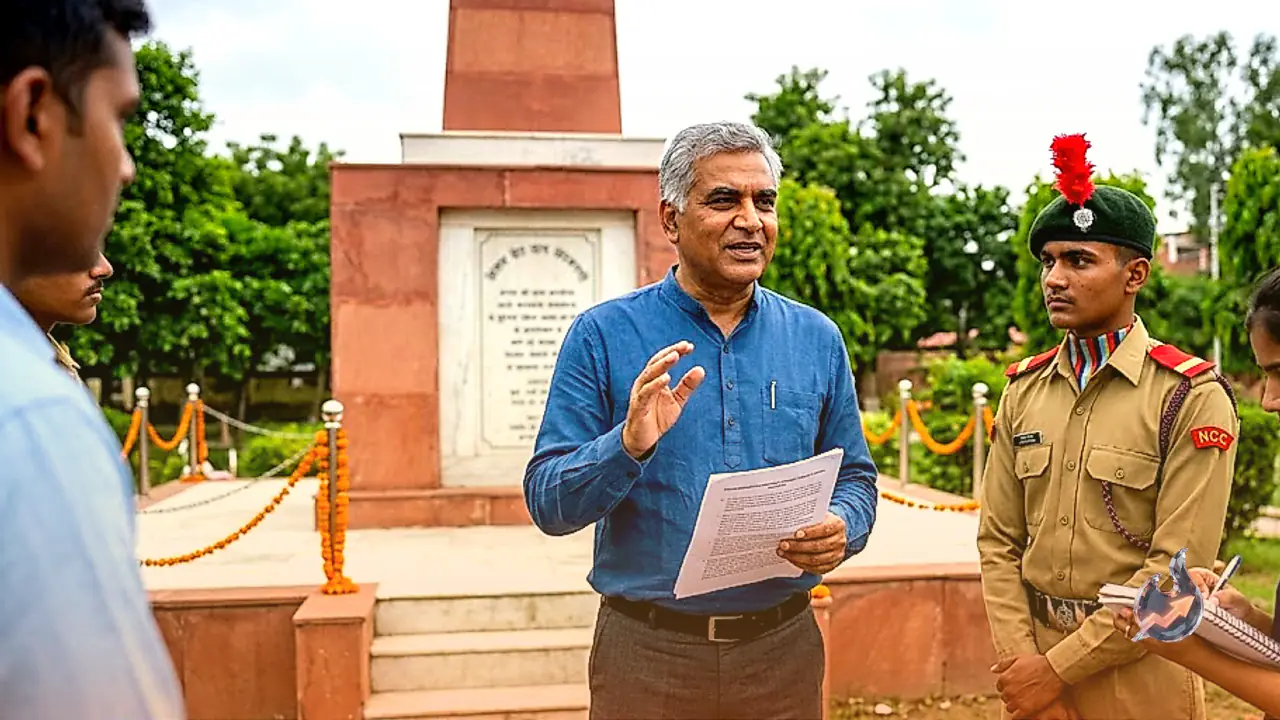
Explaining the socio-geographical factors behind why Ghazipur consistently produces revolutionary patriots and dedicated soldiers, Dr. Badrinath Singh, former Head of the Department of Military Science at PG College, Ghazipur, highlighted key insights. Ghazipur shares its eastern border with Bihar, a state historically renowned for its pioneering role in political discourse and military revolutions. The ideological fervor and revolutionary atmosphere of Bihar directly influenced the cultural and social fabric of neighboring Ghazipur.
Dr. Badrinath Singh noted that when young people observe their region's heroic heritage, they naturally absorb the principles of their legendary predecessors. Hearing tales of valor about heroes like Veer Abdul Hamid, Brigadier Usman, and Shaheed Bhagat Singh instills a deep sense of patriotism among youth. This national pride serves as a powerful catalyst, driving young men and women to join the armed forces and serve the country.
Proposal to Make Military Science and NCC Mandatory in Education
To further strengthen India's national security framework and better prepare youth for military careers, Dr. Badrinath Singh put forward a crucial policy recommendation. He advocated that Military Science and NCC training should be made compulsory across schools and colleges nationwide.
Outlining the practical benefits of early military orientation, he emphasized that teaching foundational technical skills during schooling would significantly enhance candidate readiness upon joining the armed forces. Key skills include
- Map Reading: Understanding topography, navigation, and tactical orientation during defense operations.
- Rifle Firing Angles: Mastering weapon alignment and precision targeting fundamentals.
- Basic Weapon and Artillery Handling: Gaining initial familiarity with the operation of cannons and heavy military equipment.
Equipping students with basic technical knowledge beforehand ensures higher maturity and faster skill acquisition during standard military training. Consequently, the armed forces can produce field-ready combatants in a shorter timeframe.
Preserving a Heritage of Courage for Future Generations
The identity of Ghazipur is not confined to past history or historical battles alone; it remains an active cradle of discipline, patriotism, and military commitment. Integrating this rich legacy with structured education, mandatory NCC training, and technical preparation will enable even greater numbers of youth from Ghazipur to join defense services, keeping the nation's security robust for decades to come.