





















A destructive biological infestation by a tiny insect has triggered widespread concern across Uttarakhand, threatening large swathes of the state's valuable timber resources. The sal borer beetle has invaded dense forest belts, infesting living trees from within and leaving them hollow. The insect's larvae feed directly on the inner wood, reducing the hard timber to a fine powdery substance. While an infested tree might retain an apparently healthy exterior for a time, its internal structure becomes completely compromised and lifeless. Officials estimate that roughly twenty thousand trees are currently facing the threat of drying up and perishing. In response to this pressing environmental crisis, the forest department has mobilised extensive ground personnel to locate, extract, and eradicate the beetles, successfully capturing approximately four hundred thousand insects so far.
Ecological and Commercial Importance of Sal Forests Under Threat
Forests blanket nearly 71 percent of the total land area of Uttarakhand, creating a critical ecological buffer and timber reserve. Within this extensive canopy, sal trees, scientifically identified as Shorea robusta, comprise about 12 percent of the forest wealth. Sal wood is widely regarded as one of the most durable and prized structural timbers in the country due to its exceptional density and longevity. However, these historic reserves are now confronting a major existential threat from Hoplocerambyx spinicornis, commonly referred to as the sal borer or Hoplo beetle. The current wave of infestation has struck particularly hard across forest tracts in the Dehradun and Kalsi divisions.
How the Borer Insect Devastates Hard Timber from Within
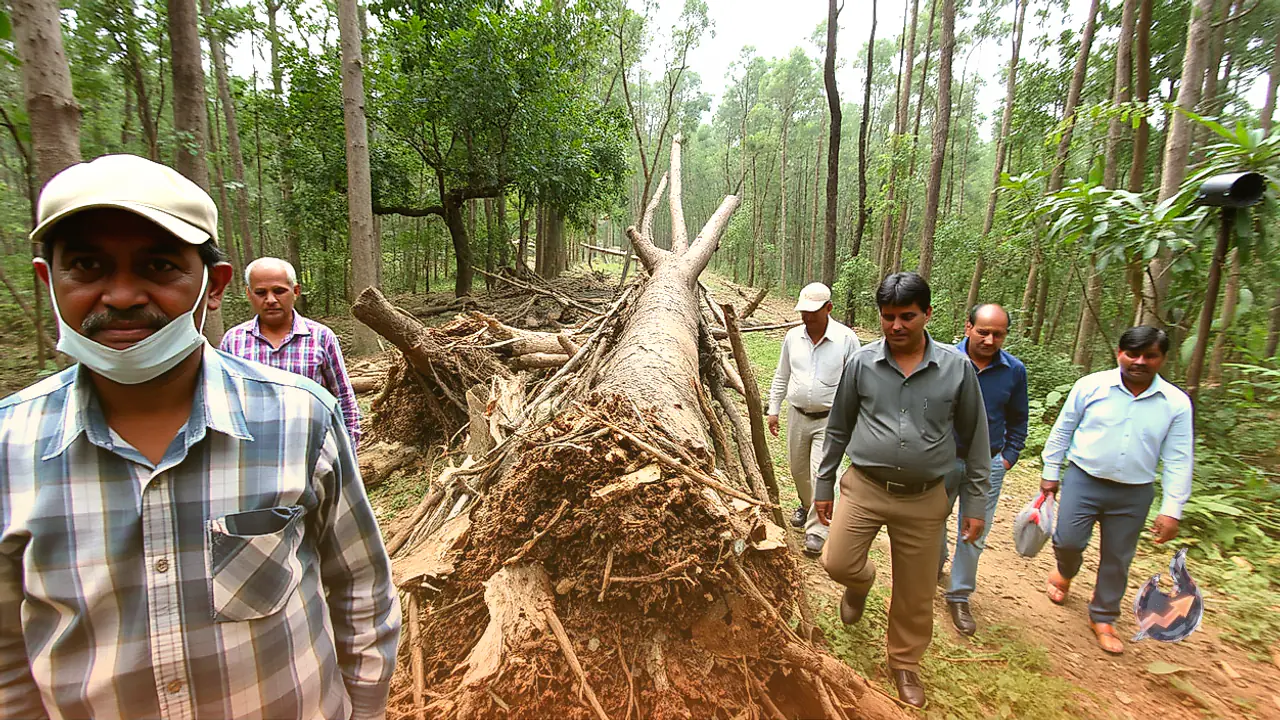
The outbreak in the Dehradun and Kalsi divisions has emerged as a demanding operational challenge for forest managers. The insect infiltrates the trunk of healthy green trees, boring deep passages and feeding continuously on the internal wood fibres. As the core turns into dust, the vital vascular transport of the tree collapses, causing it to die from the inside out. With more than twenty thousand trees identified within the danger zone, the primary concern remains preventing the beetle from spreading uncontrollably into adjacent forest compartments across the state. In order to break the transmission cycle, forest staff are actively identifying infected specimens, felling the most critically damaged trees, and executing specialised trap tree operations.
The Mechanics Behind the Trap Tree Extraction Technique
To curb the spread without relying on hazardous synthetic chemicals across wide forested tracts, officials are utilizing a time-tested biological trapping methodology known as the trap tree operation. According to Divisional Forest Officer Vaibhav Singh of the Dehradun Forest Division, the procedure begins by selecting infested sal trees that have a trunk diameter between 30 and 40 centimetres. Once these selected trees are felled, forest workers thoroughly strike the bark using hammers. This mechanical pressure stimulates the cut trunk to secrete a dense, aromatic natural resin.
The potent scent of the released resin acts as an irresistible attractant, drawing Hoplo beetles out from deep within the wood. Upon consuming the sap, the beetles experience a temporary sedated state, rendering them sluggish and inactive. Stationed forest workers quickly seize these immobilized insects and destroy them on the spot. By neutralizing adult beetles before they can mate and deposit eggs, this intervention directly interrupts the pest's reproductive cycle and protects nearby healthy vegetation.
Eradication Toll: Four Lakh Beetles Caught, 2,500 Trees Cut
DFO Vaibhav Singh confirmed that field teams have successfully eliminated nearly four hundred thousand Hoplo beetles through these coordinated field efforts. Additionally, to remove major reservoirs of larval infestation, authorities have felled more than two thousand five hundred severely infected trees. Officials noted that leaving these dead and heavily infested specimens standing inside the reserve would have posed an extreme biological hazard, serving as incubators for hundreds of thousands of new beetles capable of decimating adjacent tree clusters.
Joint Scientific Task Force Deployed for Field Oversight
To ensure that the management response adheres strictly to scientific protocols, the government has instituted a high-level specialized task force. This combined group brings together experienced entomologists and forestry researchers from the Forest Research Institute in Dehradun, along with technical personnel from the Uttarakhand Forest Development Corporation and the state forest department. Members of the task force conduct daily inspections across the affected compartments, mapping pest densities, analyzing infection trends, and executing field-level control interventions.
A Century of Documentation on Historical Borer Outbreaks
Archival records within the department demonstrate that battles against the sal borer span more than a century rather than representing an unprecedented modern phenomenon. Approved forest working plans for Dehradun dating back to 1934-35 explicitly detail past devastation wrought by Hoplo infestations. Historic records show significant outbreaks documented in Dehradun between 1916 and 1924, followed by another severe episode in the Timli forest tract between 1958 and 1960. Later, during 1964-65, similar widespread infestations were recorded and managed within the Thano forest belt.
Distribution of Sal Forest Reserves Across Uttarakhand
Sal woodlands are distributed across several key territorial divisions and wildlife habitats throughout Uttarakhand. Major stands are located across the Dehradun, Kalsi, Haldwani, Ramnagar, and Haridwar forest divisions. Dense sal tracts also form a substantial part of the Tarai Central, Tarai East, and Tarai West territorial divisions. Furthermore, valuable sal belts thrive within designated protected landscapes, including the Rathuwadhab area of Pauri Garhwal, the globally renowned Corbett National Park, Rajaji Tiger Reserve, Sitabani, and the Pawalgarh Conservation Reserve.