






















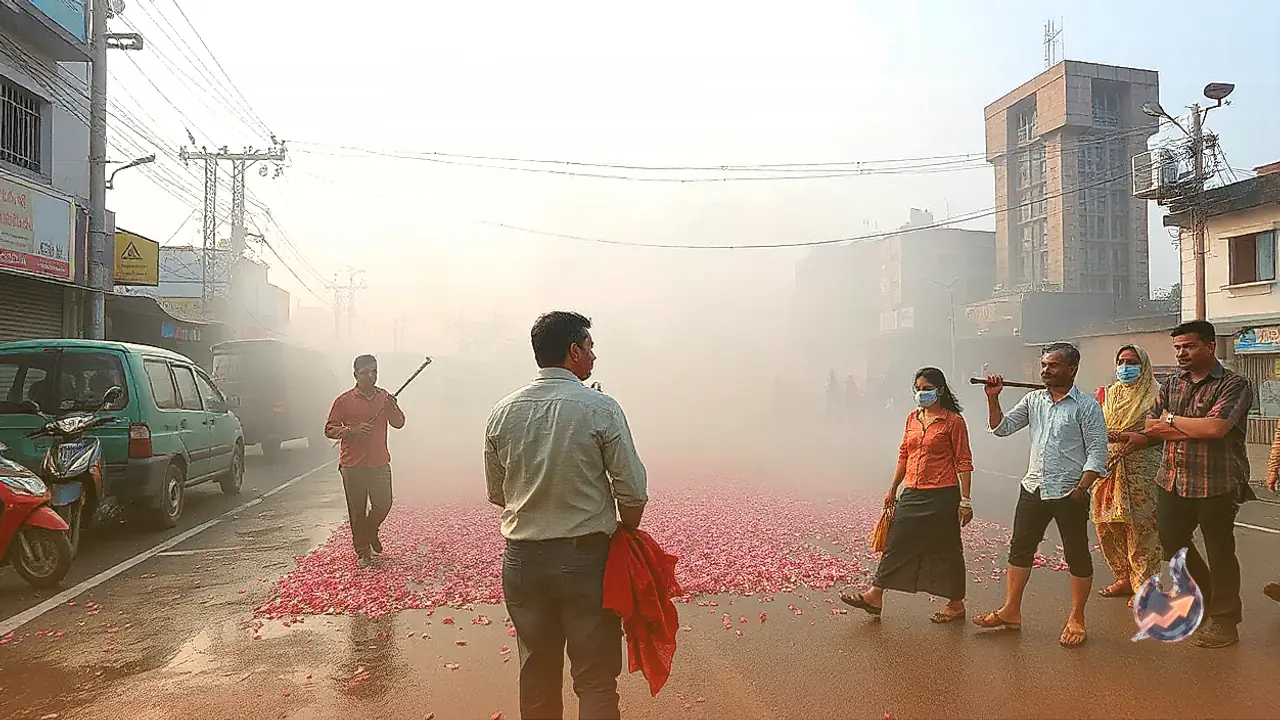

An unusual strategy is underway to cleanse the heavy air in Kolkata, involving the addition of rose water to regular mist sprays across the city. This initiative aims to tackle rising dust levels and control the declining air quality index during special occasions and upcoming festive periods. While municipal authorities believe this will help settle particulate matter while refreshing the surroundings, environmental experts have strongly criticized the approach, labeling it as an ineffective distraction from core ecological issues.
The Plan to Introduce Rose Water Sprays
Ag मित्रा Paul, the Minister for Municipal Affairs and Urban Development in West Bengal, announced this upcoming strategy through a detailed post on Facebook. She explained that the Kolkata Municipal Corporation, operating under strict state directives, has been continuously deploying water mist sprays across various parts of the city. These targeted operations are heavily concentrated in zones where the Air Quality Index consistently remains at elevated levels. According to the minister, the primary objective of this ongoing campaign is to suppress suspended dust particles and maintain better control over the AQI readings. As an extension of this routine drive, administration officials have decided to infuse the mist water with rose water during Kali Puja and other major festive events. The administration argues that this addition will help control airborne dust while simultaneously spreading a pleasant fragrance throughout the immediate environment.
Comparison With London Air Quality Levels
Detailing the inspiration behind her observations, the minister referenced her recent travels to London, where she took note of the remarkably clean atmospheric conditions. She shared that during her visit, she witnessed AQI readings dipping below 10 in multiple neighborhoods and hitting nearly 1 in certain spots, which came as a complete shock to her. In sharp contrast, she pointed out that Kolkata struggles to keep its AQI below 200 for the majority of the year. Describing the local air quality as a matter of deep public health concern, she emphasized that the local administration is utilizing its maximum capacity to deploy continuous corrective efforts.
Environmentalists Slam the Fragrance Initiative
The proposal to use rose water met with immediate and sharp resistance from local environmentalists. Prominent environmental expert Somendra Mohan Ghosh voiced strong opposition, stating that the city requires concrete remedial actions rather than superficial cosmetic displays. Speaking out on Sunday, Ghosh asserted that spraying rose water might create a temporary pleasant aroma, but it completely fails to address the root causes of urban pollution. He remarked that any fragrance from rose water would dissipate within minutes, whereas the municipality should focus its energy on tackling the actual sources of particulate emissions.
Targeting Vehicular Emissions and Open Cooking
Expanding on necessary corrective steps, the environmentalist identified aging diesel and petrol vehicles as the primary drivers behind hazardous PM2.5, PM10, and black carbon levels in the urban atmosphere. He also demanded an immediate end to the widespread practice of cooking with coal at roadside eateries, food stalls, and small vendors. Ghosh suggested that the local government should extend financial aid and necessary logistical support to small vendors, enabling them to transition toward cleaner cooking alternatives like LPG or electric systems. Furthermore, he pitched a concrete proposal for deploying one hundred water cannons across the entire metropolis. According to his assessment, these heavy-duty cannons could efficiently wash down major roads, flyovers, and dust-prone corridors, thereby forcing airborne particles to settle and cleaning accumulated grime off roadside tree foliage.
Current Air Quality Metrics Across the City
Data compiled by the Central Pollution Control Board recorded Kolkata's average PM2.5-based AQI at 165 on Sunday afternoon ahead of the Kali Puja and Diwali celebrations. Under official CAQ parameters, any reading oscillating between 101 and 200 is officially categorized as moderate. However, distinct monitoring stations managed by the West Bengal Pollution Control Board highlighted stark variations in air purity across different municipal zones. On November 7, Kolkata's AQI spiked dramatically to 232, pushing the local atmosphere into the poor category. During this period, areas like Jadavpur and Bidhannagar registered exceptionally high pollution concentrations. Meanwhile, locations such as Ballygunge, Fort William, Rabindra Bharati University, Rabindra Sarobar, and Victoria maintained comparatively moderate air conditions. Whether this fragrant water experiment will yield tangible improvements remains to be seen, but expert pushback has cast serious doubts on its overall utility.