







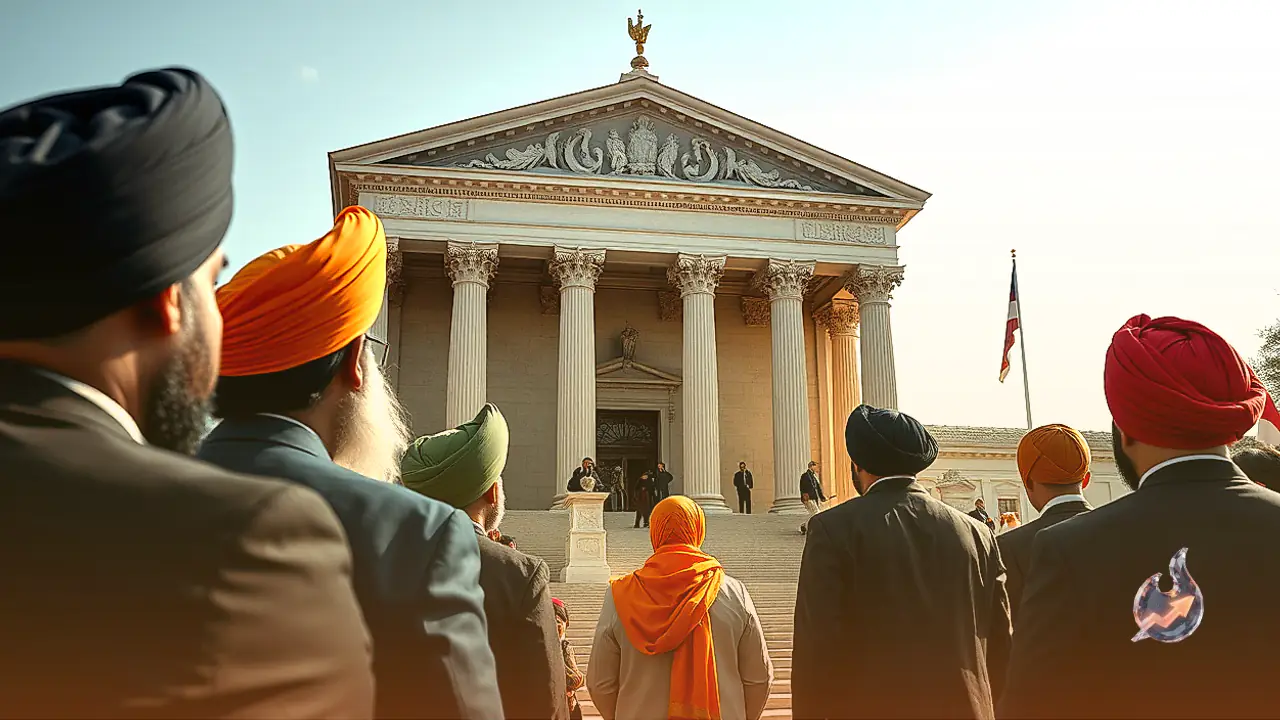















A high-stakes legal contest balancing personal religious convictions against professional licensing requirements has officially reached the highest judicial authority in Canada. Prabhjot Singh Wirring, an Edmonton-based Amritdhari Sikh, initiated the challenge after refusing to take the mandatory oath of allegiance to the British monarch, a statutory prerequisite for admission to the legal profession in the province of Alberta. Arguing that his faith forbids pledging supreme allegiance to any mortal sovereign, Wirring has propelled a fundamental constitutional inquiry to the Supreme Court of Canada regarding the boundaries of religious freedom.
The Collision Between Spiritual Duty and Crown Allegiance
As an Amritdhari Sikh, Wirring has undergone the formal initiation rite where an adherent pledges lifelong, undivided allegiance exclusively to the Almighty, Akal Purakh, in the presence of the Guru Granth Sahib. According to Sikh tenets, taking an equivalent oath of loyalty to a temporal ruler, whether a King or a Queen, directly conflicts with this supreme spiritual covenant. When preparing to embark on his legal career in Alberta, Wirring found that existing provincial statutes required prospective lawyers to swear true allegiance to the reigning British monarch.
This statutory requirement created an uncompromising dilemma: compromise his religious principles to fulfill licensing formalities, or abandon the legal profession altogether. Unwilling to sacrifice his faith or surrender his hard-earned career, Wirring chose to pursue an alternative course by mounting a direct constitutional challenge against the established mandate.
The Evolution of the Litigation Across Provincial Courts
In June 2022, Wirring formally filed legal proceedings against both the Government of Alberta and the Law Society of Alberta. His primary submission asserted that compelling an oath to the King infringed upon his constitutionally protected right to freedom of religion, a cornerstone of the Canadian Charter of Rights and Freedoms.
His initial attempt before the judiciary was unsuccessful. In October 2023, the Court of King's Bench dismissed his application, determining that the oath served a purely symbolic function within the legal system and did not amount to a direct violation of his religious liberties. Rather than accepting the dismissal, Wirring elected to contest the ruling before the provincial appellate bench.
Appellate Victory and Mandate for Statutory Reform
The trajectory of the dispute shifted dramatically on December 16, 2025, when the Alberta Court of Appeal delivered a unanimous ruling from a three-judge panel in Wirring's favour. The appellate court held that forcing prospective legal practitioners to swear allegiance to the monarch constituted an unjustifiable infringement upon freedom of religion, rendering the requirement unconstitutional in its compulsory form.
Consequently, the appellate bench directed that provincial legislation must be either amended or rescinded to accommodate religious exemptions for candidates whose beliefs prevent them from taking such an oath. This ruling marked a pivotal milestone for constitutional protections surrounding religious observance within regulated professions.
Divergent Provincial Standards and the Push to the Supreme Court
The significance of the appellate determination is accentuated by the reality across other Canadian jurisdictions. Provinces including British Columbia, Saskatchewan, and Ontario have already eliminated mandatory oaths to the British monarch for prospective lawyers or provided suitable alternatives that accommodate diverse religious and philosophical beliefs. The ruling in Alberta represented a move toward aligning the province with these nationwide standards.
However, the provincial administration in Alberta contested the appellate decision. Maintaining that the requirement warranted definitive federal clarification, the Alberta government filed an appeal before the Supreme Court of Canada in February 2026. In August 2026, the nation's highest court formally agreed to hear the case, setting the stage for a conclusive constitutional judgment.
Broader Ramifications for Professional Freedoms
The pending Supreme Court verdict will determine whether provincial governments possess the constitutional authority to mandate monarchical oaths from legal practitioners, and clarify the precise scope of exemptions that must be granted to individuals with conflicting religious tenets. The outcome carries profound implications for the legal sector and minority communities across Canada.
What began in 2022 as an individual refusal to compromise personal faith has transformed over four years into a defining landmark in Canadian constitutional jurisprudence, garnering widespread attention and support from the Sikh community as it approaches its final hearing.