



















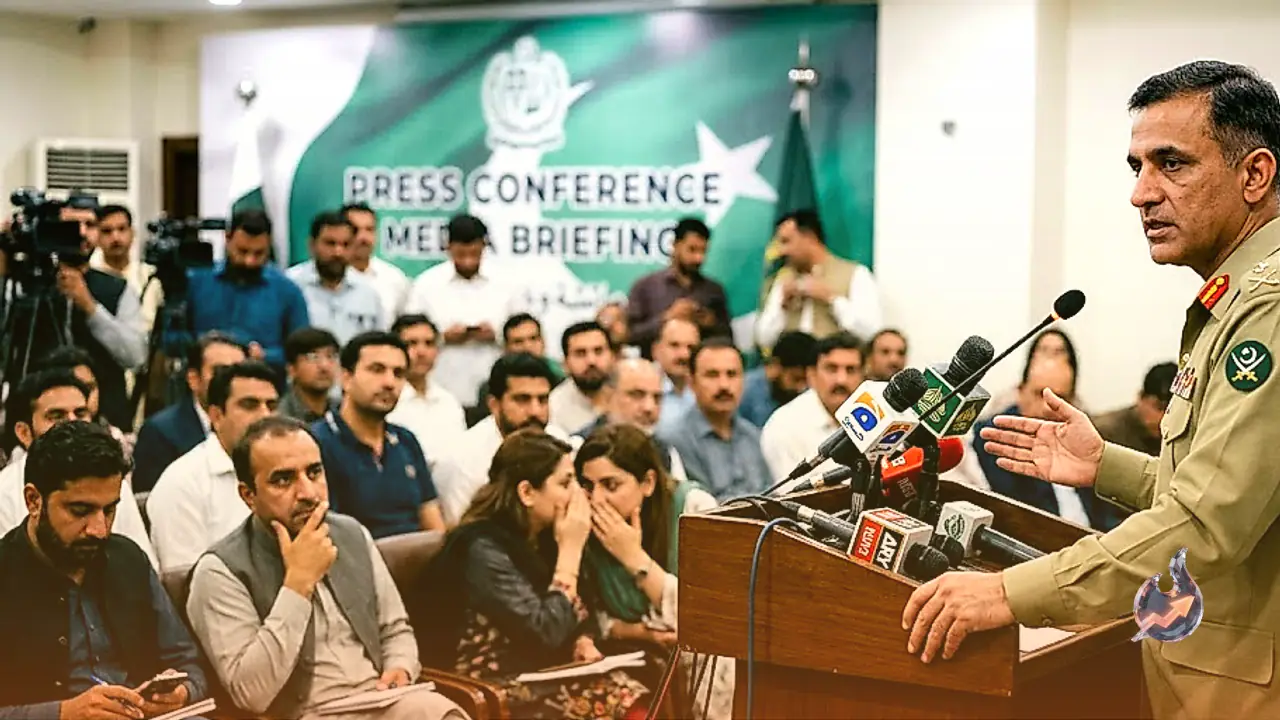

A recent media briefing delivered by Ahmed Sharif Chaudhry, the spokesperson for Pakistan's military information wing, DG ISPR, has ignited intense diplomatic and political controversy. Speaking during a press event held in Rawalpindi, the defense official engaged in overt communal rhetoric, making inflammatory statements regarding regional nations and religious identities. Analysts suggest that these remarks reflect the escalating internal instability and diplomatic pressure currently surrounding the civil-military leadership in Islamabad and Rawalpindi. During the address, Chaudhry cited religious texts to advocate for social separation from non-believers, while simultaneously asserting controversial claims about the biological and cultural heritage of Afghan and Indian citizens. The public dissemination of such reckless rhetoric has deepened diplomatic friction between Pakistan and its immediate neighbors, while raising alarming questions about the safety and fundamental rights of non-Muslim minority populations, particularly Hindus, residing within Pakistan.
Communal Rhetoric and Controversy Over Shared DNA
Throughout the press interaction, the military spokesperson leaned heavily into explicit religious polarization. He asserted that believers must refrain from establishing friendships with non-believers, warning that doing so compromises one's religious standing. Expanding on these remarks, Ahmed Sharif Chaudhry stated, "Do not make friends with non-believers, except those who believe, otherwise you do not count among Muslims." He then directed his focus toward relations between Afghan citizens and India, claiming that many Afghans openly acknowledge a shared genetic lineage or DNA with the Indian population. Based on this assertion, Chaudhry questioned how Afghan citizens could claim their religious identity if such biological commonality exists. Diplomatic observers have condemned these statements as a blatant breach of international protocol and decorum. When an official spokesperson of a nation's armed forces uses state platforms to disseminate sectarian hostility, it provides implicit encouragement to extremist elements within the country to target vulnerable religious minority communities and incite localized violence.
Escalating Friction With Kabul and the Afghan Taliban
While the Pakistani security establishment previously viewed the Afghan Taliban as a vital strategic asset in the region, that relationship has deteriorated into a major security dilemma for Islamabad. During the briefing, DG ISPR launched a sharp critique against the Taliban administration currently governing Kabul. He alleged that the Afghan Taliban's governance model and national economy are entirely dependent on terrorism and armed violence. According to the spokesperson, the banned militant organization Tehreek-e-Taliban Pakistan (TTP) works in direct coordination with the Kabul administration. Chaudhry asserted that the Afghan leadership relies on terrorism to sustain its domestic governance, manage its state finances, and execute its foreign policy. Turning his attention to growing bilateral ties between New Delhi and Kabul, Chaudhry claimed that the only factors uniting India and Afghanistan are their shared DNA and a mutual reliance on terrorism. These aggressive remarks underscore the rapidly deteriorating security and diplomatic relationship along the Durand Line.
New Security Terminology: 'Fitna-al-Khawarij' and 'Fitna-al-Hindustan'
In an effort to reframe its ongoing security failures and domestic law-and-order challenges, the Pakistani state and military have introduced new Arabic and religious terminology to describe active insurgent groups. During the conference, the military spokesperson introduced specific official designations for different armed factions. The Pakistani government has officially designated Tehreek-e-Taliban Pakistan (TTP) as 'Fitna-al-Khawarij' in an attempt to delegitimize the group's religious claims. Concurrently, armed Baloch nationalist groups fighting for regional autonomy in Balochistan have been labeled 'Fitna-al-Hindustan' by the military establishment. This naming strategy is designed to attribute every manifestation of Baloch political dissent and armed resistance directly to external sponsorship from India. Chaudhry noted with skepticism that while Baloch rebels adhere to a secular and nationalist ideology, TTP represents an extreme religious ideology. Yet despite these ideological differences, the military claims both groups are conducting joint operational activities against the Pakistani state. Defense analysts view these new classifications as an attempt by Rawalpindi to project domestic insurgencies as part of a coordinated external conspiracy.
Balochistan Unrest and the Narrative of External Subversion
A substantial portion of the military briefing focused on the volatile situation in Balochistan, where a long-running armed insurgency continues to challenge state authority. The spokesperson attributed the persistent violence and civil unrest in the province entirely to the intervention of foreign powers. He claimed that local tribal leaders and the political elite in Balochistan share a common agenda aimed at facilitating foreign interference. According to the defense wing, external powers recognize Balochistan's strategic position, its rich mineral wealth, and the vast economic potential of its coastal blue economy. Chaudhry argued that the economic development of Balochistan would drive progress across Pakistan, leading foreign adversaries to actively collaborate with local militants and tribal leaders to obstruct developmental projects. However, independent observers note that the unrest in Balochistan stems from decades of state-backed resource exploitation, human rights abuses, and the widespread phenomenon of enforced disappearances. By framing the indigenous discontent as an external plot, the military continues to avoid addressing the core political grievances of the Baloch people.
Internal Failures and the Pattern of External Blame
Pakistan's political history illustrates a repeating pattern wherein the civil-military apparatus resorts to anti-India rhetoric and religious polarization whenever internal governance breaks down. Presently, Pakistan faces compounding challenges, including severe economic distress, hyperinflation, political instability, and escalating militant attacks across its border regions. Under these circumstances, the military's emphasis on sectarian divisions, genetic arguments, and external threat narratives is viewed by political analysts as a calculated effort to distract the public from systemic domestic failures. International affairs experts warn that utilizing official military channels to broadcast sectarian hostility damages regional stability and places domestic minority populations at heightened risk. Global observers increasingly recognize that externalizing internal security failures cannot restore domestic stability, and that long-term security requires genuine institutional reform rather than divisive public statements.