























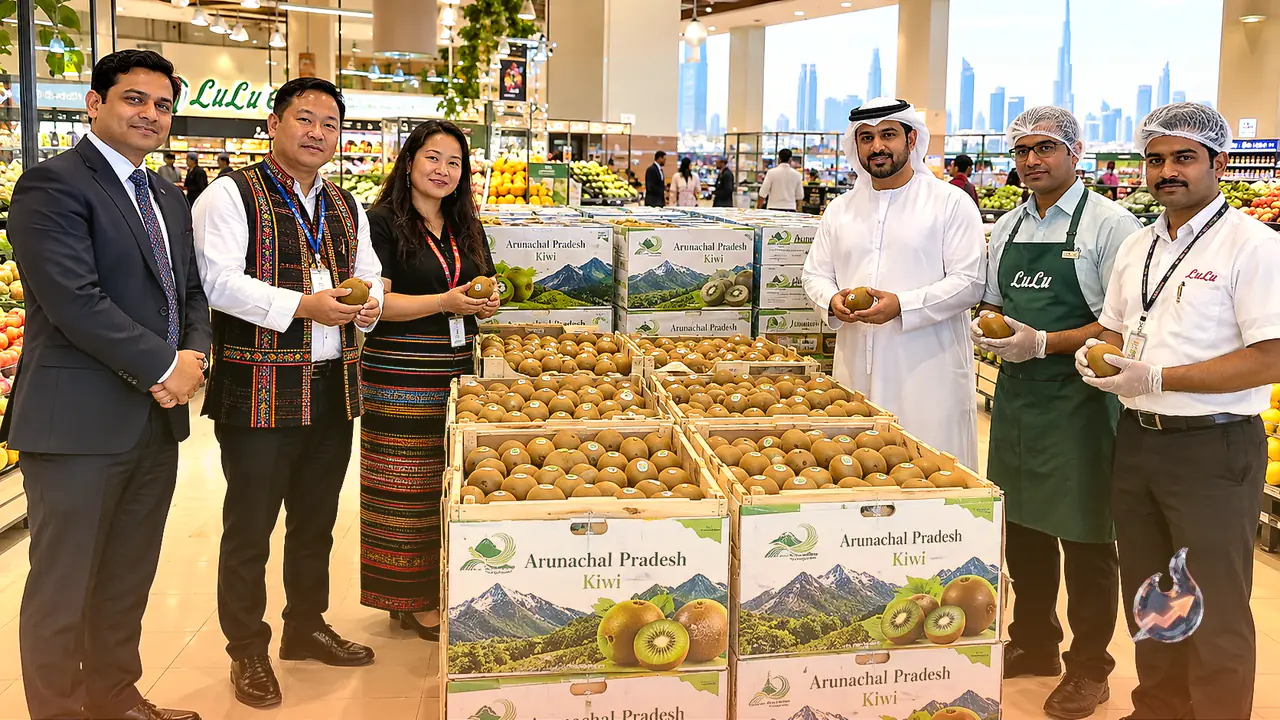

Horticulture growers in the northeastern state of Arunachal Pradesh have crossed a major trade threshold as their produce debuted on international retail shelves. An initial experimental consignment of locally cultivated kiwis arrived in the United Arab Emirates, where it was put on retail display at the LuLu Hypermarket situated in Dubai's Al Qusais locality. The cross-border movement represents an operational push to evaluate commercial appetite for the state's premium agricultural yield in the wider West Asian market.
Journey from Itanagar to West Asian Retail
Logistical operations for the cargo began on October 26, when authorities flagged off the inaugural consignment directly from the state capital of Itanagar. Rather than functioning as a routine domestic distribution, this specific dispatch was structured as an exploratory trial to test transit resilience, preserve freshness, and gauge direct shopper reception in an overseas metropolis. Placing the fruit inside a leading regional retail chain offers direct visibility among international grocery consumers and overseas purchase managers.
Elevating Incomes Across Rural Orchards
Commending the cross-border delivery, Chief Minister Pema Khandu stated that connecting growers' hard work to overseas commercial centres establishes fresh avenues for higher earnings and reliable rural livelihoods. For decades, fruit producers throughout the remote hill terrain have confronted significant geographic hurdles, often absorbing lower margins due to multiple distribution layers and restricted domestic market links. Opening regular export corridors directly addresses these limitations by connecting remote growers to lucrative overseas buyers willing to pay for quality produce.
Collaborative Institutional Framework
Realizing the dispatch required synchronized coordination across both central and state bodies. Key contributors facilitating the transport included the Arunachal Pradesh Department of Trade and Commerce, the Department of Horticulture, the Agricultural and Processed Food Products Export Development Authority (APEDA), alongside the Kiwi Growers Cooperative Society. While the cooperative and horticulture teams supervised orchard-level quality selection and handling protocols, trade departments and APEDA navigated the regulatory clearances, freight channels, and international phytosanitary compliance needed to clear customs in Dubai.
Commercial Horizons for State Horticulture
Arunachal Pradesh possesses ideal agro-climatic conditions for temperate fruits, yet turning that natural advantage into commercial viability depends entirely on distribution infrastructure. Showcasing the harvest at an established retail hub like LuLu Hypermarket offers proof of concept for the region's produce supply chains. If sustained retail demand follows this initial display, agricultural officials expect the framework to serve as a repeatable model, encouraging larger commercial plantings and potentially paving the way for other regional horticultural varieties to reach foreign markets.