






















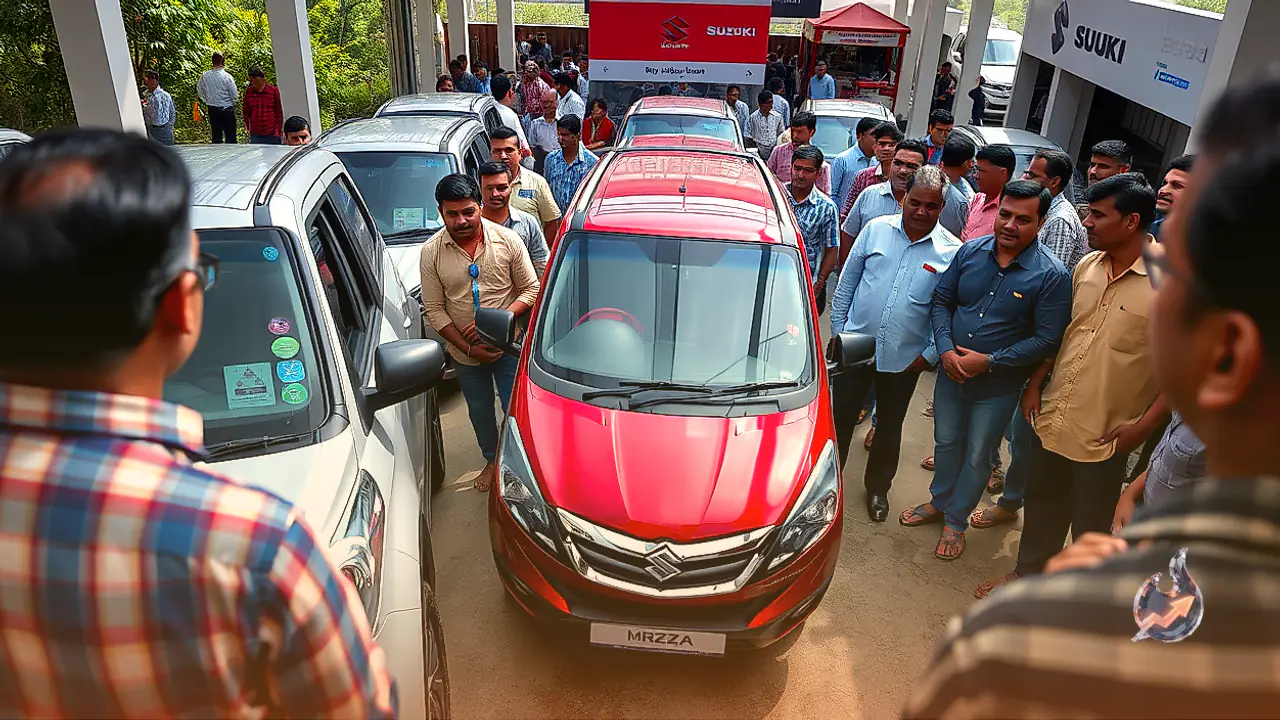

Competition in the Indian subcompact SUV arena continues to intensify, and Maruti Suzuki Brezza has cemented its market standing by crossing the milestone of 1.5 million cumulative deliveries since its launch in 2016. The vehicle has consistently maintained a commanding share in the sub-four-metre category. Building on this momentum, the refreshed edition rolled out in July 2026 has witnessed strong showroom traffic, accumulating more than 100,000 reservations in a short span.
CNG and Turbo Powertrains Drive Fresh Orders
Booking patterns show notable changes in buyer preferences across different mechanical configurations. The factory-fitted bi-fuel CNG version represents nearly 40 percent of overall reservations. Close behind is the newly added turbo-petrol powertrain, which accounts for 38 percent of customer choices. Meanwhile, the established 1.5-litre naturally aspirated petrol unit makes up the remaining 22 percent. Confronted with this sharp influx of purchase orders, the manufacturer has undertaken factory volume ramp-ups to keep delivery timelines manageable for waiting customers.
Subtle Cosmetic Revisions and Fresh Paint Choices
The exterior styling reflects deliberate cosmetic refinements that enhance the vehicle's road presence. Its front end displays an updated radiator grille finished in smoke chrome, resting alongside a reshaped bumper and a silver skid plate. Dual LED projector headlamps paired with integrated LED daytime running lights continue to handle illumination duties. The profile features updated 16-inch dual-tone alloy wheels matched with redesigned body cladding. At the rear, the vehicle carries revised LED tail-lamp units and a re-sculpted bumper. Broadening the aesthetic spectrum, two new body colors, Vivacious Orange and Lusters Beige, have been added to the catalog.
Enhanced Cabin Ambience, Seating, and Infotainment
Inside, the passenger space adopts an updated dual-tone theme pairing dark brown and black tones, enhanced by piano black accents and metallic soft-touch surfaces. The seating is wrapped in brown leather upholstery, while the second row incorporates winged headrests to bolster passenger relaxation during long journeys. Taking central position on the dashboard is a 10.1-inch floating touchscreen infotainment interface equipped with wireless Apple CarPlay and Android Auto support. The amenity roster includes ventilated front row seats, a 64-color ambient light array, a PM 2.5 particulate air purifier, an inductive phone charging pad, an electric sunroof, a heads-up display, and telematics-based connected vehicle technology.
Five-Star Crash Protection Verified by Bharat NCAP
Occupant safety forms a central pillar of the model's market positioning, highlighted by a five-star crash test rating from Bharat NCAP. Standard and optional active safety gear encompasses six airbags, electronic stability control (ESC), and hill hold assist. Drivers also benefit from a 360-degree surrounding camera system, front and rear ultrasonic parking sensors, a tire pressure monitoring system (TPMS), blind spot warning, and rear cross-traffic alert systems.
Engine Outputs, Certified Economy, and Pricing
Under the bonnet, the 1.5-litre four-cylinder naturally aspirated petrol unit generates 103 PS and 139 Nm of torque, linked to either a 6-speed manual or a 6-speed torque-converter automatic transmission. For drivers seeking greater responsiveness, the 1.0-litre Boosterjet turbo-petrol engine puts out 110 PS and 170 Nm of torque, offered exclusively with a 6-speed manual gearbox. In the bi-fuel CNG configuration, an underbody tank structure keeps the full 328 litres of cargo luggage space intact. Certified fuel economy stands at 20.17 to 21.09 km/l for the 1.5-litre petrol, 19.96 to 20.47 km/l for the turbo engine, and 26.90 km/kg for the CNG variant. Starting at an ex-showroom tag of Rs 7,49,900, the vehicle continues its rivalry with opponents such as Tata Nexon, Hyundai Venue, and Kia Sonet.