



















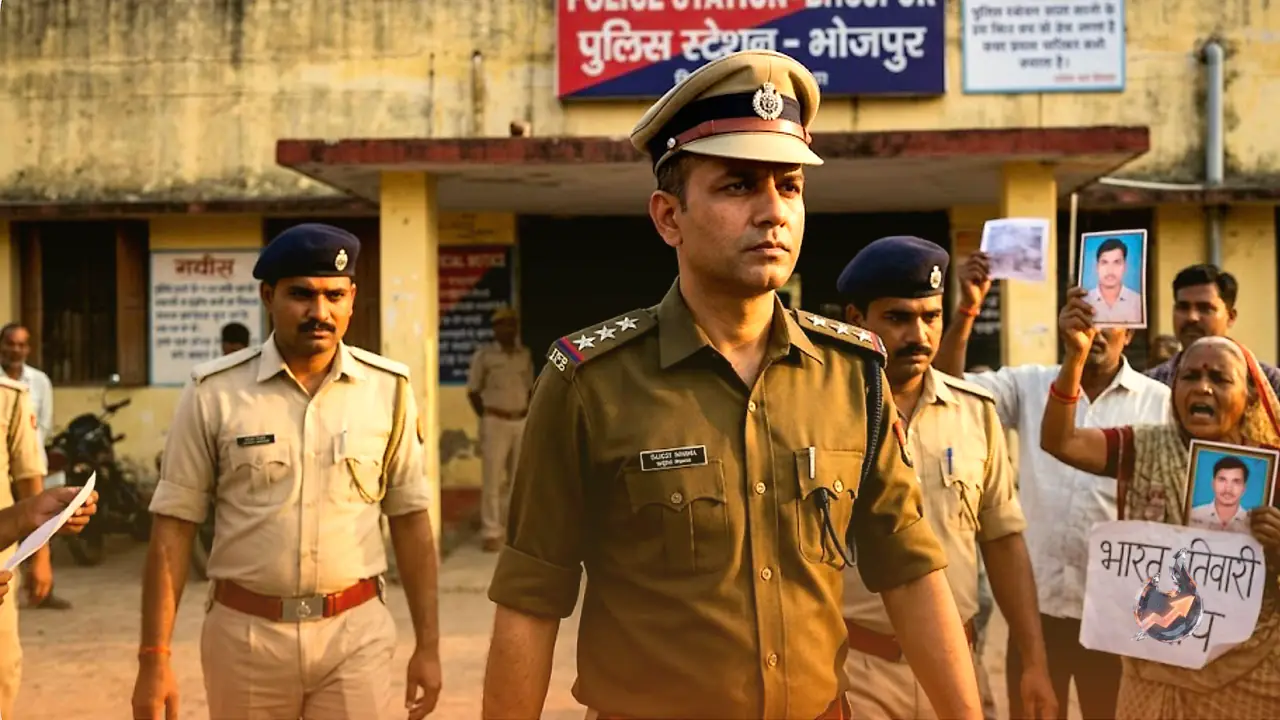

Amid a fresh round of transfers in the Bihar Police, one name is dominating the conversation, DSP Rajesh Sharma. He has been given a new posting within weeks of a murder FIR being registered against him in the much talked about Bharat Tiwari alleged encounter case out of Bhojpur district, and that decision has pushed the entire case back into the spotlight. The family of the deceased, Bharat Tiwari, has raised sharp questions over the posting. What makes the episode more striking is that Rajesh Sharma's name had already surfaced about 19 years ago in an alleged fake encounter case in Muzaffarpur. So who exactly is Rajesh Sharma, what has his police career looked like, and why has his latest posting landed in controversy?
DSP Rajesh Sharma's career so far
Rajesh Sharma is counted among the senior officers of the Bihar Police. He began his career as a Daroga, or sub-inspector. Over the following years he served as station in-charge and inspector in various districts. After a long stint in service he was promoted and rose to the rank of DSP, or SDPO. In recent years he was posted as SDPO of the Jagdishpur subdivision in Bhojpur district. But his career has not been free of controversy. First the alleged fake encounter in Muzaffarpur, and now the Bharat Tiwari encounter case, have both raised questions about the way he has functioned.
How does one become a DSP in Bihar?
The most direct and prominent route to becoming a DSP in Bihar is the combined competitive examination conducted by the Bihar Public Service Commission, or BPSC. This exam has three stages, a preliminary exam, a main exam and an interview. Candidates who clear all three stages get the DSP post based on merit and preference. A candidate must be a graduate to sit for this exam, and the age limit is fixed as per government rules. After selection through BPSC, officers are given professional training at the Bihar Police Academy. This training focuses on the study of law, field policing, crime investigation, administrative work and leadership skills, so that an officer can handle responsibility on the ground.
DSPs are also made through promotion
Bihar Police rules also allow inspectors already in service to become DSPs through departmental promotion. For this, an inspector has to complete a fixed period of service and must have a clean service record. Such promotions are decided by a departmental selection committee and require approval from the state government's home department, all carried out under Bihar Police rules. Rajesh Sharma too became a DSP this way, through promotion from the rank of inspector.
Uproar as his name appears on the transfer list
The Bihar government recently transferred 12 IPS officers and 53 DSP officers. In that same list, Rajesh Sharma was given a new charge as DSP in the Prohibition and Excise, Narcotics Control unit. As soon as this decision became public, Bharat Tiwari's family expressed strong anger. The family says that handing a new responsibility to an officer facing an FIR that includes murder charges, before the investigation is even complete, goes against the spirit of justice. Their direct allegation is that Rajesh Sharma has effectively been rewarded with this new posting in exchange for the killing of Bharat Bhushan Tiwari.
What exactly is the Bharat Tiwari encounter case?
On June 17, Bharat Tiwari, a resident of Bilauti village under the Shahpur police station area of Bhojpur district, died in a police encounter. The police claim there was a confrontation with Bharat during an operation, but his family's account is entirely different. The family says Bharat was doing a Facebook Live at the time and had thrown down his weapon and surrendered in front of the police. Despite this, they allege, policemen pushed him into a pit and shot him. The family further alleges that the then SDPO, Rajesh Sharma, ordered the policemen present at the spot to open fire. Bharat, critically injured, was taken to hospital, where he later died.
Murder FIR registered against several policemen
On a complaint filed by Bharat Tiwari's mother, Asha Devi, a case was registered at Shahpur police station under several serious sections including murder. The FIR names the then SDPO Rajesh Sharma, the then station in-charge Rajesh Malakar, and other policemen involved in the encounter as accused. After the FIR was registered, Rajesh Sharma was removed from his post and directed to report to police headquarters. He was subsequently given his new posting in the Prohibition and Excise, Narcotics Control unit.
Family says hope for justice is fading
Bharat Tiwari's father, Kashinath Tiwari, says his hope of getting justice keeps growing weaker. He believes that handing a new responsibility to an accused officer in such a serious murder case sends the wrong message. The family alleges that the state government and the police department are not treating the matter with the seriousness it deserves. They have made it clear that their protest will continue until action is taken against the guilty, and that they will also pursue the fight in court. Rajesh Sharma's new appointment is currently being described as part of a routine administrative process, but neither the police department nor the state government has publicly clarified the circumstances under which he received a new posting despite the FIR against him. That silence is precisely why questions around the decision keep piling up.
A 19 year old Muzaffarpur encounter resurfaces
Following the Bharat Tiwari case, an old matter from 2007 has also come back into the news. At that time, Rajesh Sharma was the in-charge of the Sadar police station in Muzaffarpur. On the night of November 4, 2007, police took three young men along with them for questioning. The next day, the bodies of Manish Mahiwal, Mukul Thakur and Subodh Kumar Singh were found near MIT College. The police had offered their own version of events at the time as well, but the case never fully escaped suspicion. The Bharat Tiwari encounter case has now brought this old chapter of Rajesh Sharma's career back under public scrutiny too.