






















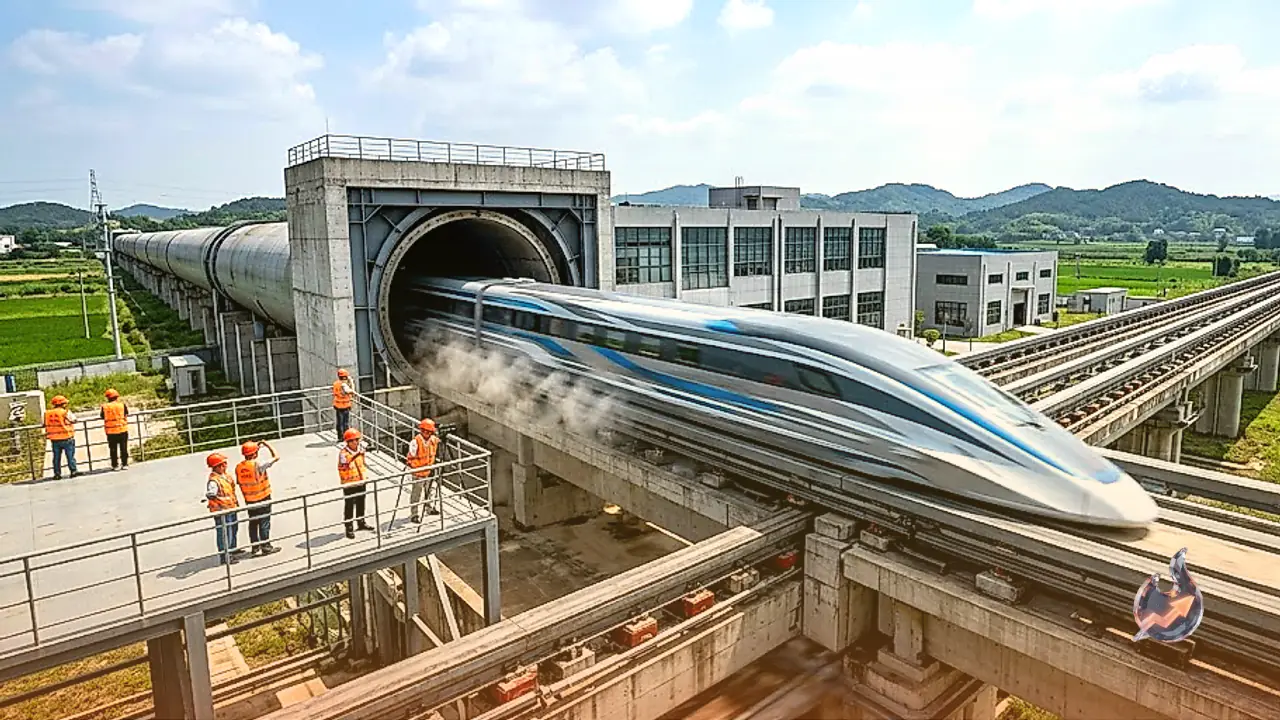

Engineers and scientists in China have successfully conducted a speed test of an experimental maglev model train, reaching a record-breaking speed of 800 kilometers per hour on a specially designed 1-kilometer test track in Hubei province. Developed by the China Aerospace Science and Industry Corporation (CASIC), the High-Speed Flying Train project aims to ultimately build a commercial transport system capable of operating at speeds of 1,000 kilometers per hour or higher. This test marks the project's third world record within the past six months, underscoring rapid progress in vacuum tube magnetic levitation technology.
Key Specifications of the Hubei Maglev Test
The experimental vehicle used in the test was a model train weighing approximately 1,110 kilograms. Run along a 1-kilometer track composed of concrete and high-grade steel, the vehicle demonstrated extreme acceleration, capable of reaching 800 kilometers per hour in just 5.3 seconds. To put such velocity into perspective, a journey between major hubs like Delhi and Patna could theoretically take only about an hour and fifteen minutes at these speeds. At present, however, the train remains a scaled testing model meant to gather critical telemetry, structural stability data, and safety parameters for future full-scale iterations.
How Magnetic Levitation Eliminates Track Friction
Standard railway systems rely on physical contact between steel wheels and metal tracks, which creates substantial mechanical friction. As speeds increase, this friction demands exponentially higher energy inputs and causes severe wear and tear. Maglev (magnetic levitation) technology overcomes this fundamental bottleneck by employing powerful electromagnets to suspend the train in mid-air above the track. Because the train does not physically touch the rail, mechanical friction is effectively reduced to zero. Linear electromagnetic wave propulsion is then used to pull and propel the vehicle forward at high velocities.
Aerodynamic Drag Reduction via Low-Pressure Vacuum Tubes
While eliminating wheel friction allows trains to travel much faster, air resistance or aerodynamic drag becomes the dominant obstacle at speeds above several hundred kilometers per hour. To overcome air drag, the High-Speed Flying Train runs inside a sealed, low-pressure tube. Powerful vacuum pumps extract most of the air from within the tube, dramatically lowering the internal atmospheric pressure. With minimal air remaining in front of the vehicle, aerodynamic drag drops significantly, allowing the train to reach speeds comparable to commercial jet aircraft while consuming far less energy.
Precision Engineering and 0.5 mm Alignment Tolerances
Operating a vehicle at 800 kilometers per hour leaves zero room for structural defects or track misalignments. To ensure maximum stability and prevent catastrophic failure during high-speed runs, the 1-kilometer concrete and steel test track in Hubei was constructed with extreme engineering precision. The allowable alignment error along the entire length of the track was capped at just 0.5 millimeters. Coupled with non-contact electromagnetic wave propulsion, this precise alignment allows the vehicle to maintain smooth acceleration and stability throughout the trial.
Three World Records in Six Months and Future Roadmap
The Hubei trial represents the third speed milestone set by the CASIC development team in the last six months. In an earlier phase of testing, a full-scale maglev vehicle achieved approximately 623 kilometers per hour inside a low-pressure tube, which was then recorded as the fastest speed for a full-sized vehicle in such a system. The new record of 800 kilometers per hour set by the 1,110 kg model vehicle demonstrates the phased progression of the project. Initial development focused on standard maglev technology up to 600 km/h, while current trials integrate low-pressure tubes to achieve the ultimate goal of 1,000 km/h and beyond.
Commercial Potential and Engineering Challenges
If successfully commercialized at 1,000 kilometers per hour, flying maglev trains could revolutionize long-distance ground transit, drastically cutting travel times on heavily frequented routes like Beijing to Shanghai to a fraction of current high-speed rail and commercial flight durations. Nonetheless, several formidable challenges must be resolved before passenger operations become feasible. Ensuring passenger safety at near-sonic speeds, maintaining vacuum pressure over hundreds of kilometers of tubing, providing emergency evacuation systems, and managing the immense infrastructure and construction costs represent key technical hurdles.
Applications in Aerospace and Defense Systems
The core technologies underlying the flying train extend beyond passenger transportation. CASIC is actively researching cross-industry applications for these high-speed electromagnetic systems. For instance, electromagnetic launch systems could be used to provide initial kinetic velocity for satellites and spacecraft entering orbit, reducing onboard fuel requirements. Additionally, similar electromagnetic catapult technology is deployed on naval aircraft carriers to launch heavy fighter aircraft within short deck distances, demonstrating the broad strategic utility of advanced magnetic propulsion.