





















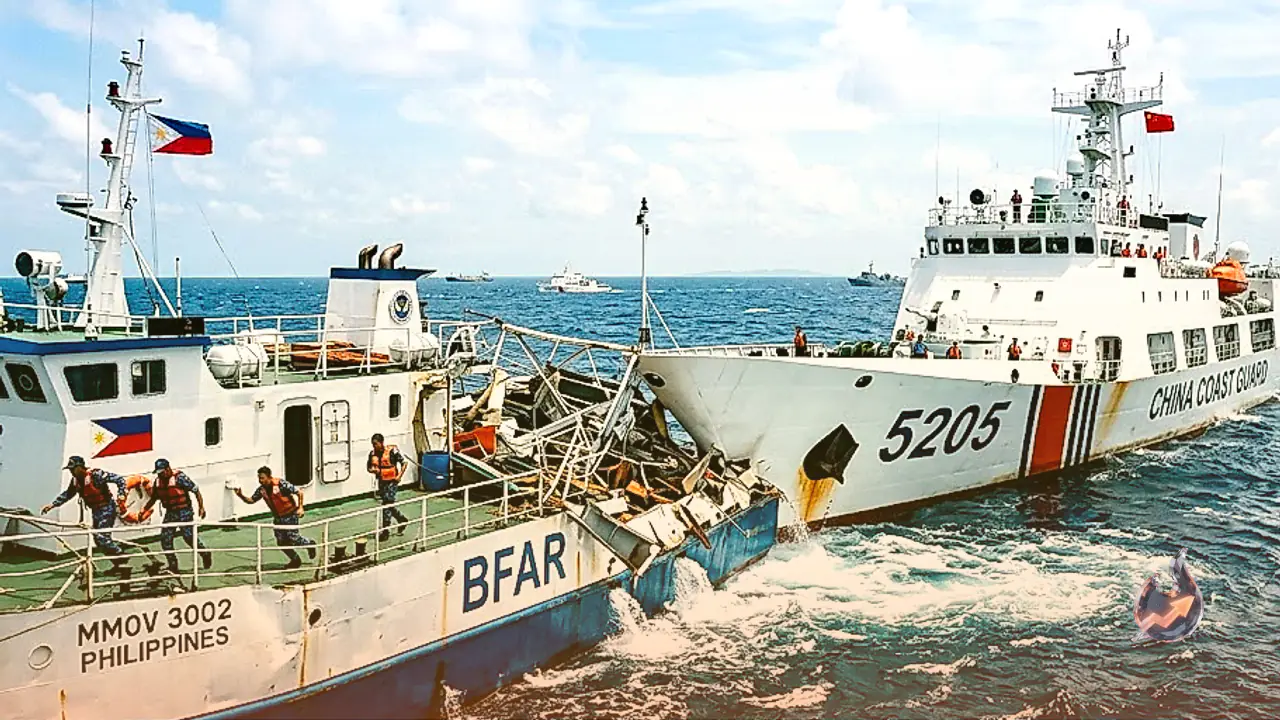

A high-stakes maritime confrontation erupted in the disputed waters of the South China Sea when a massive Chinese Coast Guard vessel collided with an official civilian boat operated by the Philippine government. The incident unfolded as Philippine personnel were conducting a humanitarian support mission intended to assist local artisanal fishermen operating far off the coastline. The impact of the collision inflicted substantial physical damage on the Philippine vessel, tearing away sections of its metal deck and defensive railings. In the wake of the encounter, tensions between Beijing and Manila have escalated sharply, with Chinese authorities refusing to accept fault and instead accusing the Philippine crew of unlawful conduct.
Detailed Sequence of Events Near Sabina Shoal
The maritime clash occurred on Friday morning at approximately 11:13 AM when the vessel BRP Datu Magat Salamat, operated by the Philippine Bureau of Fisheries and Aquatic Resources, was carrying out a scheduled support sortie. The craft was situated roughly 54 nautical miles off the coast of Palawan province, moving through waters where local Filipino fishermen routinely gather to secure their daily catch. The primary purpose of the government mission was to distribute diesel fuel along with vital food and gear packages to ensure that individual fishing crews could safely maintain their offshore livelihood.
During the operation, a substantially larger China Coast Guard vessel approached the civilian craft and initiated high-risk tactical maneuvering in close proximity. Without warning, the Chinese patrol ship closed the distance and slammed heavily into the side of the Philippine boat. The abrupt collision sheared structural supports along the outer edge of the Philippine vessel, leaving debris scattered across its forward surface.
Crew Reaction Under Danger and Structural Hull Damage
Video documentation released by the Philippine Coast Guard captured the intense distress experienced by the personnel aboard the BRP Datu Magat Salamat during the incident. Seconds prior to the violent contact, crew members could be heard shouting urgent instructions to prepare for impact, bracing against bulkheads to withstand the physical shock.
The force generated by the collision twisted the ship's protective iron railing completely out of shape and broke several metal structural points. Heavy debris littered the deck following the impact. Despite the severity of the exterior damage sustained by the vessel, authorities confirmed that none of the government employees or maritime crew members suffered injuries during the collision, preventing the event from escalating into a fatal disaster.
Contrasting Positions and Statements from Manila and Beijing
The encounter has triggered an intense diplomatic exchange between the two capitals, with each administration asserting a fundamentally conflicting version of events. The Philippine Coast Guard issued a formal statement strongly denouncing the maneuver, describing it as an unprovoked and deliberate ramming of an unarmed civilian vessel engaged exclusively in maritime welfare and humanitarian duties.
Conversely, the China Coast Guard presented its own defense regarding the clash near Sabina Shoal, maintaining that its personnel acted in strict accordance with domestic maritime regulations. Chinese maritime officials claimed that the Philippine boat repeatedly disregarded official radio warnings, altered its navigational direction abruptly, and surged forward at high speed across the path of the Chinese patrol ship. Based on this account, Beijing asserted that the entire legal and operational liability for the collision rests squarely with the Philippine side.
Parallels to the Recent Maritime Incident in the Arabian Sea
The dangerous standoff in the South China Sea closely mirrors an equally perilous encounter that occurred only days earlier in the Arabian Sea between the navies of India and Pakistan. During that incident on a Tuesday evening, a Pakistani naval vessel, PNS Hunain, made physical contact with an advanced front-line Indian Navy warship near India's Exclusive Economic Zone in international waters.
The impact in the Arabian Sea caused a massive dent to the forward bow structure of the Pakistani warship, forcing it to immediately terminate its mission and limp back to its home port for extensive dockyard repairs. In stark contrast, the Indian Navy warship sustained negligible damage, remaining entirely mission-capable and continuing its operational escort duties to protect merchant shipping transiting from the Gulf of Oman. The hazardous collision prompted New Delhi to lodge a stern diplomatic protest with Islamabad over the reckless conduct of its naval personnel.
Pattern of Prior Clashes Across Contested South China Sea Waters
The collision near Sabina Shoal is not an isolated event but part of an ongoing cycle of maritime confrontations between Chinese and Philippine vessels in contested waters. Earlier in July, both countries were involved in hostile clashes across multiple maritime formations.
During an confrontation near Scarborough Shoal in July, Chinese vessels deployed high-pressure water cannons against Philippine state-operated boats, disabling key shipboard systems. Additionally, during a standoff at Second Thomas Shoal, Chinese personnel armed with wooden batons assaulted Philippine naval personnel, inflicting a severe head wound on a Philippine service member.
Sovereignty Disputes and the Growing Risk to Global Shipping
Repeated collisions between naval and coast guard vessels in critical sea lanes present an alarming risk to freedom of navigation. Beijing claims sovereignty over nearly the entirety of the South China Sea, drawing direct opposition from neighboring nations including the Philippines, Vietnam, and Malaysia, whose internationally recognized maritime zones overlap with Chinese assertions.
Whenever regional littoral states attempt to deploy humanitarian or regulatory patrols to support their fishermen, Chinese state vessels actively seek to intercept and repel them. Defense and maritime analysts emphasize that ramming non-military ships and executing dangerous intercept maneuvers violate fundamental international maritime conventions. Unchecked aggression of this nature significantly raises the probability of a minor tactical dispute triggering an unintended military escalation across the Indo-Pacific region.