





















Drawing critical lessons from the deadly Galwan Valley standoff, India and China have undertaken multiple diplomatic and military steps to rebuild stability and normalize bilateral ties. Continuous high-level engagement between representatives of both countries over recent years has yielded visible de-escalation, a development underscored during the recent BRIC summit discussions. However, alongside diplomatic handshakes, both nuclear-armed neighbors have systematically accelerated defensive infrastructure projects and military modernization along their contested frontiers. As part of this strategic fortification, Beijing has introduced an upgraded heavy armor platform tailored specifically for the rigorous environment of the Himalayan mountain range. Designated as the Type 99B main combat tank, the platform was recently highlighted through rare operational combat training footage, with official outlets indicating its potential deployment along the border with India, where the Indian military has simultaneously fielded its custom-built Zorawar light tank for high-altitude combat.
This dual track of diplomatic engagement paired with forward armor readiness underscores how both militaries are preparing for protracted deterrence in high-altitude mountain warfare, where terrain and climate dictate combat capabilities.
Parade Debut and Live-Fire Trials in Shandong Province
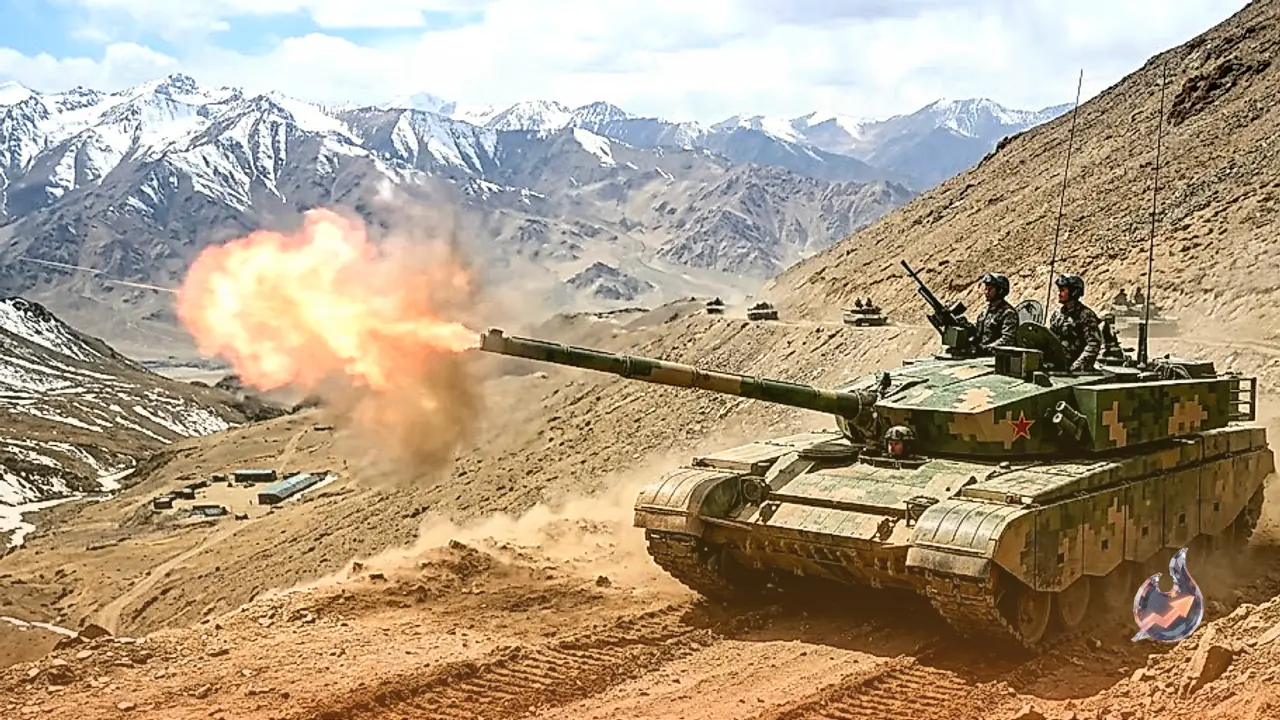
State broadcaster CCTV released detailed video documentation of the Type 99B main combat tank conducting intensive live-fire tactical trials. The vehicle was initially displayed to the global public during Beijing's massive Victory Day military parade held in September 2025. The latest footage moves beyond ceremonial display, depicting the platform maneuvering dynamically across simulated combat terrain and neutralizing armored targets across varying sectors.
According to official broadcast details, the rigorous exercise was conducted by a frontline brigade belonging to the 80th Group Army of the People's Liberation Army in eastern China's Shandong province. The primary objective was evaluating the live-fire effectiveness, reactive mobility, and engagement speed of the unit as the core combat element of a combined arms battalion. Tank crews were not merely given fixed coordinates; instead, targets were positioned across varied distances, angles, and elevations, requiring the onboard operators to rapidly assess threats and prioritize targets independently under battlefield stress.
Combat Maneuvers and 1,200-Meter Target Destruction
The broadcast featured four Type 99B main combat tanks executing synchronized tactical drills. The cameras captured the internal and external procedures of the three-person crew, including ammunition preparation, autoloader operations, digital fire-control tracking, and live firing under movement. In one specific engagement, a crew fired an armor-piercing round to destroy a designated stationary target positioned 1,200 meters away. In an adjacent dynamic sequence, the tank fired accurately on the move against an armored target vehicle roughly 1,000 meters out.
The three-person crew was evaluated on its proficiency in acquiring and engaging targets from both stationary hull-down positions and dynamic flanking runs within tight time constraints. To heighten operational difficulty, instructors integrated diverse physical obstacles across the proving grounds, including tactical bridges, water-filled craters, narrow trench lanes, and complex intersecting obstacle courses. Crews had to maintain rapid forward progression while acquiring and engaging targets positioned to the vehicle's lateral flanks and rear quadrants. Official assessments confirmed that all designated targets were successfully eliminated during the trials.
Digitized Architecture and Network-Centric Combat Roles
Defense analysts monitoring Chinese military developments noted that the release of such comprehensive trial footage strongly suggests the Type 99B has completed initial testing and attained operational service readiness within frontline armored units of the People's Liberation Army. Experts highlighted that compared to the preceding Type 99A variant, the Type 99B features major evolutionary improvements in onboard communication systems and network-centric warfare capabilities.
The platform has been redesigned to serve as an active information node within the military's broader digital combat network. It integrates secure tactical datalinks capable of transmitting real-time situational tracking, operational commands, and system status across battle groups. The turret integrates 360-degree optical and thermal infrared sensors, granting the crew day-and-night threat identification over long ranges. Furthermore, an integrated remote weapon station allows the commander and gunner to maintain continuous external surveillance and counter close-in threats from within the pressurized armored envelope.
A 55-Ton Heavyweight Optimized for High-Altitude Frontiers
Chinese state media stressed that the Type 99B has been refined specifically for operations in low-oxygen, high-altitude plateau environments and sub-zero weather conditions. This operational profile makes its tactical role particularly significant regarding the Tibetan plateau and the disputed Himalayan frontier alongside India. The Type 99 family maintains a combat weight of approximately 55 tons and utilizes a powerful 125 mm smoothbore main gun supported by advanced digital fire-control and layered modular armor packages.
Prior to this development, China had deployed its lighter Type 15 light tanks along the Indian border. Weighing roughly 33 tons, the Type 15 was specifically designed for agility across mountain passes where heavier platforms historically struggle with engine performance. In contrast, while the 55-ton Type 99B is substantially heavier, its upgraded powerplant, enhanced suspension, and long-range firepower provide the People's Liberation Army with a heavy armor punch capable of anchoring defense lines and conducting armored counterattacks across high-altitude plateaus.