







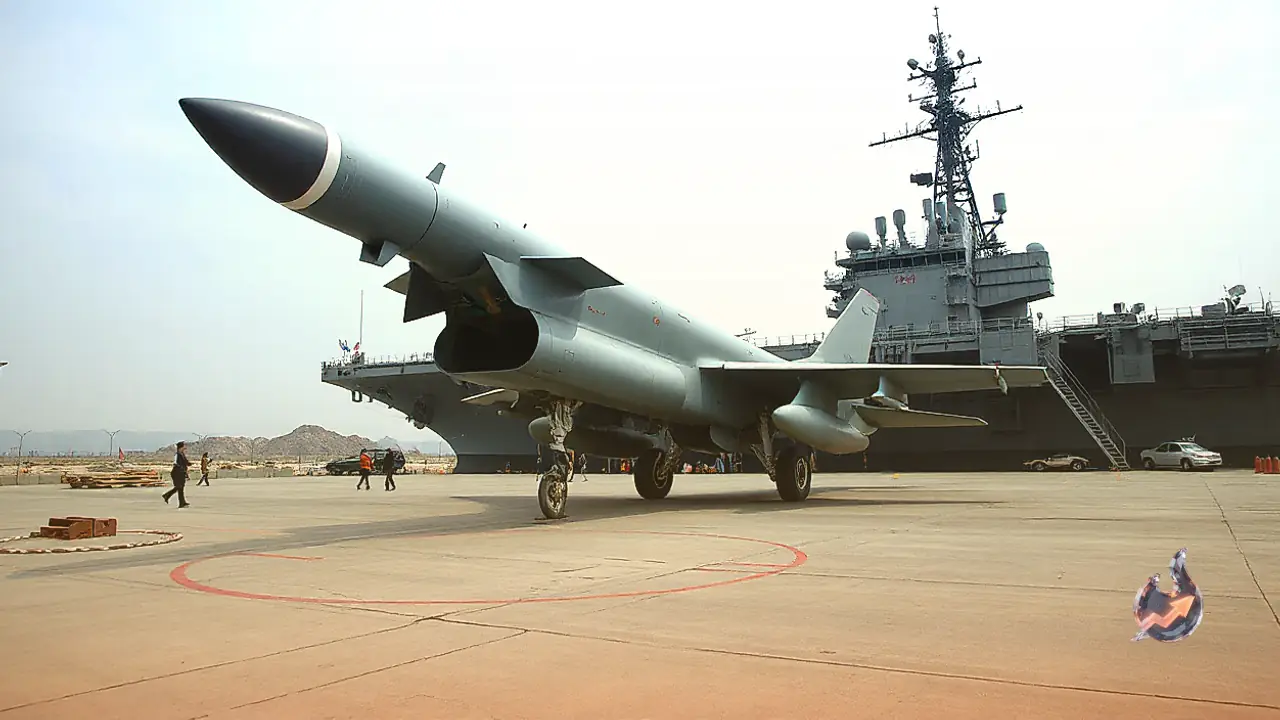















Vessels cruising thousands of miles away across vast ocean theatres now face an increasingly scrutinized threat from the Chinese missile arsenal. A video showing Beijing's DF-26B ballistic missile engaged in a simulated strike gained renewed global attention on November 1, 2026. The footage captures the weapon striking a full-scale mock-up of an American aircraft carrier constructed in a remote desert test facility. Because of this anti-ship specialty, military commentators frequently designate the system as a 'carrier killer'. Analysts suggest that the missile's sheer speed, striking distance, and specialized warhead engineering present formidable obstacles for premier American vessels, including the USS Gerald R. Ford, the USS George Washington, and the USS Abraham Lincoln. While the weapon is well established rather than brand new—Chinese state broadcaster CCTV having aired the identical footage in December 2024—its reappearance in November 2026 has refocused international scrutiny on great-power maritime deterrence. Strategic observers also point out that should such missile technology ever be acquired by regional partners like Iran, US naval formations stationed around the Strait of Hormuz could be exposed to direct ballistic threats.
Road-Mobile Deployment and Camouflaged Launch Tactics
The DF-26B belongs to the broader DF-26 ballistic missile architecture developed by the People's Liberation Army Rocket Force, functioning as a dedicated anti-ship adaptation of the platform. Operating as a ground-launched weapon, it is engineered with dual mission profiles: striking hardened land installations as well as moving naval surface targets at sea. A paramount operational advantage of the system is its complete road-mobility. Transported and fired from specialized multi-wheeled transporter-erector-launchers, the weapon is entirely free from static silos. Military crews can reposition the mobile platforms across highways, conceal them inside subterranean tunnels or rugged geography, and fire them on short notice. This dispersed deployment footprint makes it extraordinarily difficult for orbital satellites and aerial reconnaissance platforms to intercept or preempt the launch platforms before launch sequences begin.
Four-Thousand-Kilometer Range and Strategic Pressure on Guam
In terms of reach, the DF-26 family commands an estimated operational envelope between 3,000 and 5,000-plus kilometers, routinely categorized around the 4,000-kilometer mark. This vast operating radius holds immense geopolitical weight in the Western Pacific, directly cutting across vital shipping corridors and American staging nodes. Most notably, the pivotal US military bastion at Guam lies well within its calculated firing perimeter. Another crucial feature of the DF-26 family is its dual-capable architecture, designed to accommodate both heavy conventional blast packages and nuclear warheads. Specific configurations and combat deployments naturally vary depending on unit assignments. The video gained fresh traction when details of the test were circulated on social media platform X, underscoring the missile's strike against the Xinjiang desert mock-up.
The Raw Egg Analogy and the Reality of Naval Combat
Reacting to the test demonstration, Russian senator Alexey Peshkov asserted that an incoming strike by the Chinese weapon could crush an American aircraft carrier like a raw egg smashed with a hammer. He maintained that Beijing has successfully fielded an offensive asset tailored specifically to neutralize Washington's maritime dominance during an armed confrontation. Yet military specialists emphasize that inflammatory political rhetoric must be distinguished from the practical realities of high-seas warfare. Watching an explosion obliterate a static target on land confirms that the warhead functions, but it provides no definitive proof that a 100,000-ton supercarrier operating in open waters can be sent to the bottom by a single projectile. The true potency of an anti-ship ballistic missile lies not merely in its explosive yield, but in its ability to navigate complex terminal conditions at extreme velocity.
Targeting Moving Warships and Terminal Radar Guidance
Striking an immobile mock-up anchored in desert sand is fundamentally different from tracking an active carrier strike group steaming through unpredictable ocean waters. To execute such an assault, the attacking force must first locate the US naval group in real time. This requires an elaborate reconnaissance chain linking surveillance satellites, maritime patrol aircraft, and long-range over-the-horizon radar networks. This fused targeting intelligence must then be transmitted to the launch crew before the missile takes flight. Even after launch, the challenge escalates: an aircraft carrier does not stay in one place, continuously altering course and traveling at speeds up to 30 knots, meaning the missile must hit an evolving target rather than an old set of coordinates.
This dynamic environment necessitates advanced Maneuverable Re-entry Vehicle (MaRV) technology. A warhead fitted with aerodynamic control surfaces can adjust its trajectory during the final atmospheric descent, using internal radar seekers and terminal guidance packages to home in on a rapidly evading vessel. Crucially, the circulating DF-26B test footage reveals only the terminal detonation, offering zero evidence of how the missile would overcome multi-layered electronic warfare, sensor jamming, and active missile defenses shielding a real-world carrier strike group.
Supercarrier Survivability and the Risk of Mission Kill
The ultimate question confronting military planners is whether weapons like the DF-26B can realistically sink state-of-the-art warships like the USS Gerald R. Ford or the USS George Washington. These 100,000-ton behemoths are floating fortified airbases rather than conventional ships, engineered with heavy armor and resilient architectural compartmentalization. They feature hundreds of isolated, watertight compartments alongside automated, comprehensive damage-control protocols designed to contain progressive flooding, extinguish catastrophic internal fires, and keep propulsion and defensive systems operational even after heavy localized damage.
Nonetheless, surviving a ballistic missile strike does not equate to walking away unscathed. Even if a direct hit from a heavy, fast-moving warhead fails to split the hull or sink the vessel, it could tear through the flight deck, wreck radar masts, and destroy catapult launch mechanisms. In naval doctrine, this outcome is known as a mission kill: the carrier remains afloat, yet its entire flight wing is incapacitated, rendering the ship functionally useless for operational combat. That possibility alone ensures the DF-26B remains a central factor shaping American defense planning across the Pacific and the Middle East.